
Aerobatic Supremacy
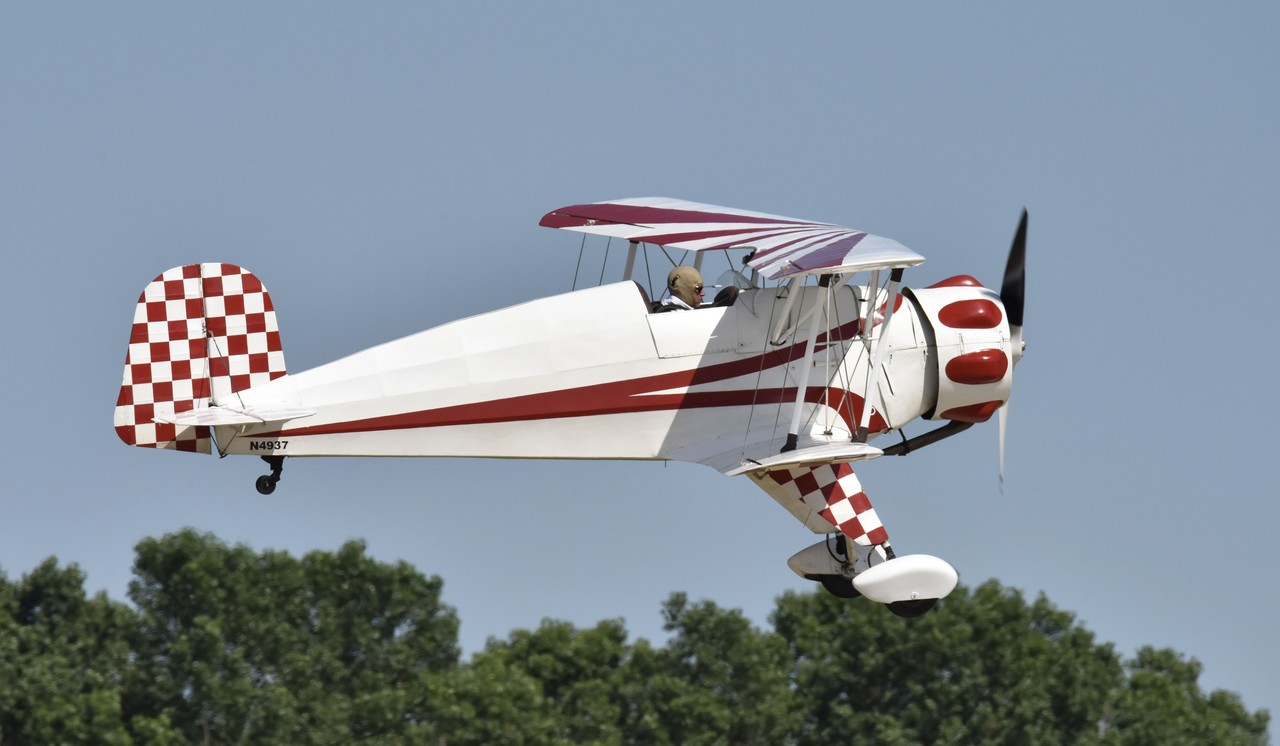
The Jungmeister's dominance in competitive aerobatics was immediate and lasting. From its debut in 1936, the aircraft consistently outperformed all competitors in European and American aerobatic championships. Its exceptional knife-edge flight capability, achieved through a shortened fuselage and precisely balanced control surfaces, gave pilots unprecedented control during complex maneuvers. The aircraft remained competitive in world-class aerobatics well into the 1960s, an extraordinary 30-year span that testified to Anders J. Andersson's brilliant design.
Patty Wagstaff, the first woman to win the U.S. National Aerobatic Championship, flew a Jungmeister in airshow demonstrations as recently as 2007, proving the design's enduring appeal to professional aerobatic pilots.
Military Training Role
The Luftwaffe adopted the Jungmeister as its primary advanced aerobatic trainer from 1936 to 1941, using approximately 200 German-built examples to prepare pilots for high-performance combat aircraft. The single-seat configuration forced student pilots to master complex maneuvers without instructor assistance, developing the independence and skill crucial for aerial combat.
Switzerland's air force operated 50 Jungmeisters built under license by Dornier-Werke at Altenrhein between 1937 and 1940, with two additional aircraft assembled from spare parts in 1943. Swiss serial U-56, entering service on July 19, 1937, exemplified the international recognition of the design's training value. Spain also produced examples during World War II for pilot training programs.
The Manufacturer's Brief Glory
Carl Bücker founded Bücker Flugzeugbau GmbH in Berlin-Johannisthal in October 1933, moving to larger facilities at Berlin-Rangsdorf in 1935 as aircraft orders increased. The company's focus shifted dramatically by 1940, when wartime demands forced production changes to the two-seat Bestmann trainer and subcontracted military components including 4,000 Henschel Hs 293 guided bombs and Junkers Ju 87 wing assemblies.
Russian forces overran the factory in 1945, destroying company records and ending Bücker's brief but influential 12-year existence. The loss of documentation explains the uncertainty surrounding exact production figures, though estimates suggest 200 German-built aircraft from the total 250 manufactured worldwide.
Engineering Excellence
Swedish engineer Anders J. Andersson designed the Jungmeister as a single-seat development of the successful two-seat Bü 131 Jungmann trainer. The prototype initially flew with a 140-horsepower Hirth HM 506 inline engine, but production aircraft adopted the more reliable 160-horsepower Siemens-Halske Sh 14A seven-cylinder radial engine.
The production Bü 133C incorporated crucial aerobatic refinements: a shortened fuselage for improved knife-edge lift characteristics, rebalanced elevator controls, a repositioned vertical stabilizer to compensate for engine torque, and a modified cowling for better engine cooling. These modifications transformed an already capable design into the world's most agile aerobatic aircraft.
The inverted radial engine configuration enhanced both aerobatic reliability and pilot visibility during inverted flight, technical advantages that contributed significantly to the aircraft's competitive dominance.
International Production and Variants
Postwar enthusiasm for the design led to renewed production in 1968 when Aero Technik Canary in Munich built the BU-133 D-1 variant with the original Siemens-Halske engine. Wolf Hirth GmbH followed with the BU-133F, featuring a more powerful 220-horsepower Franklin engine for enhanced performance.
Modern variants emerged in the 1990s and 2000s from SSH, including the T-133PA powered by a 200-horsepower Lom 337CE six-cylinder inline engine. Aircraft like SP-YBK, completed in 2014 with constructor number T-131-201, demonstrate continuing international demand for authentic Jungmeister performance.
Enduring Legacy
More than 20 airworthy Jungmeisters remain registered in the United States alone, with higher numbers worldwide including recent builds. The National Air and Space Museum preserves A19731672000, a Warner-engined example donated by the Beverly Howard estate, while the Military Aviation Museum displays a Swiss-built 1940 aircraft with serial number 38.
The Jungmeister's influence on aerobatic aircraft design remains profound, establishing performance benchmarks and handling characteristics that subsequent generations of competition aircraft still strive to match. Its remarkable longevity in active aerobatic service—spanning eight decades from the 1930s to present—stands as the ultimate testament to Anders Andersson's exceptional engineering achievement.