
Development and Design Philosophy
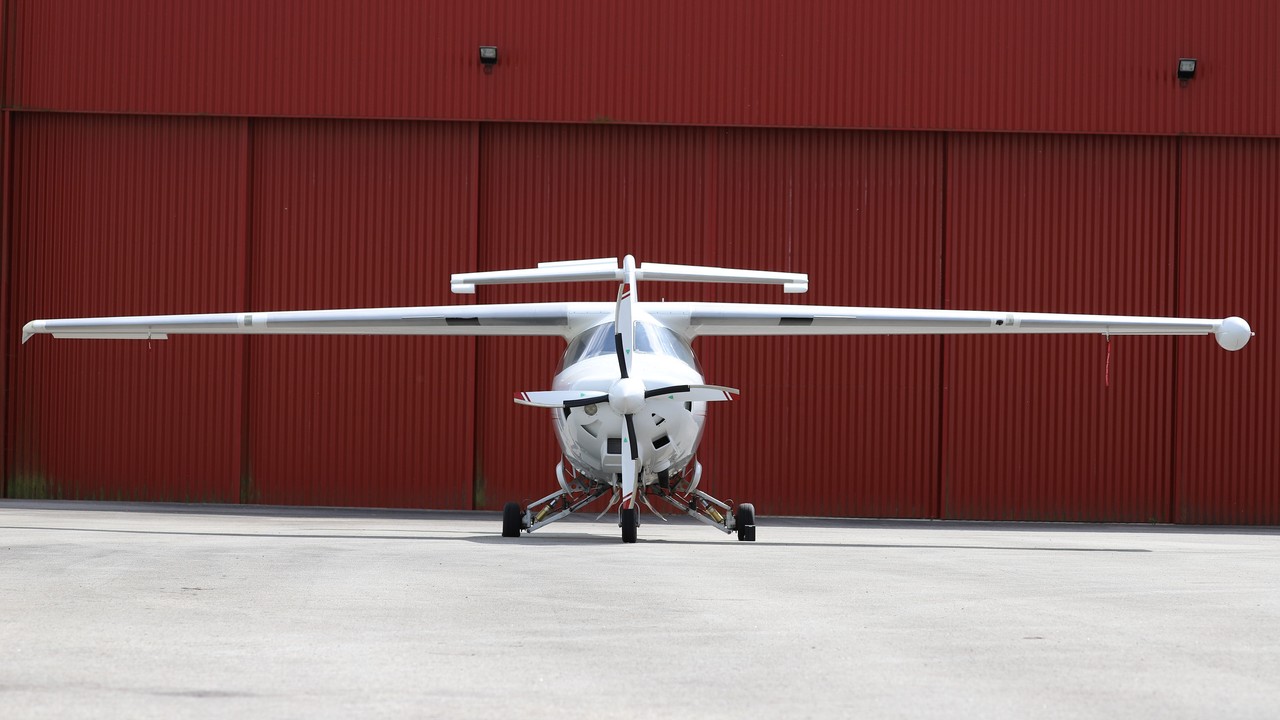
Walter Extra's decision to venture beyond his successful aerobatic aircraft line into the pressurized business aircraft market represented one of general aviation's most ambitious technical leaps of the 1990s. Collaborating with Netherlands' Delft University of Technology, Extra enlisted Professor Egbert Torenbeek for overall engineering and Loek Boermans for specialized airfoil design. Their objective centered on creating a six-seat pressurized touring aircraft that would leverage advanced composite materials to deliver unprecedented strength, interior space, and performance in the single-engine category.
The prototype D-EBEW took to the skies on April 4, 1996, showcasing revolutionary construction techniques that set new standards for composite aircraft manufacturing. The EA-400's airframe utilized carbon fiber skins over foam-core spars and ribs, with glass fiber leading edges providing impact resistance. This advanced structure earned certification for 25 years or 20,000 hours of service life, with limits of 30,000 cycles and 22,500 pressurization cycles—specifications typically associated with commercial aircraft rather than general aviation singles.
Certification and Market Entry
German LBA certification arrived on April 23, 1997, followed by crucial FAA approval on April 15, 1998, clearing the path for international sales. By 1999, the EA-400 achieved IFR certification, and the first United States delivery occurred in 2001. However, the aircraft's $1 million price tag and manufacturing requirement of 16,000 labor hours per airframe immediately positioned it in an extremely narrow market segment.
The EA-400's technical innovations commanded attention throughout the industry. Its recessed Fowler flaps reduced stall speed from 76 knots clean to just 58 knots with flaps deployed at maximum weight—performance rivaling much larger twin-engine aircraft. Design refinements continued through early production, with downturned wingtips and a ventral strake added by 1998 to enhance stability and control characteristics.
Powerplant Innovation
At the heart of the EA-400's performance lay the Teledyne Continental TSIOL-550C, marketed as the Continental Voyager. This liquid-cooled, turbocharged, intercooled six-cylinder horizontally opposed engine delivered 261 kilowatts (350 horsepower) for takeoff and 242 kilowatts (325 horsepower) continuously. Unlike traditional air-cooled aviation engines, the TSIOL-550C's liquid cooling system eliminated shock cooling concerns during rapid descents—a significant advantage for pressurized aircraft operations at high altitudes.
The liquid-cooled powerplant enabled the EA-400's pressurized cabin to function effectively at altitudes typically reserved for turbine aircraft, offering passengers jet-like comfort in a single-engine platform. The cabin accommodated six occupants, with four seats arranged in club configuration around a folding table, complete with air conditioning and pressurization systems comparable to aircraft like the Eclipse 550.
The Manufacturer's Evolution
Extra Flugzeugbau GmbH began as Walter Extra's one-man experimental operation in the 1980s, initially focused exclusively on aerobatic aircraft design. The company achieved international recognition with the EA-300 series, flown to victory by aerobatic champions including Patty Wagstaff. This success in the specialized aerobatic market provided the foundation and confidence for Extra's ambitious expansion into business aviation.
The transition from aerobatic singles to pressurized business aircraft proved financially challenging. Manufacturing operations at Dinslaken Airport near Düsseldorf struggled with the complex production requirements and limited market demand. In 2003, new United States ownership under Ken Keith attempted to revitalize the program, but the fundamental economics remained problematic.
Production Challenges and Legacy
Production figures remain disputed, with sources citing either 27 total aircraft or 63 units comprising two prototypes plus 61 production examples. Manufacturing ceased around 2003 when financial difficulties overwhelmed Extra Flugzeugbau, despite the aircraft's technical achievements. The original company faced bankruptcy in the early 2000s, ultimately selling EA-400 and EA-500 design rights to China's Jiangsu A-Star Industry in 2014.
The EA-400's operational record includes several notable incidents that highlighted both the aircraft's capabilities and the challenges of operating sophisticated single-engine aircraft. The first customer aircraft was lost on August 21, 1998, in a fatal storm encounter. Subsequent engine-related incidents on March 10, 2018, and June 12, 2020, resulted in successful forced landings with pilot survivals, demonstrating the aircraft's structural integrity.
Current Status
Extra Flugzeugbau GmbH no longer exists under its original structure, though Walter Extra continues aerobatic aircraft development separately. In February 2025, the EA-400's type certificate holder filed for insolvency, creating uncertainty for the small fleet of surviving aircraft. An unknown number of EA-400s remain in private service, representing one of general aviation's most technically advanced but commercially unsuccessful ventures.
The EA-400's legacy lies in demonstrating that advanced composite construction and sophisticated systems could be successfully integrated into single-engine aircraft, influencing subsequent designs throughout the industry. Its pressurized cabin and liquid-cooled engine combination anticipated trends that would later appear in more commercially successful aircraft, establishing Extra's brief but significant contribution to business aviation innovation.