
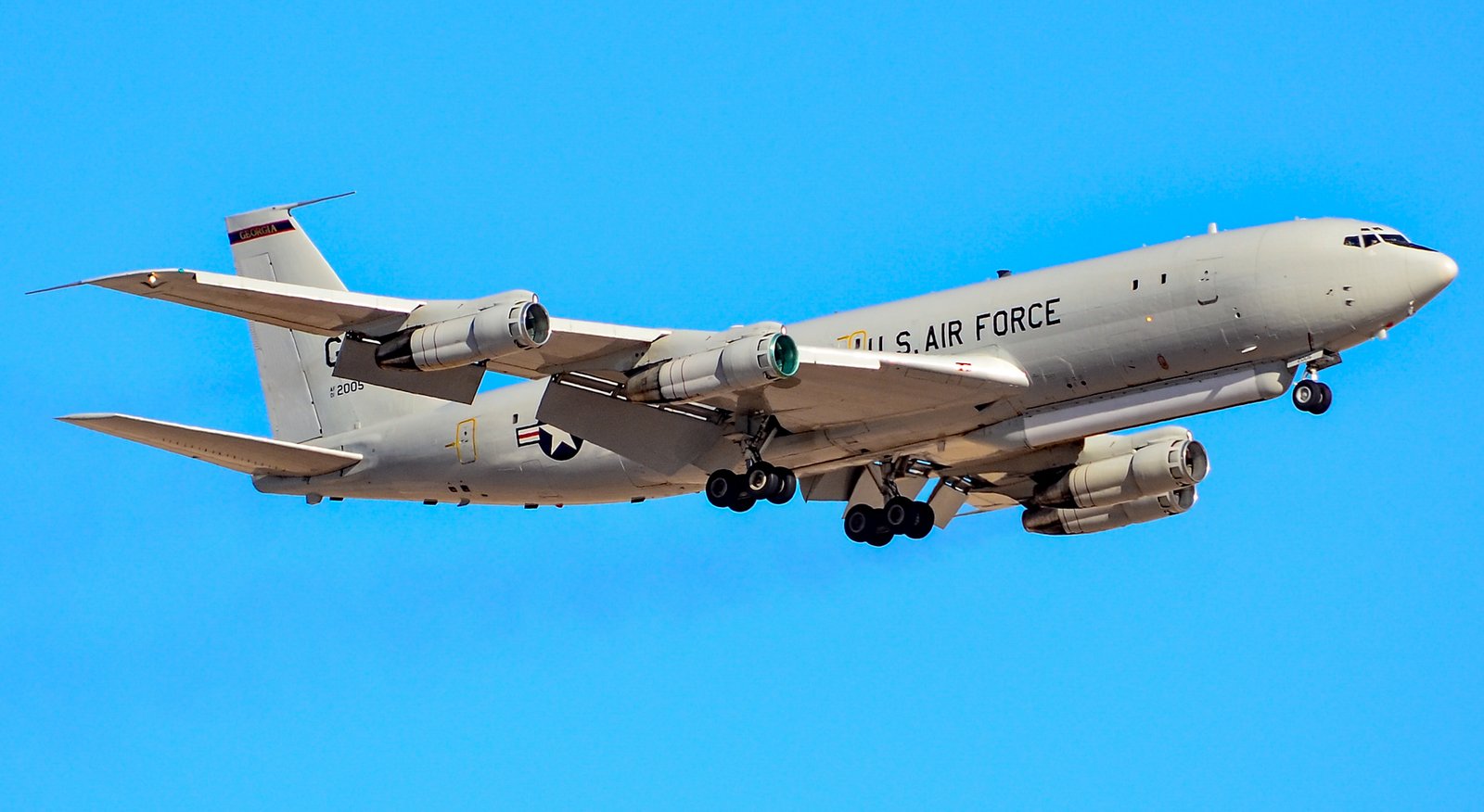
Battlefield Dominance
The E-8 Joint STARS achieved immediate combat prominence during Operation Desert Storm in 1991, when just two prototype aircraft flew 49 combat sorties totaling over 500 combat hours. These missions demonstrated the revolutionary capability to provide near-real-time ground surveillance to battlefield commanders, fundamentally changing modern warfare tactics. The aircraft's radar systems could simultaneously track hundreds of ground vehicles while serving as an airborne command post, a capability no other platform possessed.
Following its Desert Storm debut, Joint STARS accumulated over 1,000 combat hours during Operation Joint Endeavor in Bosnia during December 1995. After September 11, 2001, the fleet flew more than 130,000 combat hours across Operations Enduring Freedom in Afghanistan and Iraqi Freedom in Iraq. The aircraft's final operational deployment occurred during the 2022 Russian invasion of Ukraine, where it monitored military activity in Eastern Europe until February 2022.
Manufacturing and Development
Northrop Grumman Corporation served as prime contractor for the E-8 program, with Raytheon as co-contractor. The program originated in the late 1970s when both the Army and Air Force developed separate requirements for airborne ground surveillance technology. These programs merged under Air Force leadership, resulting in a contract award to Grumman Aerospace in 1985. When Grumman merged with Northrop Corporation in 1994, the combined entity continued as Northrop Grumman.
Production occurred at Northrop Grumman's Melbourne, Florida facility from 1996 to 2005. The program delivered 17 total aircraft to the Air Force, including two E-8A prototypes and 15 E-8C production aircraft. Deliveries spanned from March 22, 1996, to March 23, 2005. Originally, the Air Force planned to acquire up to 35 aircraft, but budgetary constraints reduced the final procurement to 17 units.
Technical Innovation
The E-8's design represented a masterpiece of systems integration, combining a proven airframe with cutting-edge radar technology. Each aircraft was powered by four Pratt & Whitney TF33-102C turbofan engines, providing the endurance necessary for extended surveillance missions. The platform's maximum speed reached 587 mph with a service ceiling of 42,001 feet.
The aircraft's radar system utilized Pulse Doppler technology to track moving ground targets while producing detailed radar maps of terrain. Mission endurance exceeded 9 hours without refueling, extendable through in-flight refueling capabilities. However, the aircraft required 11,000-foot runways when departing with maximum fuel loads of 140,000 pounds, exceeding standard NATO runway specifications of 8,000 feet.
Operational Configuration
Joint STARS carried a crew of 21 specialists: four flight crew members, 14 Air Force operators, and three Army specialists. This multi-service crew composition reflected the aircraft's joint operational concept, with Army personnel providing ground tactical expertise while Air Force operators managed the sophisticated electronic systems. Crew size varied based on specific mission requirements.
The 93rd Air Control Wing at Robbins Air Force Base, Georgia, originally operated the E-8 fleet. In 2002, this unit became the 116th Air Control Wing, incorporating both active duty personnel and Air National Guard members while remaining based at Robbins.
Aircraft Variants and Legacy
The program produced three distinct variants. Two E-8A prototypes were converted from Boeing 707-300 airliners for initial testing and combat evaluation. The planned E-8B production model was canceled in favor of the improved E-8C configuration, which became the standard production variant. Additionally, one TE-8 test aircraft remained in the inventory through the program's conclusion.
Interestingly, budgetary constraints forced the program to utilize second-hand Boeing 707-320 series airliners as base airframes. Of approximately 22 Boeing 707s involved in the program, several were former Qantas aircraft, including the first and third prototypes and the first five production examples. Qantas's high maintenance standards made these airframes particularly suitable for military conversion.
Retirement and Replacement
The E-8C fleet was retired in 2024 after more than three decades of service. The Air Force initially planned the Joint STARS Recap program in 2014, intending to field replacement aircraft by 2022. However, in 2019, the service canceled these plans and redirected funding to the Advanced Battle Management System program, which relies on distributed sensors including MQ-9 drones rather than a single large platform.
The retirement of Joint STARS marked the end of an era in airborne battlefield surveillance, as no direct replacement aircraft entered service. Instead, the Air Force adopted a networked approach using multiple smaller platforms to provide similar capabilities across distributed operations.