
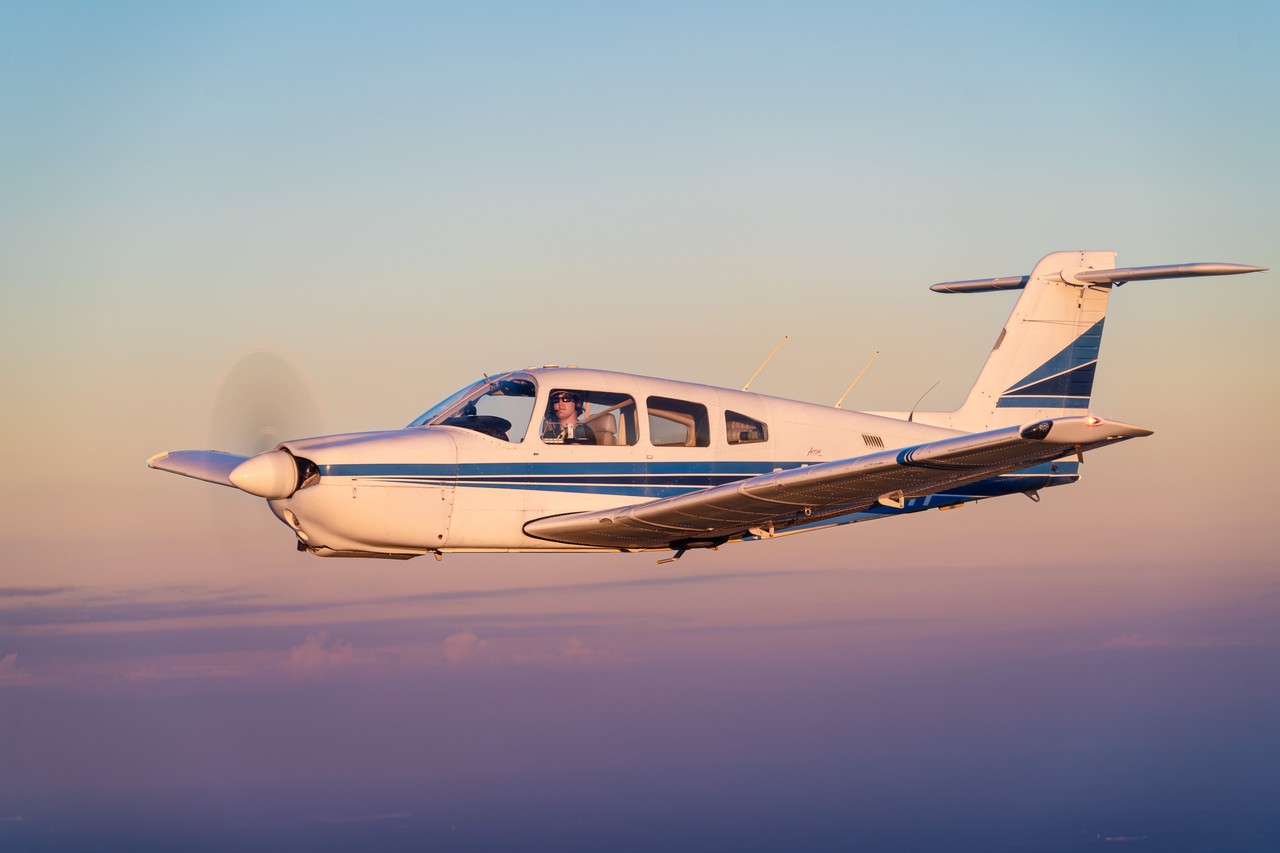
Production History and Market Position
The PA-28RT-201 Arrow IV entered production in 1979 during a challenging period for general aviation. Manufacturing continued until 1994, though production was severely disrupted by the general aviation market collapse of the 1980s. Piper halted Arrow IV production from 1984 through 1988, then resumed with limited runs: 27 aircraft in 1989, eight in 1990, none in 1991, six in 1992, and a single unit in 1994 before the line was permanently discontinued.
Design Evolution and Engineering
The Arrow IV represented Piper's attempt to refine the successful retractable-gear Cherokee formula that had competed against Mooney aircraft since the 1960s. The most distinctive feature was the T-tail configuration, which positioned the horizontal stabilizer atop the vertical fin rather than at the fuselage. This design aimed to move the tail surfaces out of the wing's wake, theoretically reducing cabin noise and improving elevator effectiveness.
The aircraft incorporated semi-tapered wings introduced across the PA-28 line in 1977, replacing the earlier straight wings. Optional three-bladed propellers were available, providing smoother operation compared to the standard two-blade units. Despite these refinements, the T-tail configuration proved controversial among pilots, who reported pitch control difficulties during landing phases.
Powerplant Options
Two engine variants powered the Arrow IV line. The standard PA-28RT-201 used the Lycoming IO-360-C1C6, a fuel-injected six-cylinder engine producing 200 horsepower. The turbocharged PA-28RT-201T variant employed the Continental TSIO-360-FB engine, also rated at 200 horsepower but capable of maintaining power output to higher altitudes through its Rajay turbocharger system.
The Continental turbocharged engine provided a service ceiling of 20,000 feet compared to the normally aspirated model's 16,200-foot ceiling. Both engines featured fuel injection systems for improved fuel distribution and more consistent power delivery across various flight conditions.
Performance Characteristics
The Arrow IV delivered respectable performance for its class, achieving a maximum cruise speed of 138 knots with a fuel consumption rate of 11.6 gallons per hour at 75 percent power. Range capabilities extended to 695 nautical miles with standard fuel tankage of 72 gallons. Initial climb rate reached 831 feet per minute, while takeoff distance over a 50-foot obstacle required 1,600 feet.
The aircraft's 2,750-pound gross weight allowed for practical load-carrying capability, though full fuel and four occupants often exceeded weight limits. Empty weight of approximately 1,637 pounds left 1,113 pounds for occupants, baggage, and fuel.
Manufacturing Heritage
Piper Aircraft Corporation produced the Arrow IV at its Vero Beach, Florida facility. The company, founded in 1927 as Taylor Brothers Aircraft Manufacturing Company, had established itself as a dominant force in light aircraft production. By the mid-1960s, Piper had built over 10,000 Cherokee-series aircraft, making the PA-28 family the fourth most produced aircraft design in aviation history.
The company faced significant financial challenges during the Arrow IV's production years. Piper filed for bankruptcy in 1991, leading to acquisition by a new entity called Piper Aircraft Inc. in 1995. Subsequent ownership changes included acquisition by Brunei's Ministry of Finance in 2008 and sale to Imprimis Clearinghouse Ltd. in 2023.
Operational Service
The Arrow IV found its primary market among flight training organizations and private owners seeking retractable-gear experience. Its four-seat configuration and moderate performance made it suitable for family transportation and business travel. The retractable landing gear provided pilots with complex aircraft experience necessary for commercial pilot licensing requirements.
Flight training schools valued the Arrow series for transitioning students from fixed-gear trainers to more sophisticated aircraft. The familiar PA-28 handling characteristics, combined with retractable gear and constant-speed propeller, offered an ideal step-up platform.
Legacy and Current Status
Approximately 496 PA-28RT-201 aircraft remained in the used aircraft market as of 2024, indicating strong survival rates despite the model's age. The type continues serving in training and personal transportation roles, though the T-tail configuration remains a point of contention among pilots and mechanics.
The Arrow IV marked the end of Piper's retractable-gear single-engine production, as the company shifted focus to fixed-gear models that offered lower insurance costs and reduced maintenance complexity. Modern Piper production continues with updated PA-28 variants like the Archer TX, maintaining the Cherokee lineage while abandoning the retractable gear complexity that defined the Arrow series.