
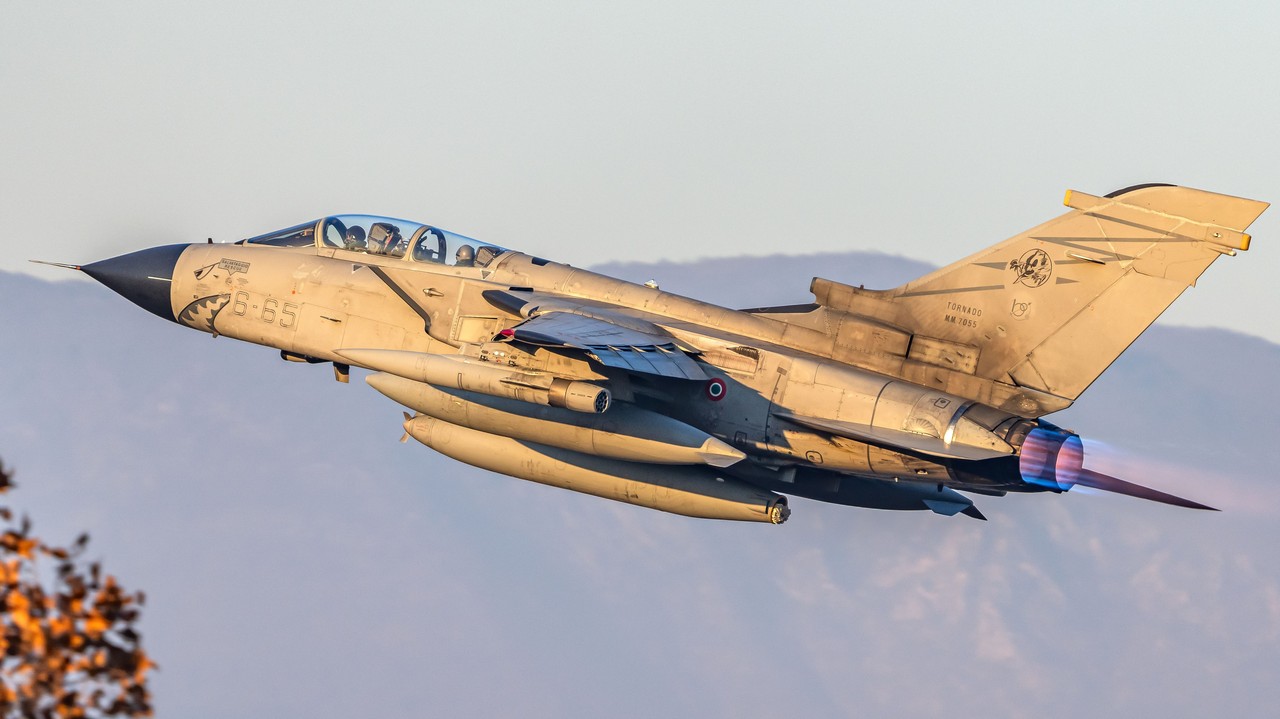
The European Defense Revolution
The Tornado emerged from the ambitious Multi-Role Combat Aircraft (MRCA) program of the 1960s, when three European nations recognized that modern military aviation costs required unprecedented cooperation. The Panavia Aircraft GmbH consortium, established in the 1970s, united British Aircraft Corporation, Germany's Messerschmitt-Bölkow-Blohm, and Italy's Aeritalia in a venture that would reshape European defense manufacturing.
First Flight and Early Development
On August 14, 1974, test pilots Paul Millett of Britain and Nils Meister of Germany lifted the P.01 prototype into the skies above Manching, Germany. This maiden flight marked the beginning of what would become one of Europe's most successful military aircraft programs. The Tornado incorporated revolutionary features for its era, including variable-sweep wings that could adapt from high-speed penetration missions to efficient loitering, and thrust reversers—making it only the second fighter aircraft equipped with this short-field capability.
Combat Proven Performance
The Tornado's combat debut came during the 1991 Gulf War, where it demonstrated the effectiveness of European military technology. The Royal Air Force deployed 49 GR1 aircraft, while Italy contributed 8 IDS variants to the coalition forces. The RAF's GR1 nicknamed "Foxy Killer" flew the most bombing sorties during Operation Granby, establishing the Tornado's reputation for precision strike capabilities. Combat losses totaled 7 aircraft—6 British GR1s and 1 Italian IDS—primarily due to the aircraft's low-level penetration tactics against heavily defended targets.
Operational Variants and Global Service
Panavia developed multiple specialized variants to meet different operational requirements. The IDS (Interdiction/Strike) variant formed the backbone of ground attack operations, while the ECR (Electronic Combat/Reconnaissance) version, with 35 aircraft built for Germany and 16 for Italy, specialized in suppression of enemy air defenses. The Royal Air Force's ADV (Air Defense Variant), later designated F2 and F3, totaled 194 aircraft optimized for intercepting Soviet bombers over the North Sea.
Beyond its Gulf War service, the Tornado participated in NATO operations over Afghanistan from 2006 to 2010, where German AG 51 squadron aircraft conducted vital reconnaissance missions. During the 2011 Libyan intervention, RAF Tornados again proved their versatility in Operation Ellamy, adapting to modern precision warfare requirements.
The Turbo Union Powerplant
The Tornado's performance relied on two Turbo Union RB199 low-bypass turbofan engines, themselves products of international collaboration. Turbo Union combined Rolls-Royce (40 percent), MTU Aero Engines (40 percent), and Italy's Avio (20 percent) in a partnership that produced over 2,000 engines. These powerplants enabled the Tornado to achieve its demanding mission profiles, from tree-top level penetration flights to high-altitude interceptions at Mach 2.2.
Manufacturing Achievement
Over its 19-year production run from 1979 to 1998, Panavia manufactured 992 Tornados across all variants. Final assembly took place in Germany, but components came from all partner nations, creating an intricate web of European aerospace cooperation. Germany operated 357 aircraft across Luftwaffe and Marineflieger units, Italy flew 115 with the Aeronautica Militare, and Saudi Arabia purchased 120 aircraft in the program's largest export success.
Technical Innovation
The Tornado's variable-sweep wing technology allowed optimization for different flight phases—wings swept forward for takeoff, landing, and loitering, then swept back for high-speed dash and low-level penetration. Each airframe was designed for 4,000 flying hours of service life, reflecting the robust engineering required for demanding low-altitude missions. The two-seat configuration paired a pilot with a navigator/weapons systems operator, essential for the complex navigation and targeting required in all-weather operations.
Legacy and Preservation
By 2024, approximately 100-200 Tornados remained operational with Germany, Italy, and Saudi Arabia, following the RAF's retirement of its fleet in 2019 after nearly 40 years of service. The aircraft marked the 50th anniversary of its first flight in 2024, cementing its place as a Cold War icon that successfully transitioned to post-Cold War operations.
Notable preserved examples include the Pima Air & Space Museum's West German Navy IDS (tail number 43+74), the Deutsches Museum's former AG 51 reconnaissance variant from 1985, and IWM Duxford's display featuring both the famous "Foxy Killer" GR1 and a later GR4 variant. These museum pieces represent not just individual aircraft, but the broader achievement of European defense cooperation that continues to influence military aviation partnerships today.