
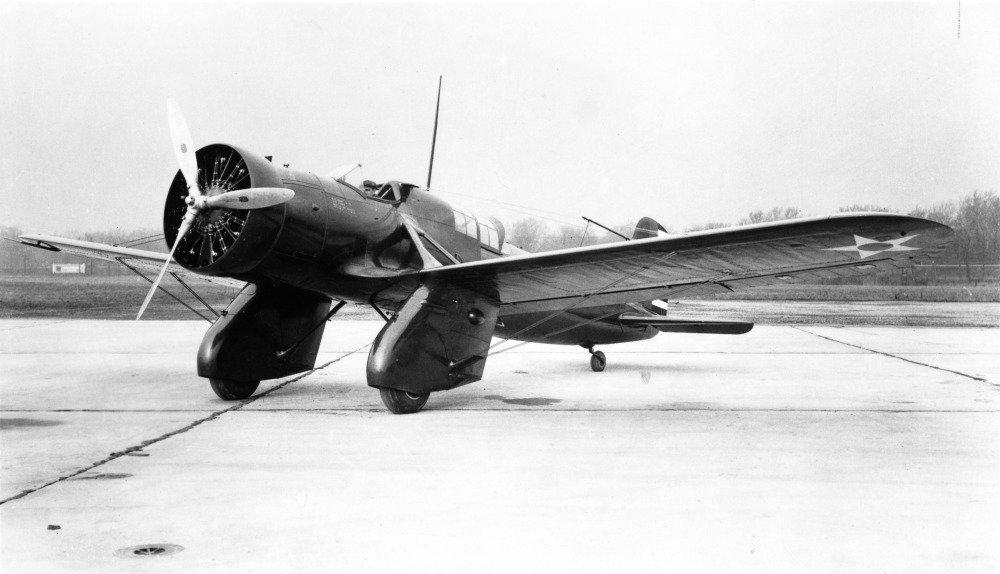
The Curtiss A-12 Shrike was a transitional ground-attack aircraft developed by the Curtiss Aeroplane and Motor Company during the early 1930s. Derived from the XA-8 and YA-10 prototypes, the A-12 was the second monoplane attack aircraft adopted by the U.S. Army Air Corps (USAAC) and the first of its kind to be deployed in significant numbers. Its design bridged the gap between the biplane era and the all-metal monoplanes that would define World War II aviation.
Production began following a 1933 Army order for 46 aircraft. These production units were delivered to the 3rd Attack Group between December 14, 1933, and February 20, 1934. In addition to the USAAC batch, 20 export versions were supplied to China in 1936, bringing the total known production to 66 airframes. Technically, the A-12 was powered by a single Wright R-1820-21 Cyclone radial piston engine, producing approximately 690 hp. This air-cooled powerplant was a significant upgrade over the liquid-cooled inline engines used in the A-8, offering improved reliability and easier maintenance. The aircraft featured a two-seat open cockpit configuration for a pilot and an observer/gunner.
Armament was a defining characteristic of the Shrike; four .30-caliber M1919 Browning machine guns were integrated directly into the landing-gear wheel fairings. Defensive fire was provided by a single flexible .30-caliber gun in the rear cockpit. For offensive strikes, the A-12 could carry four 122 lb bombs under the wings or ten 30 lb fragmentation bombs in fuselage chutes. Performance figures included a maximum speed of approximately 180–190 mph and a service ceiling of around 20,000 feet.
In U.S. service, the A-12 was the mainstay of the 3rd Attack Group until mid-1936, when the unit transitioned to the Northrop A-17. Interestingly, between February and May 1934, the 3rd Attack Group utilized the A-12 for U.S. Mail Service delivery. While never used in combat by American forces, nine A-12s were present at Hickam Field during the attack on Pearl Harbor on December 7, 1941, though they were grounded shortly thereafter and retired by 1942.
Conversely, the Chinese Nationalist Air Force (CNAF) utilized the A-12 in active combat during the Second Sino-Japanese War. Operating within the 9th Attack Group, Chinese pilots achieved a notable victory on August 15, 1937, during the Battle of Shanghai, where A-12s shot down two Japanese Aichi D1A1 dive bombers and damaged a third. Despite these early successes, the A-12 was rapidly outclassed by Japanese aircraft and suffered heavy attrition, with most units lost or relegated to training by early 1938.