
Development and Design
The A-16 Sport Falcon emerged during the formative years of the American light sport aircraft category, when the Federal Aviation Administration's new LSA rules opened opportunities for simplified aircraft certification. Aviadesign Inc., a Camarillo-based aircraft modification company, designed the A-16 as a team effort to capitalize on this expanding market segment. The company announced their new aircraft at Sun 'n Fun in April 2006 and later showcased it at the LSA Expo in Sebring, Florida in 2007.
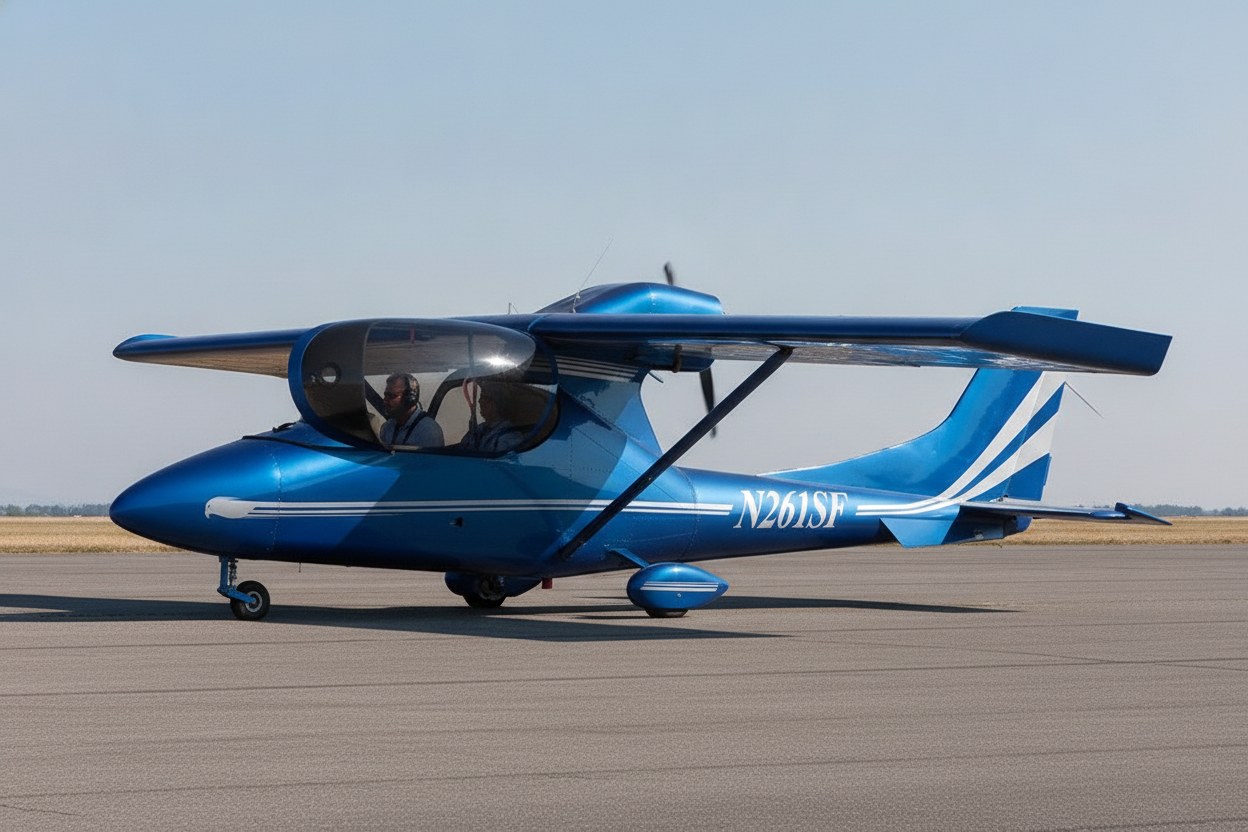
The design team prioritized visibility and comfort in their tandem-seat configuration. The pilot sat approximately four feet ahead of the wing's leading edge, providing exceptional forward visibility through the expansive bubble canopy. The aircraft's welded steel tube airframe supported a 29-foot wingspan braced by a single strut on each side, creating a robust yet lightweight structure weighing just 739 pounds empty.
Technical Configuration
Powering the A-16 was the proven Rotax 912ULS, a four-cylinder, four-stroke engine producing 101 horsepower. The liquid- and air-cooled powerplant drove a three-bladed Prince Aircraft composite propeller in pusher configuration, contributing to the aircraft's quiet cabin environment and unobstructed forward view. This engine choice enabled impressive performance figures including a climb rate of 980 feet per minute and a maximum speed of 140 mph.
The aircraft incorporated several thoughtful design elements for the LSA market. An airstair door provided easy cabin access, while full dual controls in both front and rear seats made the aircraft suitable for flight training applications. With an 80-liter fuel capacity, the A-16 achieved a range of 450 miles at its cruise speed of 121 mph.
Production and Testing
Aviadesign completed both prototypes by 2006, with the first aircraft (registration N166SF, construction number 001) serving as the primary test platform. The short production run reflected the challenging economics facing small aircraft manufacturers entering the competitive LSA market. Despite announcing an intended selling price of approximately $110,000, Aviadesign failed to secure sufficient orders to justify full-scale production.
Test pilot Dan Johnson conducted a comprehensive evaluation flight in March 2010, praising the aircraft's spacious interior, predictable handling characteristics, and exceptional visibility. His assessment highlighted the A-16's potential as a comfortable cross-country tourer, noting the smooth operation of the Rotax powerplant and the aircraft's stable flight characteristics throughout its performance envelope.
The Manufacturer's Demise
Aviadesign Inc.'s brief existence exemplified the challenges facing startup aircraft manufacturers in the 2000s. Despite their expertise in aircraft modifications and the A-16's promising design attributes, the company lacked the capital and market presence necessary to compete with established manufacturers entering the LSA segment. Production ceased in 2007, and Aviadesign subsequently went out of business, leaving the A-16 as another promising design that failed to reach commercial viability.
Performance Specifications
The A-16's performance envelope positioned it competitively within the LSA category. Its stall speed of 45 mph provided good short-field capabilities, while the 140 mph maximum speed offered respectable cross-country potential. The aircraft's wing loading of 9.55 pounds per square foot contributed to its stable handling characteristics, and its +4/-2 g-load limits met LSA requirements while providing adequate maneuvering capability.
With a gross weight of 1,232 pounds, the A-16 could carry a useful load of 493 pounds, accommodating two occupants and partial fuel for shorter trips or full fuel with reduced passenger weight for maximum range flights.
Legacy and Current Status
At least one A-16 prototype survived beyond the company's closure, with N166SF photographed at Camarillo Airport in August 2009 equipped with experimental float gear, suggesting continued development efforts by independent parties. This modification demonstrated the basic design's adaptability, though no commercial floatplane variant materialized.
The Federal Aviation Administration continues to list the A-16 Sport Falcon in its Special Light-Sport Aircraft database under the designation "no longer in production," reflecting its brief but official recognition within the LSA category. The aircraft remains classified under ICAO designation A16 in the L1P category for single-engine land aircraft.
While the A-16 Sport Falcon's commercial impact proved negligible due to limited production, it represented the innovative spirit and market optimism that characterized the early LSA era, when numerous small manufacturers attempted to establish themselves in aviation's newest certification category.