
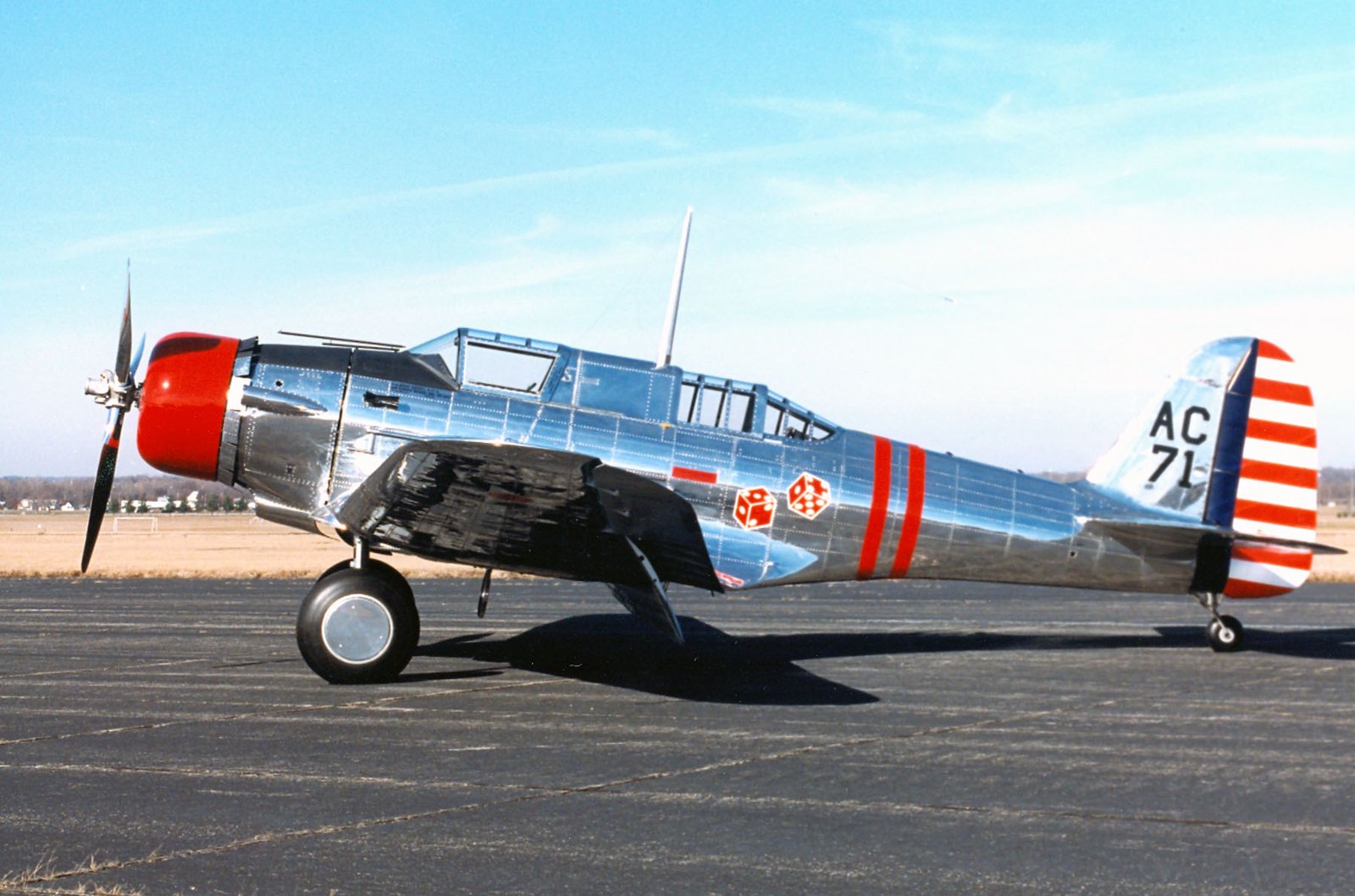
The Northrop A-17, also known as the Northrop Model 8, was a two-seat, single-engine land-based attack bomber developed from the Northrop Gamma 2F. Designed under the leadership of John K. Northrop, the aircraft represented a significant evolution in American military aviation, replacing fabric-covered biplanes like the Curtiss A-8 and A-12 Shrike with an all-metal, low-wing monoplane configuration. The A-17 was the final single-engine attack aircraft ordered by the U.S. Army Air Corps (USAAC) before military doctrine shifted toward multi-engine attack platforms.
Production began in 1935, with the first A-17 aircraft delivered to the USAAC in December of that year. Approximately 110 fixed-gear A-17s were produced, followed by the improved A-17A, which first flew on July 16, 1936. The A-17A introduced a retractable undercarriage to increase speed, though it initially suffered from mechanical issues. Production of the A-17A totaled approximately 129 aircraft. While Northrop Corporation began manufacturing, Douglas Aircraft Company eventually took control of the project after acquiring 49% of Northrop's stock in 1937. Douglas subsequently produced export versions designated as the Model 8A series, with production continuing into the early 1940s, including a batch of 34 Model 8A-5s for Peru completed around 1941–1942.
Technically, the A-17A was powered by a single 825 hp Pratt & Whitney R-1535-13 radial air-cooled piston engine. It achieved a maximum speed of 220 mph and a cruising speed of 170 mph, with a service ceiling of 19,400 feet and a range of 732 miles. The aircraft was optimized for precision dive-bombing, featuring an internal bomb bay with vertical chutes capable of holding twenty 30-lb fragmentation bombs, supplemented by four external racks for a total load exceeding one ton. Armament consisted of four fixed .30-caliber forward-firing guns in the wings and one flexible .30-caliber gun in the rear cockpit.
In military service, the A-17 saw diverse global operations. The USAAC utilized them for light attack and coastal patrols, notably with the 59th Bombardment Squadron (Light) in the Panama Canal Zone starting December 14, 1941. Export versions saw combat in the Peruvian–Ecuadorian War of 1941 and were used by the Netherlands during the German invasion in May 1940. Other operators included the Royal Air Force (as the Nomad Mk I), the South African Air Force, Sweden (as the B-5), and Norway, whose aircraft were used for training at the "Little Norway" camp in Canada. By early 1942, the USAAF commandeered 31 Peruvian Model 8A-5s, redesignating them as A-33s for training and utility roles. The last A-17A was removed from USAAF records in early 1945, though some foreign variants flew as late as 1958. Today, only one example survives: A-17A serial 36-207, preserved at the National Museum of the U.S. Air Force.