
Commercial Dominance
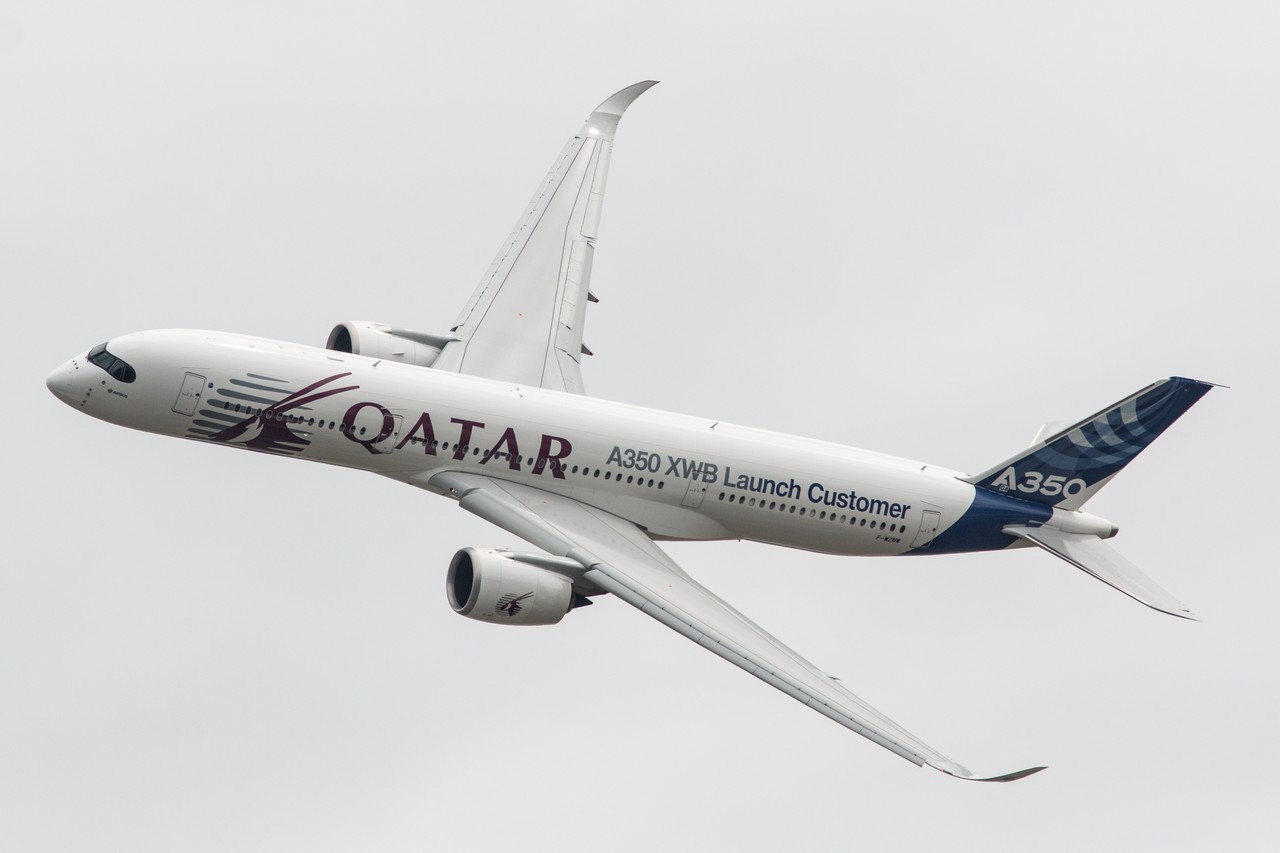
Since entering service in January 2015, the A350 has transformed long-haul aviation with over 669 aircraft delivered to airlines worldwide by 2025. Qatar Airways, the launch customer, received the first A350-900 on December 22, 2014, inaugurating commercial service on the Doha-Frankfurt route just three weeks later. The aircraft quickly gained acceptance among major carriers including Delta Air Lines, which became the sole United States operator, Cathay Pacific, and Singapore Airlines. With 1,428 firm orders accumulated by 2025, the A350 captures significant market share from Boeing's competing 777 and 787 models.
Annual delivery rates demonstrate the aircraft's commercial success, climbing from just 14 deliveries in 2015 to peak production of 112 aircraft in 2019. Despite pandemic-related slowdowns reducing deliveries to 55 aircraft in 2021, Airbus maintained steady production with 64 deliveries in 2023 and targets monthly production rates of 10 aircraft by 2026.
The Manufacturer's Vision
Airbus SE traces its origins to a 1970 European consortium formed specifically to challenge American aviation dominance. Originally established as Airbus Industrie before reorganizing as Airbus SAS in 2001, the company overcame early financial struggles through backing from French, German, Spanish, and British governments. The current corporate structure emerged through strategic acquisitions, with parent company EADS purchasing assets from DaimlerChrysler in 2006 and BAE Systems between 2006-2010, eventually rebranding as Airbus SE in 2017.
The A350 program represented Airbus's most ambitious clean-sheet design, moving beyond an initial plan to simply upgrade the existing A330. Chief engineer Nigel Greenway led the development team in creating an entirely new aircraft optimized for 250-300 seat capacity. Development costs escalated from an initial €3.5 billion estimate to between €12-15 billion as Airbus committed to revolutionary composite construction and advanced systems.
Revolutionary Engineering
Powered exclusively by two Rolls-Royce Trent XWB engines, the A350 achieved breakthrough efficiency through advanced materials and propulsion technology. Each Trent XWB generates between 84,000-97,000 pounds of thrust using a three-spool design that delivers 15-20 percent better fuel consumption than predecessor engines. Ceramic matrix composites in hot sections enable higher operating temperatures while maintaining durability, contributing to the engine's exceptional 99.9 percent dispatch reliability.
The airframe itself pioneered extensive composite usage, with carbon-fiber materials comprising more than half the aircraft's structural weight. This construction reduces overall weight while improving passenger comfort through better cabin pressurization and humidity control. Manufacturing occurs across multiple European locations, with forward fuselage sections built in Illescas, Spain, center wingboxes assembled in Hamburg, Germany, and final assembly completed in Toulouse, France.
Performance Excellence
Two primary variants serve different market segments: the A350-900 measuring 66.8 meters in length accommodates 300-410 passengers with 15,000-kilometer range, while the stretched A350-1000 extends to 73.8 meters, carrying up to 480 passengers across 16,100 kilometers. Both variants maintain identical 64.75-meter wingspans and operate with maximum cruise speeds of Mach 0.89 at service ceilings reaching 13,100 meters.
Pilots appreciate the A350's fly-by-wire controls and advanced cockpit systems that reduce crew workload during long-haul operations. The aircraft requires only two pilots, incorporating extensive automation and safety systems derived from Airbus's decades of commercial aviation experience. Initial climb rates of approximately 500 meters per minute enable efficient departure profiles from congested airports worldwide.
Production Legacy
Manufacturing began with component production in 2010, including the first center wingbox completion in Hamburg during August 2010 and initial forward fuselage delivery from Spain later that year. China joined the supply chain in 2011 with composite rudder production, demonstrating the program's global manufacturing approach.
Certification proceeded rapidly for such an advanced aircraft, with European Aviation Safety Agency approval granted in September 2014 followed by Federal Aviation Administration certification in January 2015. This eight-year development timeline from program launch to service entry reflects efficient project management despite the aircraft's technological complexity.
Airbus continues expanding the A350 family with the A350F freighter variant, accumulating 65 firm orders by October 2025 with deliveries scheduled from 2027. Current unit costs reach $317.4 million for the A350-900 and $366.5 million for the A350-1000, reflecting the aircraft's advanced technology and materials. With over 600 aircraft remaining in active service as of late 2025 and production continuing indefinitely, the A350 establishes Airbus as a permanent competitor in the wide-body airliner market previously dominated by American manufacturers.