
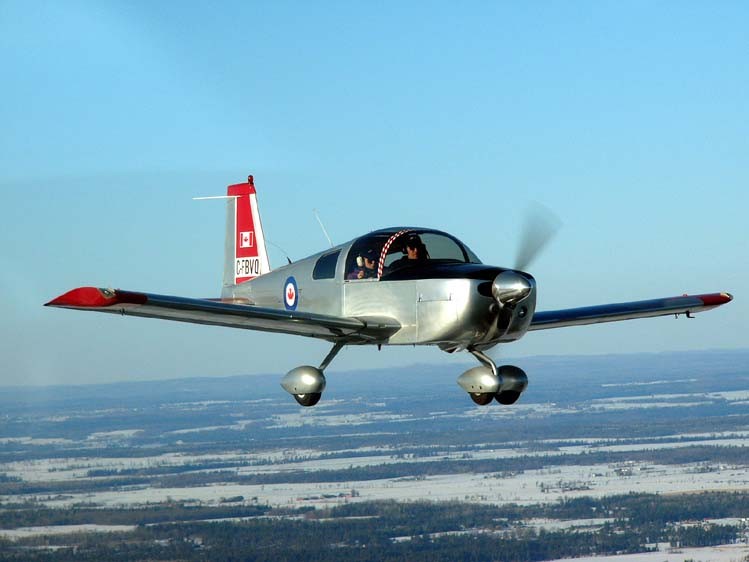
Service History
The AA-1 family dominated the entry-level flight training market during the early 1970s, with production peaking at over 200 aircraft annually as flight schools embraced its combination of affordability and performance. Between 1969 and 1978, manufacturers delivered 1,820 aircraft across all variants, establishing the type as one of the most successful two-seat trainers of its era. The original AA-1 Yankee Clipper launched at a base price of $6,495 in 1968, significantly undercutting competitors like the Cessna 150 and making aircraft ownership accessible to a broader market.
Flight schools particularly favored the AA-1A and AA-1B Trainer variants, which incorporated design modifications specifically addressing the training environment. The AA-1B featured an increased gross weight of 1,560 pounds compared to the original 1,500-pound limit, while both trainer versions offered improved stall characteristics that made them more forgiving for student pilots.
The Manufacturer
The aircraft's complex corporate lineage began with designer Jim Bede, who originally conceived the design as the BD-1 in 1962. American Aviation Corporation acquired Bede's design in 1968 after removing the problematic folding wings that had prevented FAA certification. The company successfully certified the redesigned aircraft under FAR Part 23 on August 29, 1967, with the first production AA-1 flying on May 30, 1968.
Grumman Aircraft Engineering Corporation recognized the market potential and acquired American Aviation in 1971, creating Grumman American Aviation. Under Grumman's ownership, production continued through 1976 with the AA-1B variant. Gulfstream Aerospace subsequently purchased the light aircraft division in 1977, establishing Gulfstream American in Savannah, Georgia, where they produced the final AA-1C variants until 1978. True Flight Holdings LLC currently holds the type certificate, having acquired it from Tiger Aircraft in August 2007.
Engine & Technical Details
The AA-1 family utilized Lycoming O-235 series engines throughout its production run, with the four-cylinder, air-cooled powerplants providing reliable performance in the entry-level market. The original AA-1 Yankee, AA-1A, and AA-1B variants employed the 108-horsepower O-235-C2C engine, while the final AA-1C received an upgraded 115-horsepower O-235-L2C high-compression engine designed specifically for 100LL aviation fuel.
The aircraft's bonded aluminum construction represented innovative manufacturing techniques for its era, contributing to both structural integrity and cost-effective production. The low-wing configuration utilized a NACA 64-415 airfoil section, though American Aviation modified this design for the AA-1A to address handling concerns. The AA-1C incorporated a larger horizontal tail and other aerodynamic refinements that improved overall flying qualities.
Pilot Perspective
Pilots praised the original AA-1 Yankee for its responsive controls and sporty handling characteristics, enhanced by the distinctive slide-back canopy that provided exceptional visibility. However, the type earned a reputation for abrupt stall behavior and a severe tendency to experience rapid drag buildup at low speeds, characteristics that concerned flight instructors and student pilots.
The AA-1A addressed these handling issues through wing leading-edge modifications that produced gentler stall characteristics and permitted lower approach speeds, though these changes reduced cruise speed by 10 mph from the original's 138-mph performance. The final AA-1C variant successfully combined improved handling with restored cruise performance through its more powerful engine and aerodynamic refinements, creating what many considered the most refined version of the design.
Production & Legacy
Production declined dramatically by the late 1970s as the general aviation market contracted, with only 88 aircraft delivered in 1978 compared to the 200-plus annual figures of the early 1970s. Gulfstream American ceased production after 1978, ending nearly a decade of continuous manufacturing across three different corporate owners.
The AA-1 family's legacy endures in the general aviation community, where surviving aircraft remain popular among pilots seeking economical operation and maintenance costs. The type's reliability and straightforward systems have made it a favorite among flying clubs and individual owners who appreciate its combination of performance and affordability. Many examples continue flying today, testament to the sound engineering principles that Jim Bede incorporated into his original 1962 design and the manufacturing quality maintained throughout the aircraft's production history.