
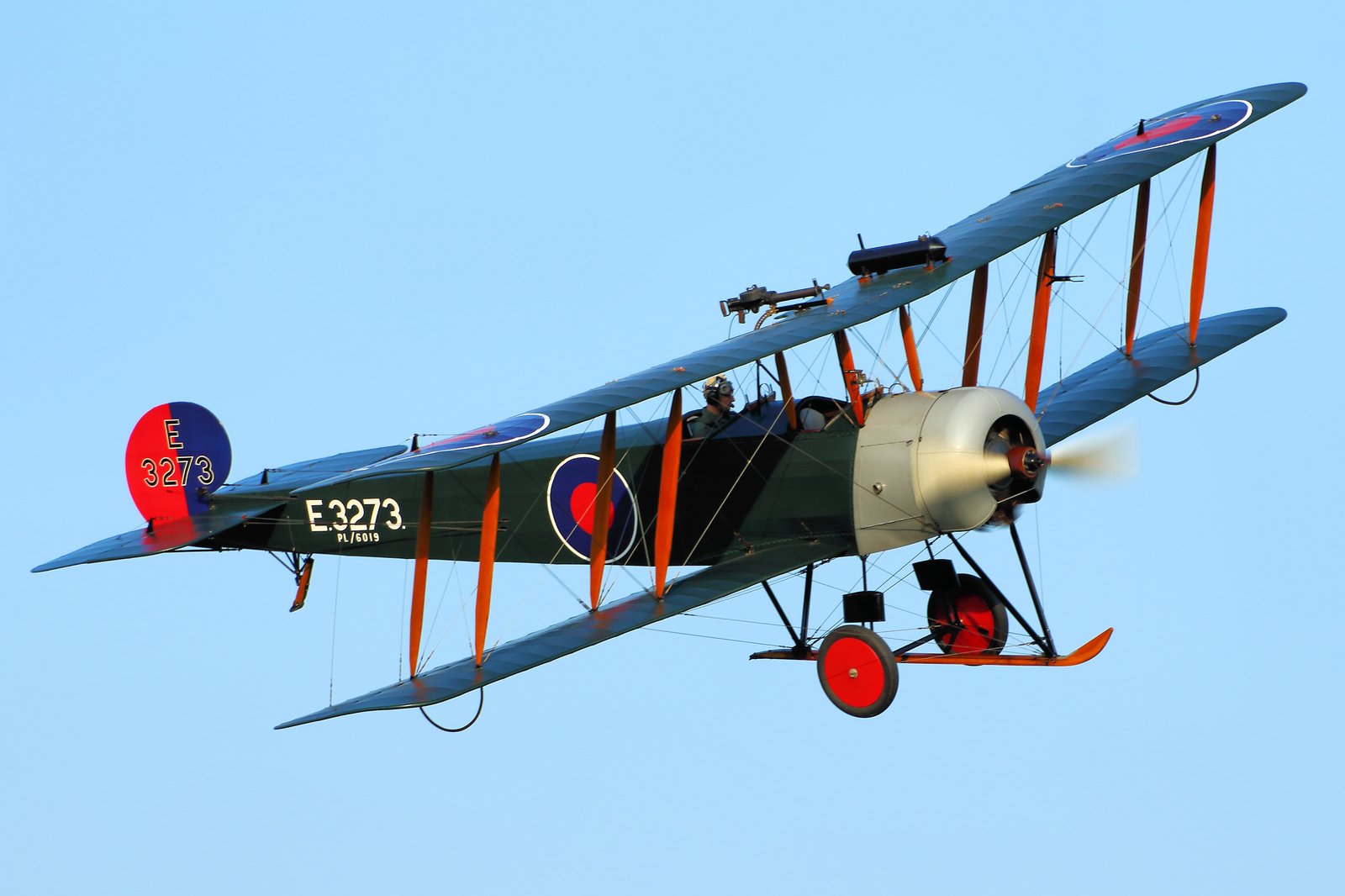
Design and Production
Designed by Alliot Verdon Roe, the Avro 504 was developed from the Avro E.500. Design work commenced in April 1913, and the prototype flew at Brooklands in July 1913. Production began in the summer of 1913 with an initial order of 12 aircraft for the British War Office. The aircraft remained in production for nearly two decades, ending around 1931–1932. While exact production totals vary, more than 8,000 units were built during World War I by A.V. Roe & Co. and subcontractors such as Grahame-White Aviation. Including post-war and overseas production, the total number of airframes exceeded 10,000.
Technical Specifications
The Avro 504 was a two-seat biplane utilizing air-cooled piston rotary engines. The 504J variant, the first mass-produced version, typically used a 100 hp Gnome Monosoupape or an 80 hp Le Rhône engine. The subsequent 504K featured modified engine bearers to allow for a wide variety of rotary engines, including the 130 hp Clerget, 110 hp Le Rhône, and 100 hp Gnome. This modularity improved maintainability during wartime shortages. Performance figures for the 504K include a maximum speed of 95 mph and a service ceiling of 13,000 ft, with a weight of 1,830 lb.
Military Service
Though designed for private use and training, the Avro 504 saw early combat in 1914. It achieved several British firsts: the first aircraft shot down by enemy fire (August 22, 1914), the first to strafe ground troops, and the first to bomb Germany. On November 21, 1914, RNAS Avro 504s attacked Zeppelin sheds at Friedrichshafen, carrying four 9 kg bombs each. By mid-1915, the aircraft was withdrawn from front-line duty due to vulnerability and became the standard trainer for the RFC and RNAS. The 504J and 504K were integral to Major Smith Barry’s systematic instruction at the School of Special Flying, Gosport, where the 504J first implemented the Gosport speaking tube for instructor-student communication. The US Army Air Service also utilized the 504K, ordering 52 aircraft in July 1918 for aerobatic training at Issoudun, France.
Post-War Service and Legacy
The RAF continued using the 504 as its basic trainer until the early 1930s, when it was replaced by the de Havilland DH.82 Tiger Moth. Between 1927 and 1933, the RAF ordered an additional 512 units. In a surprising longevity, some 504N variants were impressed into RAF service in 1940 during World War II for glider-towing operations, with some remaining in service until 1944. Civilly, surplus aircraft were used by barnstorming companies and flying schools throughout the British Commonwealth. Today, examples are preserved at the National Museum of the United States Air Force, the RAF Museum, the Military Aviation Museum, and the Shuttleworth Collection.