
Development and Design
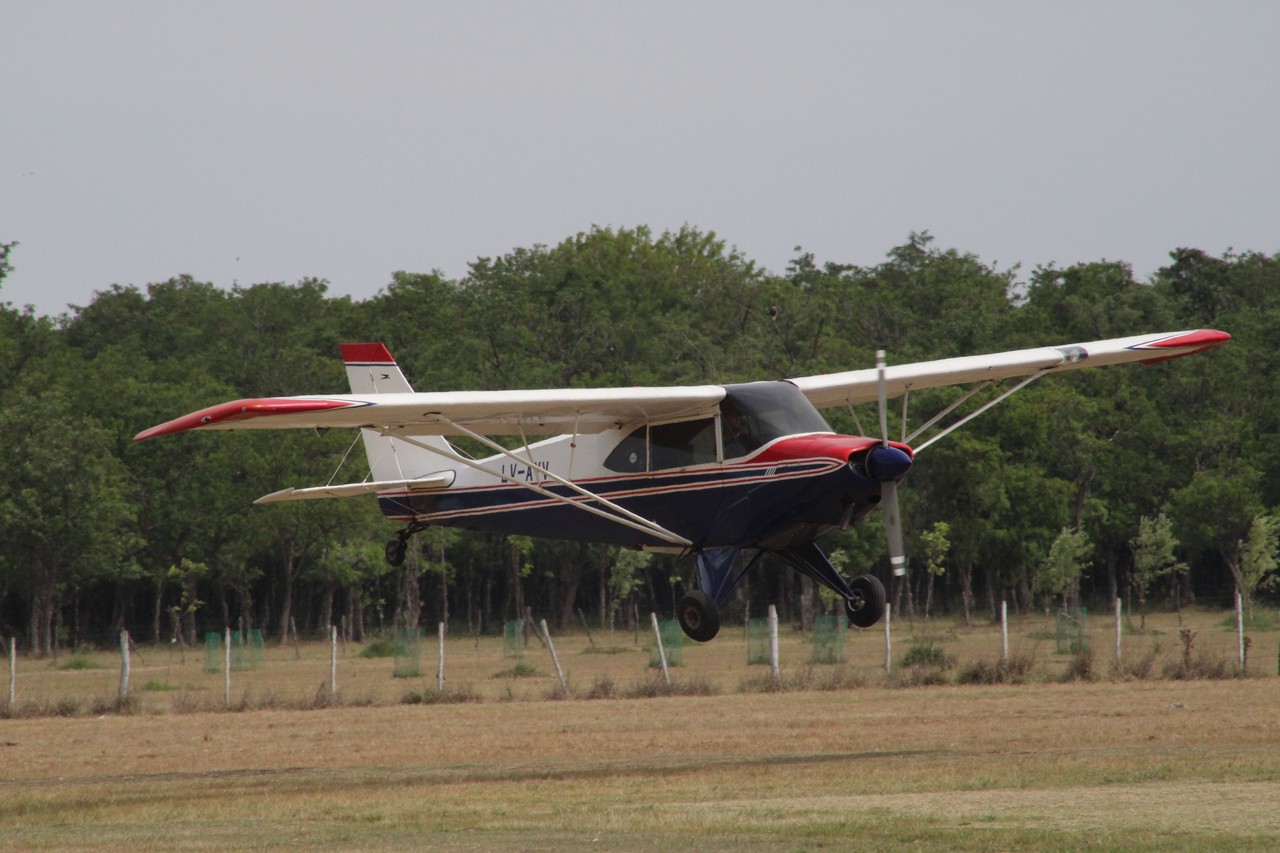
The AB-115 emerged from the collaborative efforts of brothers César and Héctor Boero, working alongside Celestine Barale at their Morteros facility. Building upon their earlier AB-95 design from 1958, the team sought to create an improved trainer with enhanced performance through more powerful engines and refined aerodynamics. The aircraft incorporated several innovative features for its era, including streamlined wheel spats, a lightweight fiberglass engine cowling, and aluminum construction for the ailerons and flaps.
The high-wing configuration utilized strut-braced rectangular wings based on the NACA 23012 airfoil, constructed entirely of metal. The fuselage and empennage featured fabric covering over a welded steel tube framework, a proven construction method that balanced durability with manufacturing economy. The cockpit arrangement included duplicated controls with a front center stick mechanically linked to rear controls, manual flaps with three positions at 15, 30, and 45 degrees, and ground-adjustable trim tabs.
Manufacturing and Production
Aero Boero S.A. established operations in 1956 when Héctor Boero founded the company in Morteros, Córdoba Province. Initially focused on repair and maintenance of crop-dusting aircraft, the company evolved into aircraft manufacturing by the late 1950s. The AB-115 entered production as a natural progression from the AB-95, with manufacturing continuing until January 1973 when the line transitioned to the improved AB-115BS variant.
The AB-115BS first flew in February 1973, incorporating a greater wingspan, swept empennage design, and increased fuel capacity. Aero Boero produced 25 units of this enhanced variant before concluding the program. Total production across all AB-115 variants exceeded 350 aircraft, representing a significant manufacturing achievement for the Argentine aviation industry.
Engine and Performance
Powering the AB-115 was the reliable Lycoming O-235-C2A, a four-cylinder air-cooled horizontally-opposed engine producing 86 kilowatts (115 horsepower). This powerplant, manufactured by Textron Lycoming, drove a Sensenich 72CK-050 fixed-pitch metal propeller with two blades. The engine featured a FACET MA-3PA carburetor equipped with carburetor heat and operated on aviation gasoline ranging from 80/87 to 100/130 octane.
Fuel storage consisted of two aluminum tanks mounted in the wing roots, providing a total capacity between 115 and 130 liters, with 110 liters usable. Simple sight glasses served as fuel quantity indicators, reflecting the aircraft's emphasis on straightforward, maintainable systems.
Performance figures demonstrated the AB-115's suitability for training operations. Maximum cruise speed reached 169 kilometers per hour (105 mph), with a never-exceed speed of 209 kilometers per hour (130 mph). The aircraft achieved a range of 1,230 kilometers (764 miles) and required only 115 meters for takeoff at maximum weight, with landing runs between 45 and 150 meters depending on conditions.
Service History and Export Success
The AB-115's primary market lay in flight training, with Argentine and Brazilian aero clubs forming the backbone of its operational service. Most production units were exported to Brazil, where they served flying clubs as primary trainers. This export success represented a significant achievement for Argentine aviation manufacturing, demonstrating the aircraft's competitiveness in international markets.
Variants included the standard AB-115 Trainer, the AB-115BS utility and ambulance configuration, and the AB-115/150 equipped with a 150-horsepower Lycoming O-320 engine for agricultural spraying operations. The ambulance variant particularly showcased the design's versatility, adapting the basic airframe for medical evacuation duties.
Legacy and Current Status
Aero Boero S.A. continued aircraft production until 2000, when political instability and economic challenges in Argentina forced a transition from manufacturing to maintenance and spare parts support. The company remains operational under Héctor Boero's ownership, providing services to existing aircraft rather than building new ones.
At least one AB-115 remained active as of 2025, with PP-FHN (manufacturing serial number 118-B, built in 1988) operated by Aeroclube do Paraná in Brazil until experiencing a runway excursion accident in May 2025 with no fatalities. Given the total production exceeding 350 units, additional examples likely continue flying in private ownership and aero club service, though exact numbers remain undocumented.
The AB-115 represents an important chapter in South American aviation manufacturing, demonstrating how a small Argentine company could successfully develop and export training aircraft to regional markets. Its practical design philosophy and reliable performance characteristics established a foundation for later Aero Boero developments, including the AB-150, AB-180, and AB-210 series that followed.