
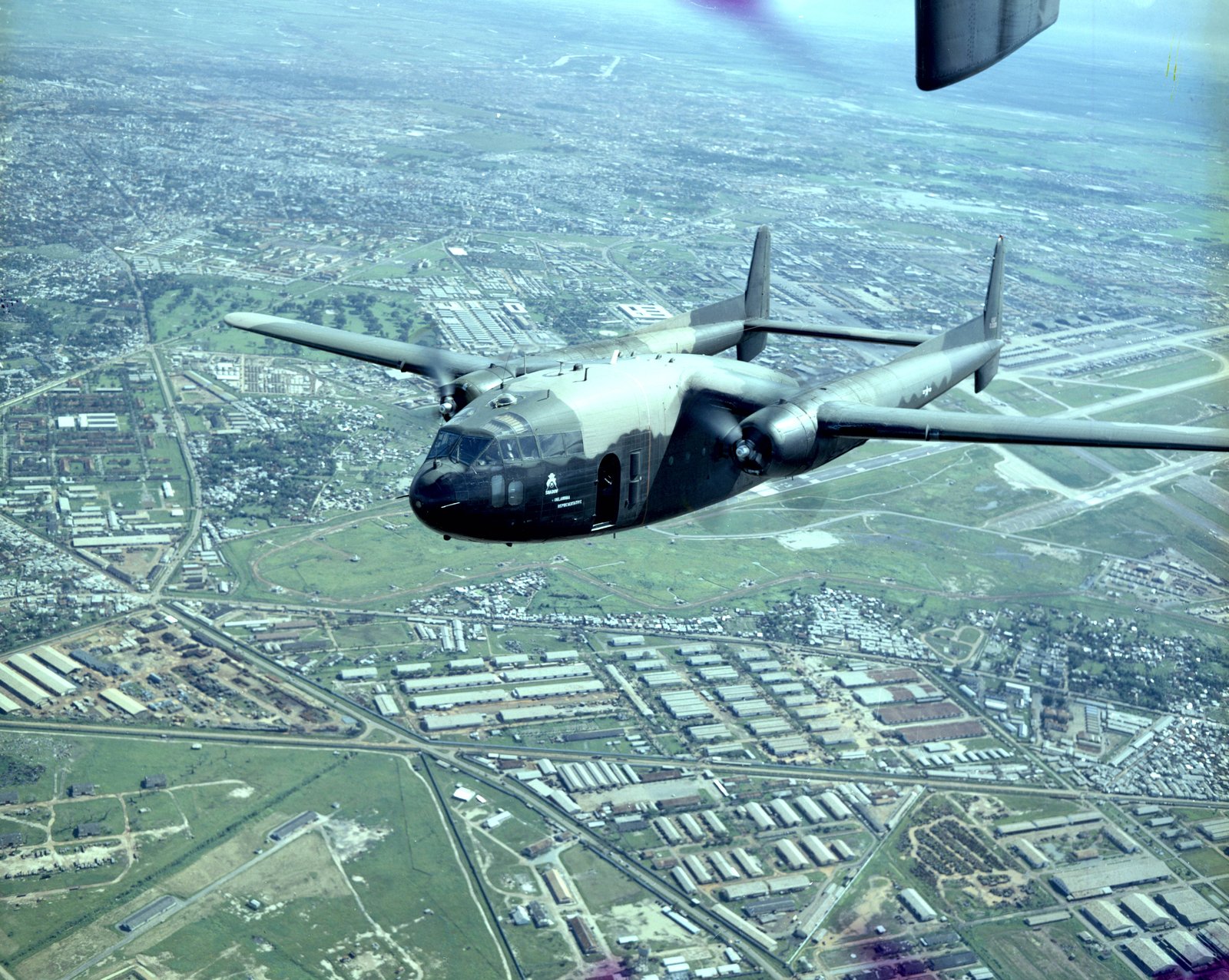
The Fairchild-Hiller AC-119 was not a new-build aircraft but a weapons-system conversion of existing Fairchild C-119G/K "Flying Boxcar" transports. Developed for the U.S. Air Force during the Vietnam War, the program aimed to expand the gunship concept pioneered by the Douglas AC-47. A total of 52 aircraft were converted by Fairchild-Hiller at its Hagerstown, Maryland facility, consisting of 26 AC-119G "Shadow" and 26 AC-119K "Stinger" variants.
Design and development were handled jointly by Fairchild-Hiller engineering teams and the USAF gunship program office. While the base C-119 prototype first flew in November 1947, the gunship variants entered service in late 1968. The first AC-119K was delivered to the 4413th Combat Crew Training Squadron on November 8, 1968, and the first operational AC-119G combat sortie took place on January 5, 1969.
Technical specifications varied between the two models. The AC-119G was powered by two Wright R-3350 Duplex-Cyclone radial piston engines, producing between 2,500 and 3,250 hp each. The AC-119K "Stinger" utilized the same radial engines but added two General Electric J85-GE-17 turbojet engines in underwing pods to improve takeoff and climb performance in "hot and high" combat conditions. Armament was mounted to fire from the left side of the aircraft; the AC-119G carried four 7.62 mm GAU-2/A Miniguns, while the AC-119K was up-armed with two 20 mm M61 Vulcan cannons, four Miniguns, and up to 60 Mk 24 flares fired from LAU-74A launchers.
Operationally, the AC-119 served with the USAF's 14th Special Operations Wing at Nha Trang Air Base and the 56th Special Operations Wing at Nakhon Phanom Air Base in Thailand. The AC-119G focused on fire support and air base defense, while the AC-119K acted as a "truck killer" targeting the Ho Chi Minh Trail. In 1969 alone, the fleet flew 3,700 sorties and expended 35 million rounds of ammunition. Despite these intensive operations, only five AC-119s were lost. The USAF phased out the type by 1972, though the Republic of Vietnam Air Force continued using them until the Fall of Saigon in 1975. Today, several non-flying examples are preserved in museums in the United States and Vietnam.