
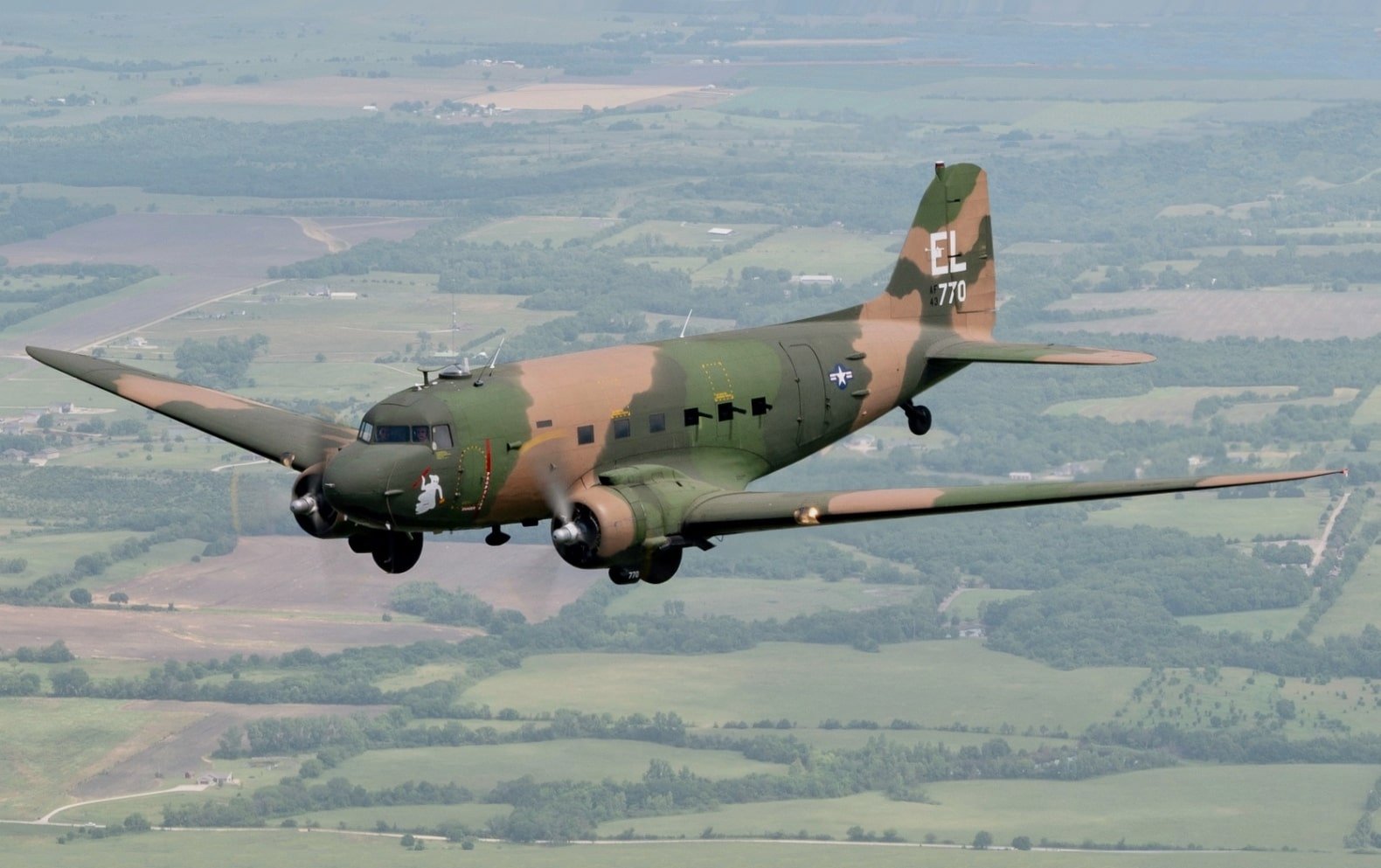
The Douglas AC-47 Spooky emerged as a specialized conversion of the C-47 Skytrain (also known as the Dakota or Gooney Bird), which itself was derived from the Douglas DC-3 that first flew on December 22, 1935. Rather than being a factory-new production model, the AC-47 was the result of a conversion program utilizing existing airframes. While the broader DC-3/C-47 lineage was established much earlier, the specific conversion work for the AC-47 took place between 1963 and 1965. The original manufacturer, Douglas Aircraft Company, later became part of McDonnell Douglas and is now part of Boeing.
Designed as a field conversion rather than a clean-sheet project, the AC-47 combined a rugged, long-endurance transport airframe with a side-firing armament configuration. This allowed the aircraft to loiter over targets and deliver concentrated fire at night. The gunship was powered by two Pratt & Whitney radial piston engines, specifically the R-1830-S1C3G Twin Wasp, each producing 1,200 horsepower. In its gunship configuration, the aircraft typically operated with a crew of seven.
Combat deployment began in Vietnam in 1964, with the first operational gunship flying in December of that year. A total of 53 C-47s were converted to AC-47s by the United States, 41 of which served in Vietnam, where 19 were lost. The aircraft was armed with three 7.62 mm M134 miniguns mounted on the left side, capable of firing up to 6,000 rounds per minute each. The aircraft could carry up to 54,000 rounds of ammunition; notably, during the first eleven days of Vietnam operations, AC-47s fired 179,710 rounds. Its primary roles included close air support, outpost defense, suppression of enemy attacks, and night illumination using flares. Known by the nicknames "Spooky" and "Puff, the Magic Dragon," the type remained in American service until the final flights in December 1969.
Performance data for the C-47/AC-47 lineage indicates a top speed of 220 mph and a cruising speed of 185 mph at 9,480 feet, though some technical summaries list a maximum cruise speed of 200 knots. The aircraft had a service ceiling ranging from 23,950 to 24,450 feet and a maximum range between 1,500 miles and 1,890 nautical miles. The AC-47's success proved the viability of the fixed-wing gunship, directly influencing the development of subsequent platforms such as the AC-119 and AC-130.