
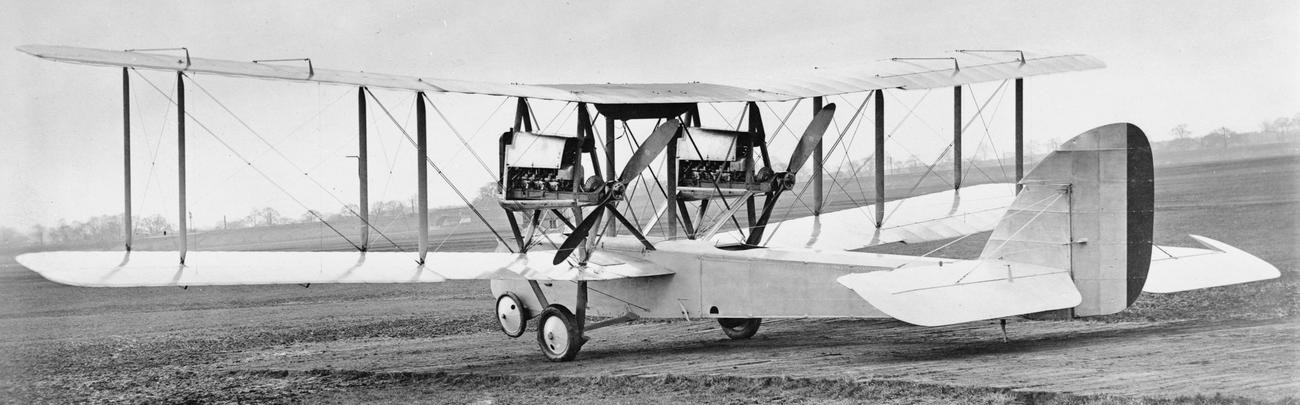
Designed in 1916 by Captain Geoffrey de Havilland, the Airco DH.3 was conceived as a long-range day bomber or fighter-bomber for the Royal Flying Corps. It represented a significant milestone for the Aircraft Manufacturing Company (Airco), as it was the firm's first twin-engined aircraft. The design featured a large biplane configuration with wide-span three-bay wings, a slender fuselage, and a curved rudder. To prevent the aircraft from tipping forward during landing, de Havilland equipped the airframe with a tailskid main landing gear supplemented by two anti-nose-over wheels positioned under the nose.
Two prototypes were constructed at Airco's manufacturing works in Hendon, north-west London. The original DH.3 prototype was powered by two 120 hp water-cooled Beardmore straight-six piston engines, each driving a 9 ft 6 in (2.90 m) diameter four-bladed wooden fixed-pitch pusher propeller. A second, modified prototype designated the DH.3A was built, utilizing more powerful 160 hp Beardmore engines to increase total installed power from 240 hp to 320 hp. The aircraft was designed for a crew of three and could carry a bombload of up to 680 lb (310 kg), with defensive capabilities provided by two .303 in (7.7 mm) Lewis guns on flexible mountings.
Despite its innovative layout, the DH.3 suffered from poor climb performance, taking 58 minutes to reach an altitude of 6,500 ft (1,980 m). While the aircraft could achieve a maximum speed of 95 mph and a range of 700 miles, the War Office judged it unsuitable for strategic bombing. Although an order for 50 DH.3A aircraft was placed, it was cancelled before any production airframes were completed. Both prototypes were scrapped in 1917, and the type never entered operational service during the First World War.
The DH.3's primary legacy was its role as a technical stepping stone. The DH.3A concept directly influenced the development of the Airco DH.10 Amiens, which adopted a similar twin-engine biplane layout but utilized significantly more powerful engines (nearly 800 hp compared to the DH.3A's 320 hp). This evolution demonstrated the transition from early pusher-propeller experiments to the more capable multi-engine bombers of the later war period.