
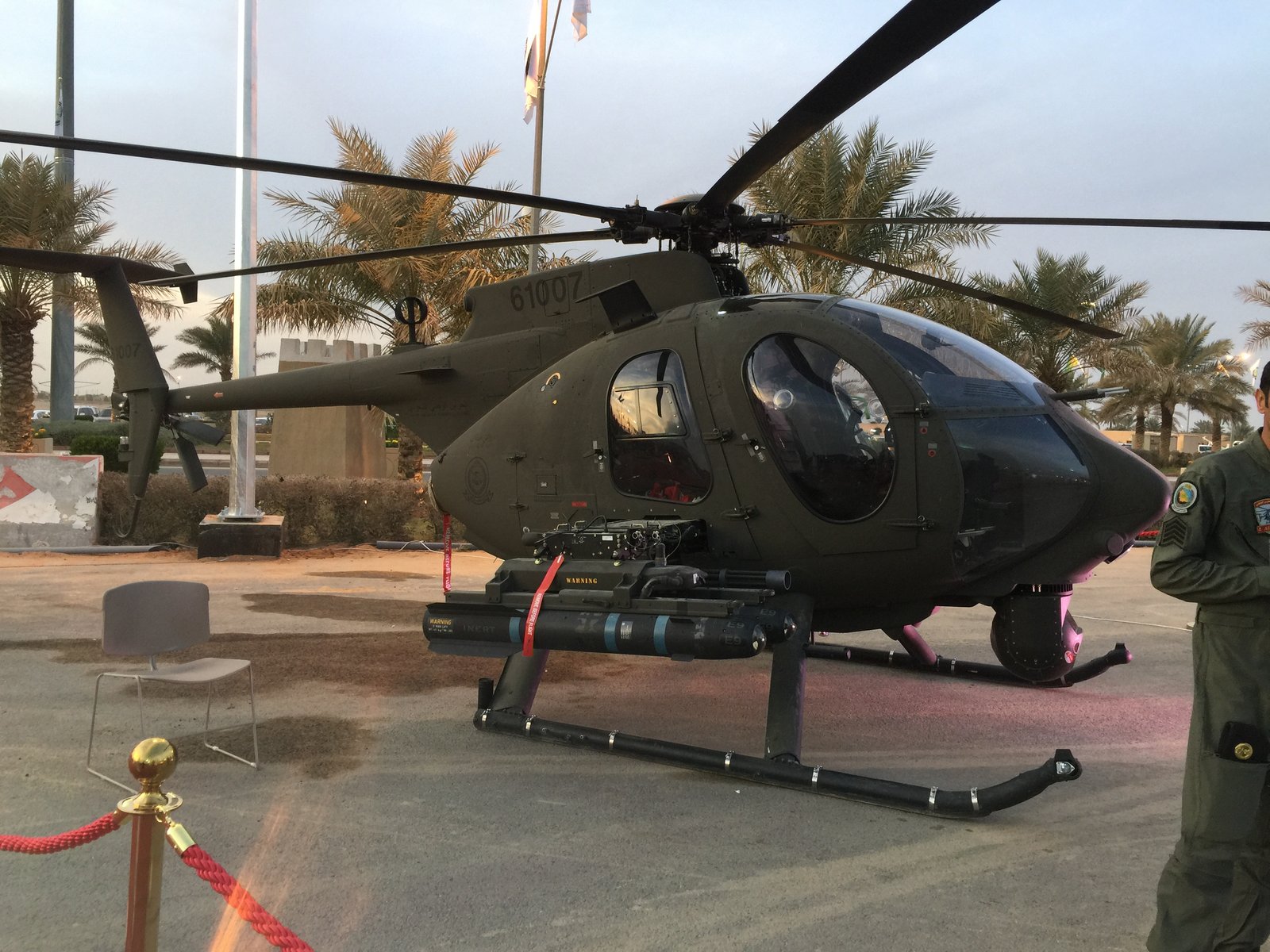
The Boeing AH-6 Little Bird is a light attack and reconnaissance helicopter derived from the MH-6 Little Bird and MD-500 series. The aircraft's lineage traces back to the Hughes OH-6 Cayuse, which first flew on February 27, 1963, for the U.S. Army's Light Observation Helicopter program. Following the sale of Hughes Helicopters to McDonnell Douglas in 1984 and the subsequent 1997 merger between McDonnell Douglas and Boeing, the program transitioned to Boeing Defense, Space & Security (BDS).
Boeing developed the AH-6 as a Boeing-funded project, producing the Unmanned Little Bird (ULB) demonstrator in 2004 and the Mission Enhanced Little Bird (MELB) in 2006. The first production-configuration AH-6i "International" made its maiden flight on April 18, 2014. The AH-6i is characterized by a purpose-built military fuselage integrated with systems derived from the AH-64 Apache, optimized for high maneuverability and a small visual and aural signature. It is designed for diverse roles, including anti-armor, close-combat attack, combat search and rescue, and troop insertion/extraction.
Technically, the AH-6i is a single-turboshaft engine helicopter. While specific engine models are not detailed in Boeing's primary documentation, the aircraft is capable of reaching a maximum service ceiling of 20,000 feet and a maximum range of 179 nautical miles. Its modular weapons suite allows for the installation of 7.62 mm miniguns, 12.7 mm gun pods, and two LAU-68D/A seven-tube rocket pods for 70 mm Hydra 70 or APKWS laser-guided rockets. It can also carry up to four AGM-114 Hellfire anti-tank missiles and four FIM-92 Stinger ATAS missiles for self-defense.
Operationally, the AH-6 family has a storied history with the U.S. Army's 160th Special Operations Aviation Regiment (SOAR), seeing combat in Operation Urgent Fury (1983), Operation Prime Chance (1987–1989), Operation Just Cause (1989), and the Battle of Mogadishu (1993), as well as conflicts in Iraq and Afghanistan. The export AH-6i has been acquired by the Saudi Arabian National Guard (SANG) via a 2014 contract for 24 aircraft and the Royal Thai Army, which signed a contract for eight aircraft in 2022. The Royal Jordanian Air Force is also listed as an operator. Boeing has indicated that production of the AH-6i will conclude following the completion of the Royal Thai Army's order.