
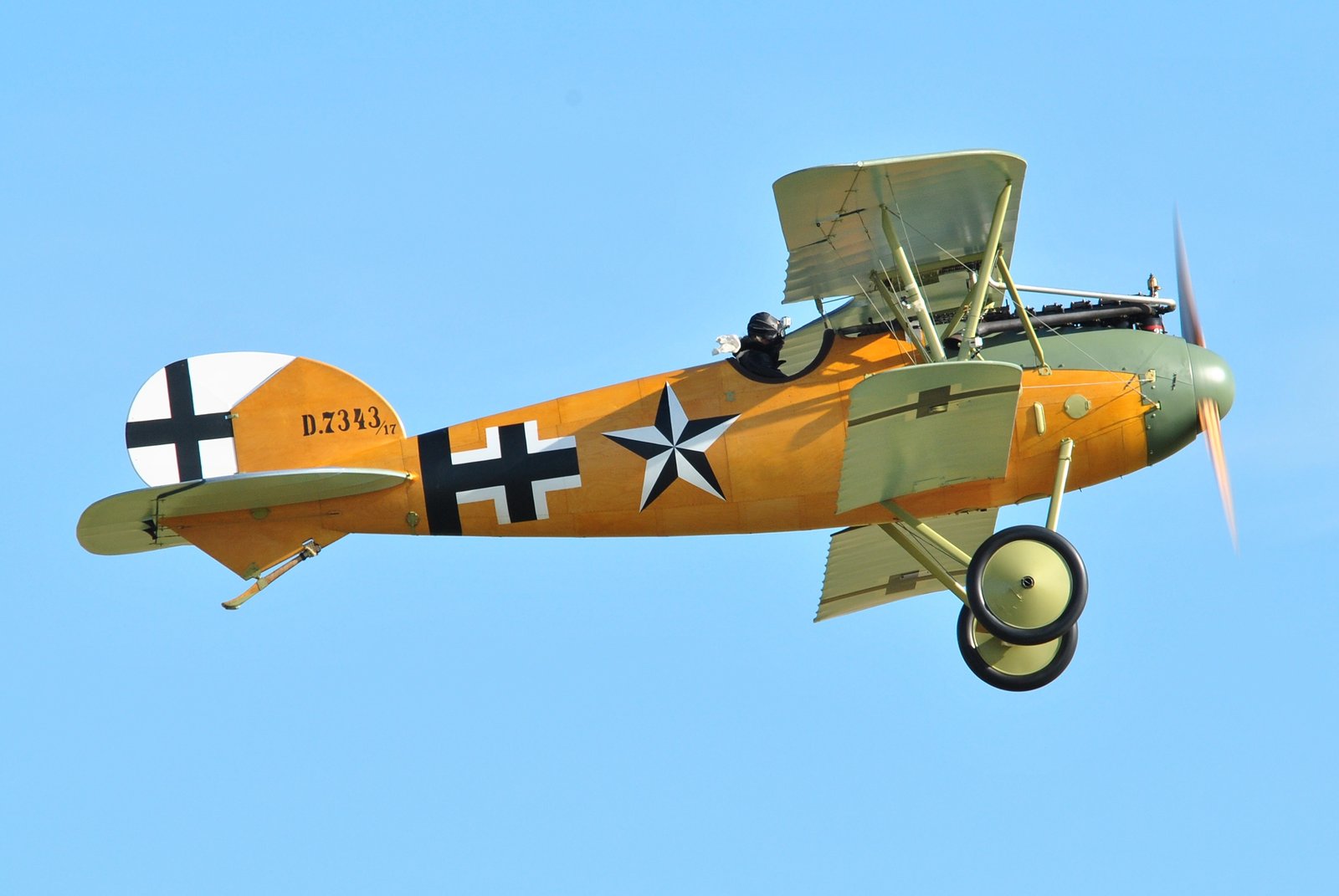
The Albatros D.V was a German single-seat biplane fighter that entered frontline service in May 1917. As the final production development of the Albatros D-series, it was designed under Robert Thelen and his team at Albatros Flugzeugwerke. The aircraft was characterized by its aerodynamically clean, semi-monocoque plywood fuselage with an oval cross-section and a sesquiplane wing layout, which utilized a smaller lower wing braced by V-struts.
Production was carried out by Albatros Flugzeugwerke GmbH at their main works in Berlin-Johannisthal and by the Ostdeutsche Albatros Werke (OAW) in Schneidemühl. While exact production totals are debated, estimates range from approximately 2,635 airframes—based on serial number analysis—to over 3,000 units. The D.V was eventually succeeded by the strengthened D.Va in late 1917, which featured a revised aileron control system and structural reinforcements. Both variants remained in production until the Armistice in November 1918.
Technically, the D.V and D.Va were powered by water-cooled inline piston engines from Daimler-Motoren-Gesellschaft (DMG), commonly known as Mercedes. The D.Va specifically utilized the 180 hp Mercedes D.IIIa engine. For armament, the aircraft carried two synchronized 7.92 mm LMG 08/15 "Spandau" machine guns, providing significant forward firepower. Despite these advantages, the type suffered from severe structural weaknesses in the lower wings, which often failed during steep dives. By 1918, German authorities prohibited prolonged diving to mitigate these accidents.
Operated by the Luftstreitkräfte, the D.V/D.Va was deployed across the Western Front, Italy, and Palestine. At its operational peak in May 1918, over 1,000 of these fighters were in service. The aircraft was flown by several prominent aces, including Manfred von Richthofen, who flew a D.V with the serial number D.2859. Although outclassed by newer Allied fighters by mid-1918, the Albatros D-series remains historically significant for sustaining German fighter operations longer than any Fokker series. Today, only two original D.Va aircraft survive, located at the National Air and Space Museum in Washington D.C. and the Australian War Memorial in Canberra.