
Development Genesis
The An-70 emerged from Soviet military requirements established in the mid-1970s, when preliminary design studies began at the Antonov Design Bureau. The project gained formal approval on July 23, 1984, when the Council of Ministers of the USSR enacted the development program. Initial contracts were finalized in May 1989, positioning the aircraft as a cornerstone of modernized Soviet tactical airlift capabilities.
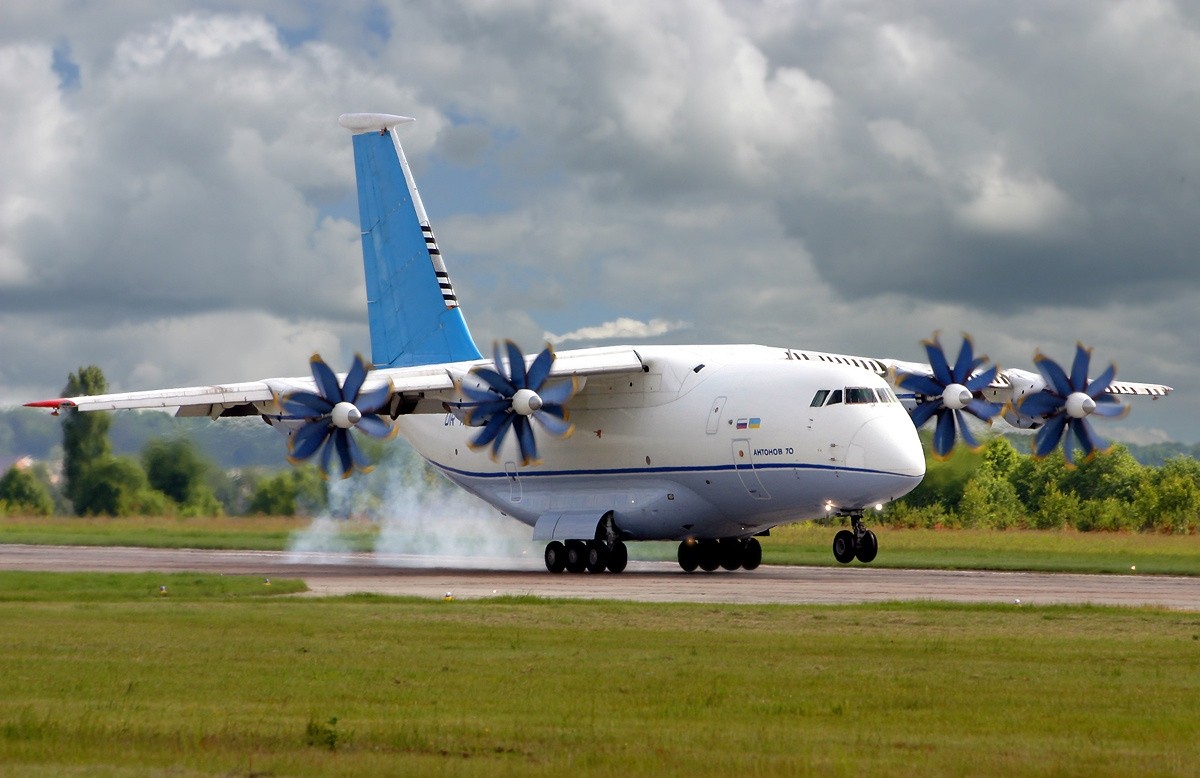
The design philosophy centered on versatility and operational flexibility. Engineers specified requirements for transporting vehicles, soldiers, and cargo loads up to 47 tons, including oversized equipment and paratroopers for aerial delivery missions. The aircraft incorporated short takeoff and landing technology, enabling operations from austere unpaved airfields measuring just 600 to 800 meters in length. Additional capabilities included aerial refueling, medical evacuation, and patrol missions, establishing the An-70 as a multi-role platform.
Troubled Development Timeline
Construction of the first prototype commenced in Kyiv during 1991, amid the dissolution of the Soviet Union. Originally scheduled for maiden flight in late 1992, the program encountered significant delays due to financing constraints and technical difficulties. Ukraine's weakened currency severely limited the bureau's ability to procure components from Russian suppliers and maintain adequate worker compensation. Pre-flight inspections revealed numerous design and manufacturing deficiencies requiring extensive corrections.
The first prototype finally rolled out on November 24, 1994, achieving maiden flight on December 16, 1994. Captain Sergii Maksimov commanded the six-person crew, including co-pilot Volodymyr Lysenko, navigator Volodymyr Nepochatyh, flight engineer Pavel Skotnikov, radio operator Andrii Kostrykin, and test engineer Mykhaylo Bereziuk. Within months, however, this prototype suffered a catastrophic mid-air collision, necessitating construction of a second airframe to continue flight testing.
International Collaboration Challenges
The second prototype emerged on December 26, 1996, in ceremonies attended by Ukrainian President Leonid Kutchma. Test pilots Alexander Galunenko and Russian Air Force pilot A. Andronov conducted the 31-minute maiden flight on April 24, 1997, from Svyatoshino Airfield. The aircraft made its public debut at the Moscow Air Show in August 1997, demonstrating the continued Russian-Ukrainian cooperation.
By 1994, twenty companies and organizations from former Soviet republics had agreed to jointly develop, market, and support the An-70. The Russian government committed to providing 80 percent of development funding through a June 1993 bilateral agreement. Production planning established manufacturing sites at both the Kyiv Aircraft Production Plant and Russia's Samara Aircraft Production Plant, later reorganized as Aviakor.
Manufacturing Arrangements
A comprehensive workshare agreement emerged by 2009, distributing production responsibilities across multiple facilities. Antonov's Kyiv facility would manufacture wings, tail surfaces, and engine nacelles. The KAPO factory in Kazan, Russia, received responsibility for fuselage production, final assembly, and flight testing. Additional major components originated from facilities in Novosibirsk, Ulyanovsk, and Voronezh. Construction of the first production aircraft fuselage reached completion in December 2012.
Testing and Certification
The An-70 demonstrated exceptional performance capabilities during its extended test program. On November 10, 2003, the aircraft established a world record by lifting 55,000 kilograms to 2,000 meters altitude, exceeding its specified maximum cargo capacity. State acceptance trials commenced in September 2012, continuing through April 2014 when the aircraft successfully passed certification requirements.
During this critical period, the sole flying prototype conducted approximately 120 flights totaling 220 hours of flight time. Ukrainian specialists and officials carried out much of the certification effort independently after Russia withdrew from the project in November 2012, though this withdrawal remained undisclosed until April 2013. Russian officials cited slow development progress as justification for abandoning the program.
Service Entry
Ukraine's Minister of Defense approved State Joint Test results for the An-70 on June 11, 2014. Following successful completion of all requirements, the Minister of Defense signed acceptance orders on January 13, 2015, formally inducting the An-70 short takeoff and landing medium military transport into Armed Forces of Ukraine service.
The Ukrainian Air Force reportedly expected delivery of its first two operational An-70s during 2011 and 2012, though actual delivery schedules remained subject to production constraints. Commercial interest materialized through Volga-Dnepr Airlines, which signed a Memorandum of Understanding with Antonov for five commercial-standard An-70T variants.
Performance Specifications
The An-70 achieves cruise speeds between 700 and 750 kilometers per hour with operational range of 5,100 kilometers while carrying 35-ton cargo loads. Maximum service ceiling reaches 12,000 meters, enabling high-altitude operations across diverse geographic regions. The aircraft maintains all-weather operational capability at all latitudes during day and night conditions, supporting autonomous mission execution.
Legacy and Impact
The An-70 development program consumed more than twenty years from initial concept to service acceptance, reflecting the complex geopolitical transitions following Soviet dissolution. Despite production beginning in 2008, the aircraft represents both the achievements and limitations of post-Soviet international aerospace cooperation, demonstrating advanced short takeoff and landing technology while illustrating the challenges of multinational defense programs during periods of political instability.