
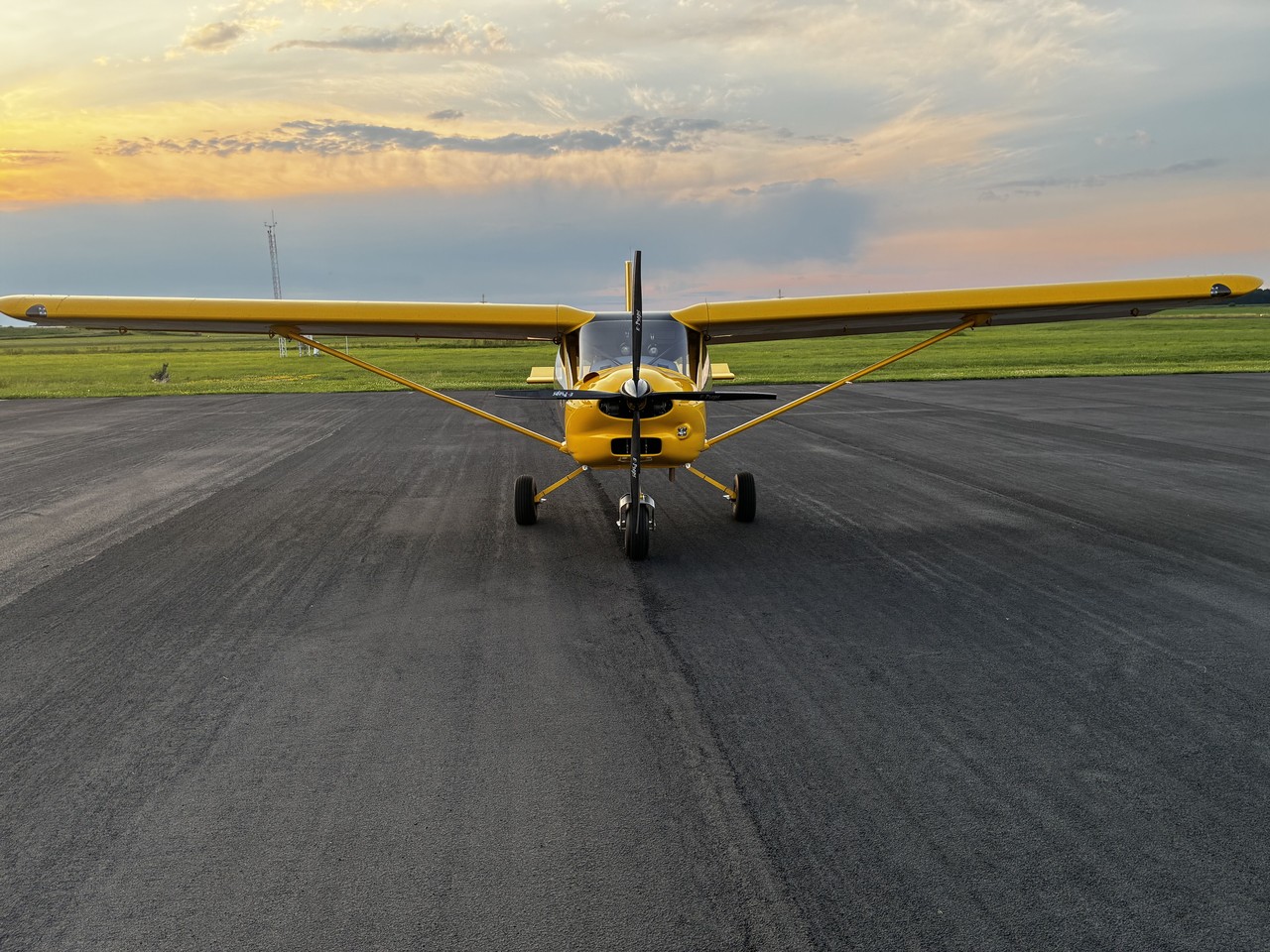
Design Revolution in Light Aviation
The A-22 emerged from the ambitious vision of Ukrainian designer Yuri Yakovlev, who sought to create an aircraft combining maximum safety, comfort, and rugged construction with modern materials and traditional manufacturing techniques. The design built upon Aeroprakt's earlier success with the A-20 "Chervonets," sharing wing and tail structures while introducing significant improvements in pilot comfort and flight performance.
The aircraft's exceptional short takeoff and landing performance became its defining characteristic, with touchdown speeds approaching 50 kilometers per hour and landing runs of just 135 meters at maximum takeoff weight. This capability, combined with its 28-knot stall speed and 690-foot-per-minute climb rate, made the A-22 ideally suited for operations from short, unprepared airstrips.
Manufacturing Excellence from Ukraine
Aeroprakt Kiev began as an aircraft design organization in 1986, evolving from humble beginnings when aeronautical engineers employed by the renowned Antonov company founded the Aeroprakt Aero Club in 1991. The company's first production aircraft, the A-20, entered manufacturing in 1993 with Finnish funding, establishing the foundation for future success.
By the time A-22 production commenced following the 1996 prototype flight, Aeroprakt had developed sophisticated manufacturing capabilities at their factory west of Kiev. The company operated from its own airfield, complete with flying school, maintenance facilities, and test flight operations. Today, Aeroprakt employs nearly 100 people, many veterans from the company's early days, and maintains production rates approaching 100 aircraft annually.
Global Market Adaptation
The A-22's international success stemmed partly from Aeroprakt's strategic approach to different market requirements. In Germany, the aircraft earned certification to demanding BFU-95 requirements. American markets received the aircraft as the "Valor" or "Valour," while British and Australian operators knew it as the "Foxbat." This flexibility allowed the manufacturer to penetrate diverse regulatory environments worldwide.
Foxbat Australia, originally SilverWing Aviation, began operations in 2002 with the first demonstrator A-22 built from a UK kit and shipped to Australia. This partnership model proved successful in establishing international distribution networks and local support infrastructure.
Technical Innovation and Reliability
The A-22's powerplant selection proved crucial to its success. The Austrian-manufactured Rotax 912 series engines provided exceptional fuel economy and reliability, with the 80-horsepower 912UL and 100-horsepower 912ULS variants offering operators performance choices. The liquid-cooled flat-four design, operating at 5,800 RPM, delivered consistent power while maintaining the fuel consumption rates of 16-17 liters per hour that made the aircraft economically attractive.
Aeroprakt's decision to employ traditional all-metal construction with fabric covering on control surfaces and wing bottoms created an optimal balance between structural integrity and weight savings. The tricycle landing gear with steerable nosewheel, combined with effective brakes, contributed to the aircraft's reputation for safe ground handling.
Production Evolution and Variants
Series production generated multiple variants addressing different market segments. The original A-22 maintained a 472.5-kilogram maximum takeoff weight suitable for ultralight regulations. The A-22L reduced fin size and modified landing gear while decreasing gross weight to 450 kilograms. The A-22LS, launched in 2009, achieved light sport aircraft compliance with a 600-kilogram gross weight.
The A22LSA variant, specifically developed for American markets, featured a 544-kilogram gross weight designed to satisfy FAA light sport aircraft regulations. In 2015, Aeroprakt introduced the A32 Vixxen, sharing the Foxbat wing design but incorporating completely redesigned fuselage and tail sections.
Performance and Pilot Appeal
Pilots praised the A-22's forgiving flight characteristics and broad performance envelope. The aircraft achieved maximum speeds of 120 knots while maintaining exceptional low-speed handling, creating a flight envelope accessible to pilots of moderate ability. Service ceiling reached 16,000 feet, while typical range exceeded 500 miles with the standard 90-liter fuel capacity.
The side-by-side seating configuration provided excellent visibility and communication between pilot and passenger, while the 20-kilogram baggage capacity accommodated practical cross-country flying requirements. These characteristics, combined with the aircraft's 271-kilogram empty weight and 201.5-kilogram useful load, created an attractive balance for sport aviation applications.
Continuing Legacy
With over 1,250 aircraft delivered and production continuing at nearly 100 units annually, the A-22 represents one of the most successful modern ultralight designs. Its combination of safety, performance, and affordability established benchmarks that continue influencing light sport aircraft development. The aircraft's success demonstrated that thoughtful engineering, quality manufacturing, and international market adaptation could create sustainable business models even for smaller aerospace companies operating from developing economies.