
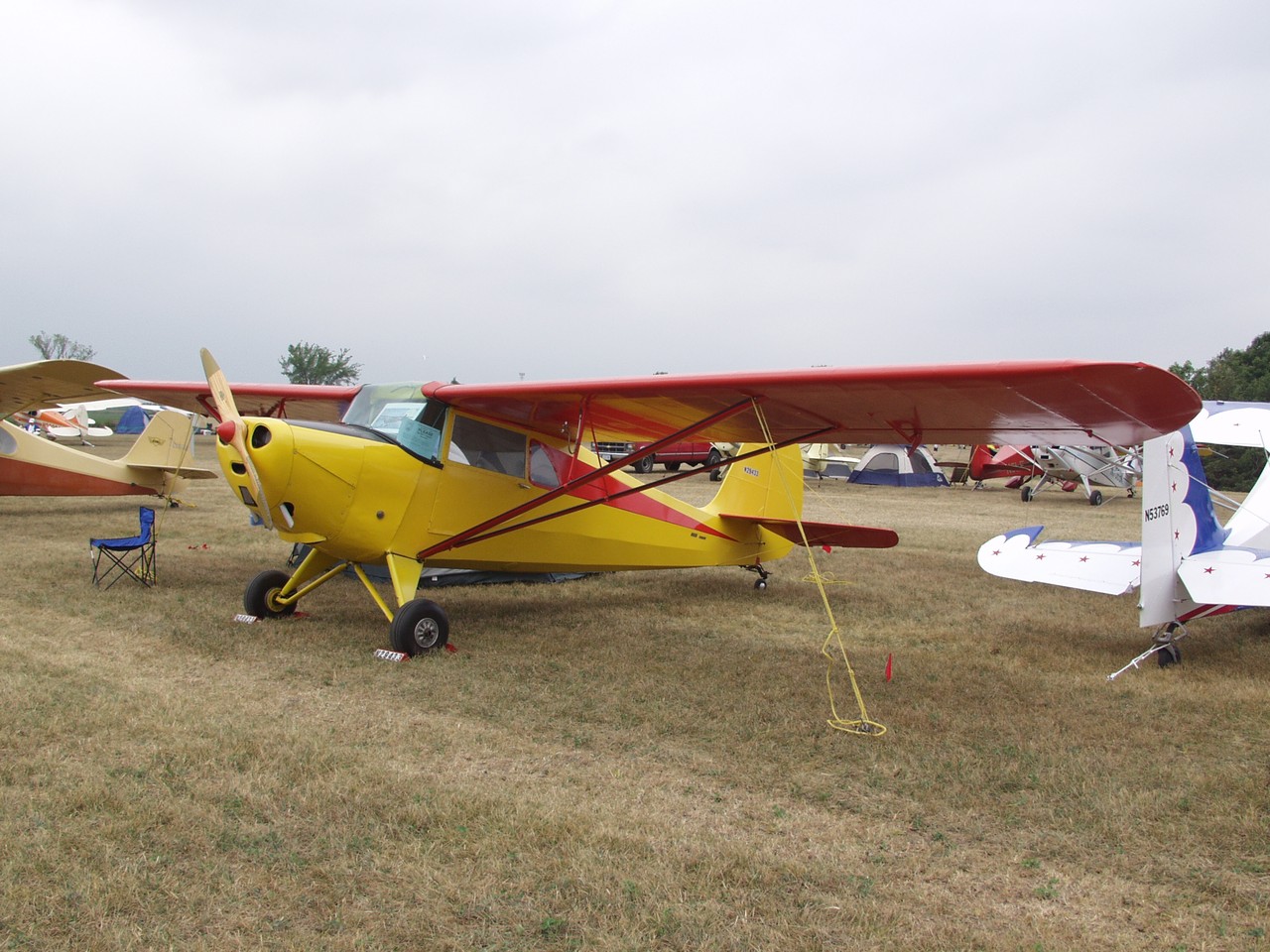
Design Innovation and Market Impact
The Super Chief emerged as Aeronca's answer to pilots demanding more refinement than the spartan trainers dominating aviation in the mid-1930s. The aircraft featured revolutionary comfort elements including car-style doors for entry, improved instrumentation panels, and side-by-side seating that made it ideal for touring and training applications. Its welded steel tube fuselage covered with fabric and wooden wings with plywood and fabric covering represented advanced construction techniques for its era.
Wartime Service Record
World War II transformed the peaceful Super Chief into a crucial military asset. The United States Army Air Forces designated military variants as the L-3 series, with the L-3F representing 19 Super Chiefs equipped with Continental A-65-8 engines and the L-3G comprising four aircraft with Lycoming O-145-B1 powerplants. The related O-58 Grasshopper served as a liaison and observation aircraft, while the tandem-seat variants saw extensive use in the Civilian Pilot Training Program, preparing thousands of pilots for combat service.
Military production reached significant numbers, with 701 L-3B aircraft and 499 L-3C variants built specifically for Army Air Forces operations. These aircraft performed reconnaissance, liaison, and training duties across multiple theaters, proving the design's versatility beyond its civilian origins.
The Aeronca Legacy
Aeronca Aircraft Corporation pioneered affordable aviation, having introduced the groundbreaking C-2 in 1929. The company established its naming convention based on engine horsepower, with the Chief family representing a major evolutionary step from the earlier K series aircraft. The 1938 introduction of the Aeronca 50 Chief established the foundation for the entire Chief lineage, which would eventually encompass over 13,700 aircraft across all variants.
Engine Specifications and Performance
The Continental A-65 four-cylinder, air-cooled, horizontally-opposed engine provided 65 horsepower to drive the Super Chief's fixed-pitch propeller. This reliable powerplant, combined with the aircraft's 1,150-pound gross weight and 675-pound empty weight, delivered economical operation for private owners. Alternative engine options included the Lycoming O-145 in various configurations, offering pilots choice in powerplant selection based on availability and preferences.
Pilot Experience
Pilots appreciated the Super Chief's docile handling characteristics and forgiving flight envelope, making it an excellent choice for low-time aviators transitioning from training aircraft. The 169 square feet of wing area provided stable flight characteristics, while the Continental engine's reputation for reliability gave pilots confidence during cross-country flights. The aircraft's useful load of 530 pounds allowed for two occupants plus baggage for extended touring.
Production Success and Enduring Influence
The Super Chief's design DNA continued long after production ended in 1949. The subsequent Aeronca 7 Champion shared 70% of its parts with the 11AC Chief variant, demonstrating the design's fundamental soundness. This lineage eventually evolved into the Champion Citabria, which later became the Bellanca Citabria, keeping the basic configuration alive for decades.
International recognition came when Hindustan Aeronautics selected the Chief design as the basis for their HAL-26 Pushpak trainer in 1958, validating the aircraft's training capabilities on a global scale. The Chief family's success helped establish Aeronca as a major force in general aviation, contributing to the post-war boom in private flying.
Modern Status
Today, surviving Super Chiefs remain popular among vintage aircraft enthusiasts, though specific numbers of airworthy examples vary as restoration projects continue worldwide. The type's simple construction and readily available parts make restoration feasible for dedicated owners, ensuring the Super Chief's continued presence at fly-ins and airshows. Museums preserve examples of the military variants, recognizing their contribution to pilot training during America's greatest conflict.