
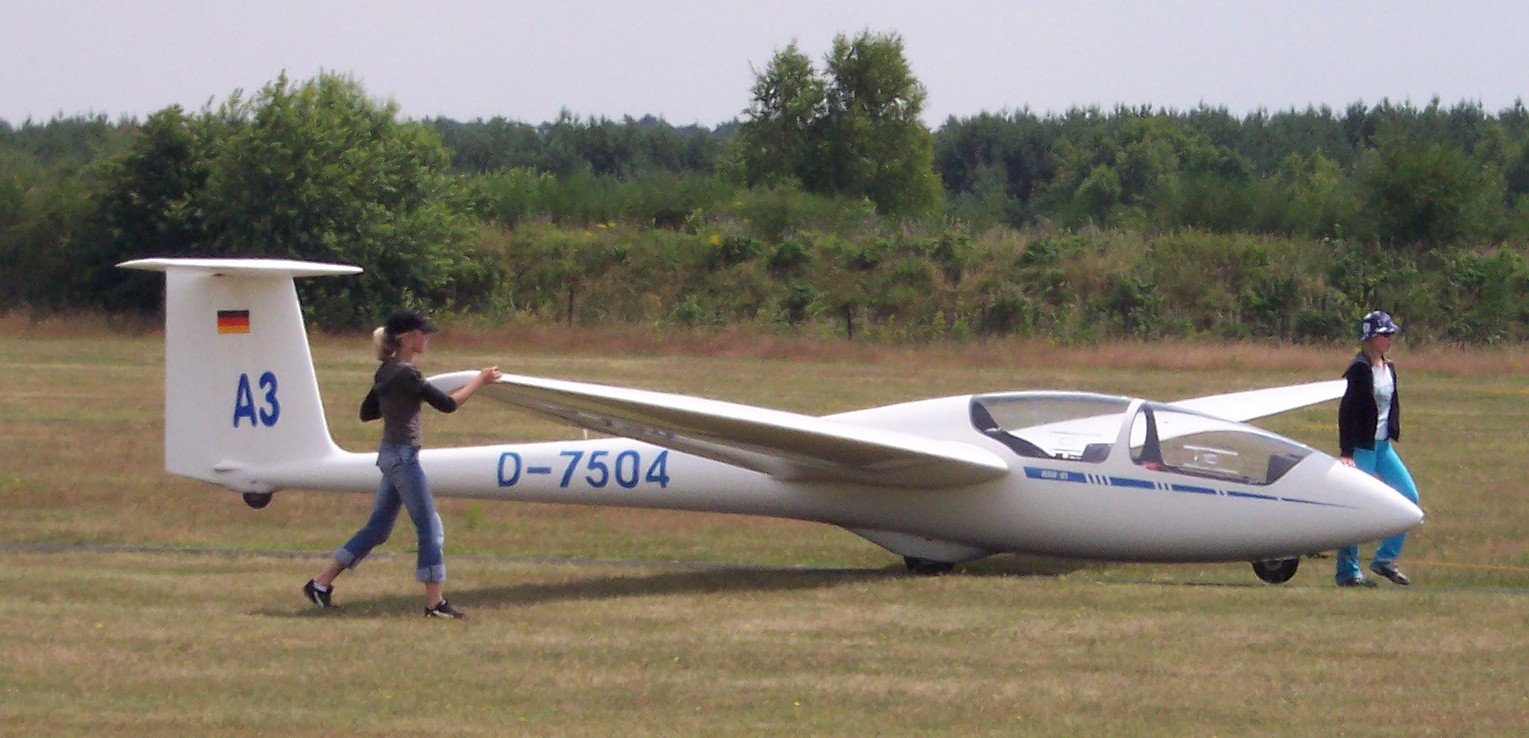
Design and Development
The ASK-21Mi emerged as a logical evolution of Rudolf Kaiser's successful ASK-21 design, addressing the growing demand for self-sufficient glider training operations. Kaiser, working alongside Michael Greiner, adapted the proven airframe to incorporate a retractable powerplant, creating a versatile training platform that eliminated dependence on ground-based launching equipment. The motorglider variant maintained the full glass-reinforced plastic construction that had made the original ASK-21 Schleicher's first composite two-seater when it debuted in 1978.
Technical Specifications
The ASK-21Mi's powerplant consists of an Austro Engine AE50R rotary engine producing 41 kilowatts. This liquid- and air-cooled unit features fuel injection, dual ignition, and automatic altitude compensation, consuming approximately 15 liters per hour from its 23-liter fuel tank. The engine drives a fixed-pitch propeller mounted behind the wing, retracting completely when not in use to minimize drag during soaring flight. Austro Engine designed the powerplant specifically for motorglider applications, eliminating traditional service life limits and overhaul requirements that burden conventional aircraft engines.
The aircraft's tricycle landing gear configuration includes a steerable nose wheel coupled to the rudder system and wingtip wheels for ground handling protection. Maximum takeoff weight reaches 700 kilograms, with an empty weight of 495 kilograms providing substantial payload capacity for two occupants and fuel. The side-by-side seating arrangement facilitates effective instruction, maintaining the training-focused cockpit layout of the unpowered variant.
The Manufacturer
Alexander Schleicher GmbH & Co. KG represents one of Germany's most enduring aviation manufacturers, resuming sailplane production in 1951 after World War II interruption. The Poppenhausen-based company established its reputation through iconic designs including the Ka 6 series and played a crucial role in post-war German aviation revival. Under the Schleicher name, the firm has remained independent throughout its modern history, avoiding the mergers and acquisitions that consolidated much of the general aviation industry.
The company's commitment to composite construction technology positioned it at the forefront of modern sailplane development. When the ASK-21 introduced full GRP construction to Schleicher's two-seat lineup, it established manufacturing techniques that would benefit subsequent designs including the motorized variant.
Operational Capabilities
The ASK-21Mi serves primarily civilian flight training organizations seeking operational independence from traditional glider launching methods. Its retractable powerplant allows for conventional takeoffs from standard airports, eliminating requirements for winch systems or tow aircraft that constrain many gliding operations. The 23-liter fuel capacity provides approximately 1.5 hours of powered flight, sufficient for launch, pattern work, and emergency situations while preserving the aircraft's primary role as a soaring platform.
The folding drive belt system ensures minimal aerodynamic penalty when the engine retracts, preserving the clean lines essential for efficient soaring performance. This design philosophy maintains the training value that made the ASK-21 family successful while adding practical capabilities for modern flight instruction environments.
Production and Legacy
While specific production numbers for the ASK-21Mi variant remain undisclosed, the broader ASK-21 family exceeded 750 units by 2018, when production transitioned to the improved ASK-21B model. The motorglider variant contributes to this legacy by extending the platform's utility without compromising its fundamental training characteristics.
Austro Engine reports installation of over 500 of its powerplants in various Schleicher self-launching sailplanes, indicating substantial acceptance of the retractable engine concept. The ASK-21Mi benefits from this operational experience, incorporating proven systems into an established airframe design.
Current Status
The ASK-21Mi remains available from Alexander Schleicher alongside the updated ASK-21B, which introduced automatic control connections, revised canopy design, and improved aileron systems beginning in 2018. These developments, credited to R. Kaiser, M. Heide, and P. Anklam, demonstrate continued evolution of the basic design first established four decades earlier.
The aircraft serves flight training organizations worldwide where self-launching capability provides operational advantages over traditional glider launching methods. Its combination of proven training characteristics with modern powerplant technology represents the ongoing development of specialized aviation training equipment.