
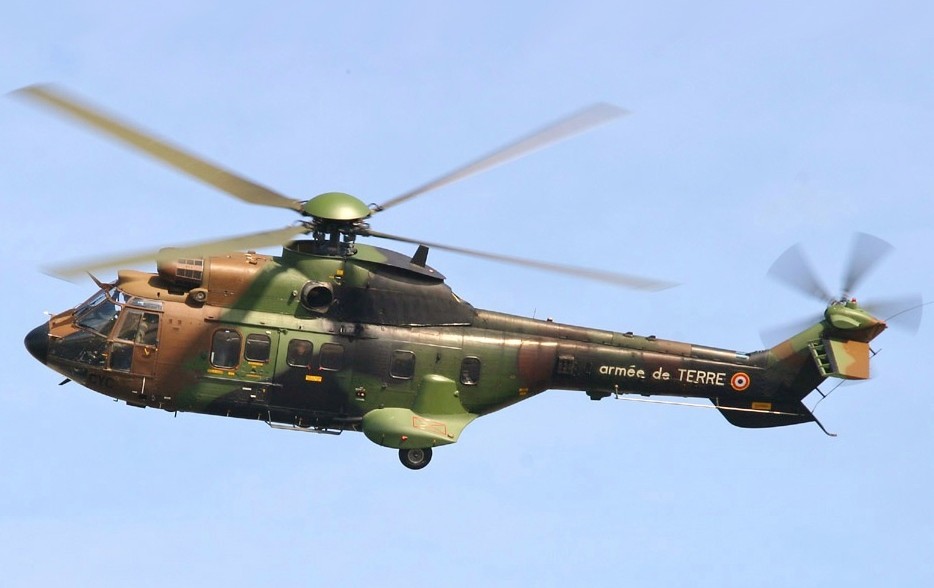
Service History
The AS-532 Cougar established itself as a versatile workhorse across multiple military forces, with primary operators including the French Air Force and Army Aviation (ALAT), Turkish Air Force, Royal Netherlands Air Force, and Bulgarian Air Force. By the 1990s, the Cougar family had proven its worth in demanding operational environments, with French forces deploying the type extensively during the Gulf War in 1991 and subsequent operations in the Balkans throughout the decade.
The helicopter's adaptability enabled it to fill numerous specialized roles beyond basic transport. The AS-532SC naval variant incorporated the Aircraft Ship Integrated Secure and Traverse (ASIST) system for shipboard operations, while anti-submarine warfare configurations carried torpedoes and sophisticated sonar equipment. Anti-surface warfare variants mounted AM39 Exocet missiles, transforming the Cougar into a potent maritime strike platform.
Operational Capabilities
Military operations in Afghanistan during the 2000s further demonstrated the Cougar's operational flexibility. The type excelled in search-and-rescue missions, troop insertion, and cargo resupply across the challenging Afghan terrain. French forces particularly valued the helicopter's ability to operate in all-weather conditions while maintaining high availability rates.
The AS-532 UL and AL variants became the backbone of utility operations, accommodating up to 29 combat-equipped soldiers or alternatively configured for medical evacuation with six stretchers and ten seated passengers. External sling operations allowed the Cougar to transport 4.5-ton loads, making it invaluable for forward base resupply and heavy equipment movement.
The Manufacturer
Aérospatiale emerged in 1970 from the merger of Sud Aviation and two other French aviation manufacturers, inheriting the successful SA 330 Puma program that began in 1963. The company's Marignane facility became the primary production center for the Cougar family, drawing on decades of rotorcraft expertise developed through earlier programs.
The corporate landscape shifted significantly when Aérospatiale's helicopter division merged with Germany's MBB and DASA operations in 1992 to form Eurocopter. This European consolidation strengthened the Cougar's market position and led to expanded production capabilities. The company transformed again in 2014, becoming Airbus Helicopters, while maintaining continuous production of Cougar variants well into the 2010s.
Aérospatiale's legacy extended beyond the Cougar through successful licensed production agreements. Romanian manufacturer IAR produced the IAR-330 derivative, with the first flight occurring in 1975. Romania ultimately built 104 units for domestic forces plus 60 for export, while Indonesian and South African production lines further expanded the Puma family's global reach.
Engine and Technical Innovation
The Cougar's performance advantage stemmed primarily from its twin Turbomeca Makila 1A1 turboshaft engines, each producing 1,330 kilowatts of power. This represented a substantial upgrade over the original Puma's powerplant, enabling improved payload capacity and operational flexibility. The later Cougar Mk II, which first flew on February 6, 1987, incorporated even more powerful Makila 1A2 engines rated at 1,570 kilowatts each.
Turbomeca, later acquired by Safran, developed the Makila series specifically for heavy-lift helicopter applications beginning in the late 1970s. The engines' reliability in military operations became legendary, contributing significantly to the Cougar's reputation for operational readiness. France's 2012 modernization program invested €288.8 million to upgrade 26 Cougars, largely centered on engine and avionics improvements.
Design innovations extended beyond powerplant improvements. Engineers incorporated composite rotor blades for enhanced performance and durability, while modifications to the tailfin and landing gear improved handling characteristics. The AS332L variant introduced a lengthened fuselage configuration, first flying on October 10, 1980, which became the basis for increased passenger capacity in military applications.
Specialized Variants
The AS532 Horizon represented the type's most sophisticated application, serving as an airborne early warning platform. Following its first radar-equipped flight in 1992, the Horizon provided French forces with critical surveillance capabilities. This variant demonstrated the Cougar's adaptability to highly specialized mission requirements beyond traditional transport roles.
Naval operations drove development of the AS532SC, specifically configured for anti-submarine and anti-surface warfare. These variants operated from both land bases and naval vessels, with deck handling systems enabling operations from smaller platforms. The combination of Exocet missiles and torpedo capability created a formidable maritime warfare platform.
Production Legacy
Total production reached approximately 540 units across all AS-532 variants by the 2010s, representing a significant commercial success for the European helicopter industry. Manufacturing continued under the Airbus Helicopters designation, with the 1,000th Super Puma/Cougar family aircraft delivered in 2019 as an H215M variant.
The Cougar's influence extended into current-generation helicopters, serving as the foundation for the EC725 Caracal and H225 Super Puma families. This evolutionary development ensured French rotorcraft technology remained competitive in global markets while building upon decades of operational experience. Today, Cougar variants remain active with their primary operators, testament to the type's enduring operational value and robust design philosophy that emerged from Aérospatiale's engineering excellence in the 1970s.