
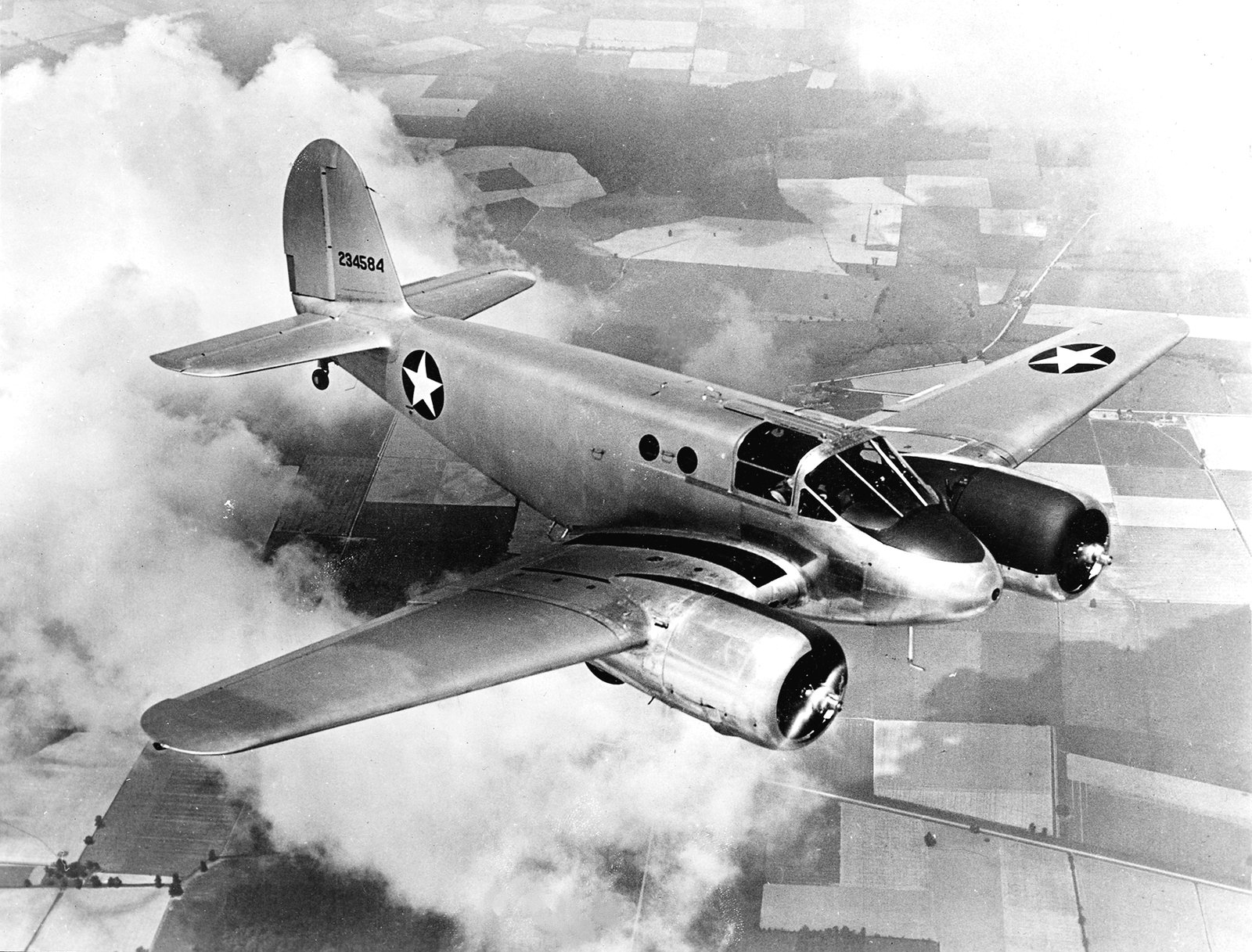
The Beechcraft AT-10 Wichita was developed as an advanced multi-engine trainer to serve as an intermediate bridge between basic single-engine aircraft and high-performance twin-engine bombers and fighters. Designed by an engineering team led by T. A. Wells at the Beech Aircraft Corporation, the project began as the Model 25 in early 1940 to meet United States Army Air Corps requirements for a trainer with retractable landing gear. After the Model 25 prototype crashed on May 5, 1941, the team immediately began work on the improved Model 26, which successfully made its first flight on July 19, 1941.
One of the most distinctive features of the AT-10 was its primary structure, which was built almost entirely of wood. This design choice was a strategic response to concerns that aircraft-grade aluminum would become scarce during the escalation of World War II. The aircraft was powered by two Lycoming R-680-9 air-cooled, 9-cylinder radial piston engines, each producing 295 hp. This configuration provided a total of 590 hp, allowing the AT-10 to reach a maximum speed of approximately 198–200 mph and a service ceiling of 16,900 feet.
Production began in 1942, with the first deliveries to the United States Army Air Forces (USAAF) occurring in February of that year. Beech Aircraft Corporation produced 1,771 units at its Wichita, Kansas factory—the city for which the aircraft was named—before ending its production run in 1943. To meet continued demand, the Globe Aircraft Corporation produced an additional 600 aircraft (designated AT-10-GF) under license at its facility in Fort Worth, Texas, through 1944. In total, 2,371 aircraft were manufactured.
During its service with the USAAF, the AT-10 proved highly effective; more than half of all USAAF pilots utilized the type for their transition to multi-engine aircraft. By the end of 1942, 748 units were already in service training crews for the expanding fleets of transports and bombers. Due to its wooden construction, the AT-10 suffered from significant deterioration over time, leaving very few survivors. Currently, the only complete original example is serial number 41-27193, preserved at the National Museum of the U.S. Air Force in Dayton, Ohio. Additionally, the Cadet Air Corps Museum is working on a restoration project to return one AT-10 to airworthy condition.