
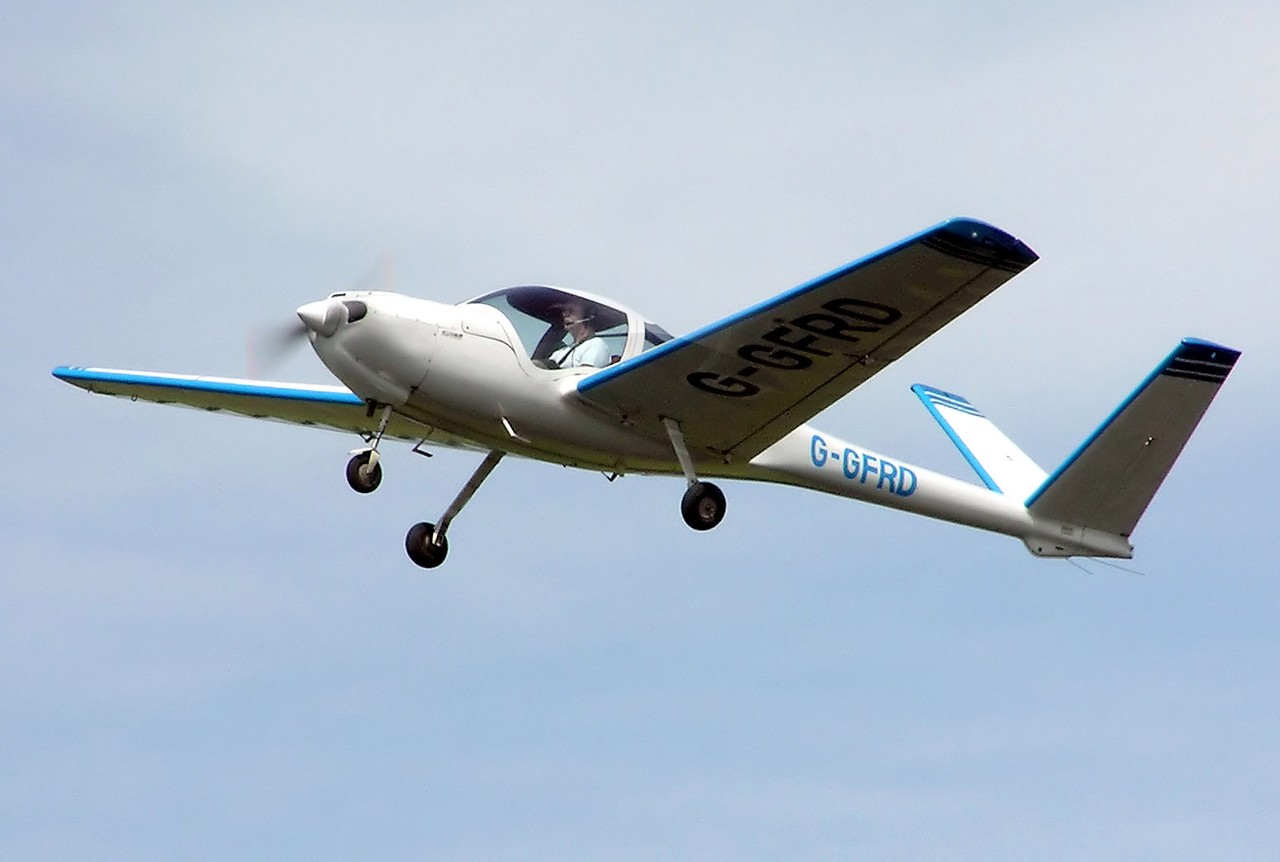
Development and Design Philosophy
The Robin ATL emerged from a French government competition launched in the early 1980s to address a crisis facing French flying clubs. Rising costs of American training aircraft, combined with unfavorable exchange rates, had made flight training prohibitively expensive for many operators. Avions Pierre Robin won this competition in 1983 with their radical ATL design, which promised to deliver an economical two-seat trainer through innovative construction methods and lightweight automotive powerplants.
The aircraft's mixed-media construction represented a bold departure from conventional all-metal designs. Robin engineers combined a glass-reinforced plastic fuselage with traditional wooden wings and a conventional all-metal V-tail configuration. This approach aimed to reduce both manufacturing costs and structural weight while maintaining adequate strength for training operations.
Engine Troubles and Technical Setbacks
The ATL's Achilles heel proved to be its powerplant selection. The original prototype employed a JPX PAL 1300, a 47-horsepower two-stroke radial engine that generated excessive vibration during flight testing. Robin quickly abandoned this configuration in favor of the JPX 4T 60A, a modified Volkswagen automotive engine producing 65 horsepower through a four-cylinder, horizontally-opposed arrangement.
While the JPX 4T 60A solved the vibration problems, it introduced new reliability concerns through its single-ignition system. This configuration left pilots with no backup ignition source if the primary system failed—a significant safety concern for training operations. Recognition of this limitation led Robin to offer a premium variant powered by the 70-horsepower Limbach engine, also derived from Volkswagen automotive origins but featuring crucial dual ignition. Unfortunately, this improved powerplant received certification in 1989, too late to salvage the program's reputation. Only 10 of the 132 total ATL aircraft received the superior Limbach installation.
Production and Market Reception
Production commenced at Robin's Darois facility near Dijon in 1985, with initial deliveries beginning in April under limited airworthiness approval. Full French certification followed on January 15, 1986. The French National Aviation Federation demonstrated early confidence by ordering 30 aircraft in November 1983, becoming the program's launch customer.
International marketing efforts showed initial promise but failed to generate substantial orders. Australian distributor Paxford Aviation announced ambitious plans to assemble ATL aircraft at Port Macquarie, New South Wales, targeting 60 deliveries in 1986, 80 in 1987, and 150 locally-built examples in 1988. The first demonstrator aircraft, F-WFOA (later VH-JXY), arrived in Australia in November 1985 and appeared at the Schofields Airshow, but the projected production volumes never materialized.
British marketing efforts rebranded the aircraft as the "Bijou," but this market also failed to generate significant sales. The combination of engine reliability concerns and competition from established trainers limited international acceptance.
The Robin Legacy
The ATL's commercial failure stood in stark contrast to Avions Pierre Robin's previous successes. Founded in 1957 by Pierre Robin as Centre Est Aéronautique, the company had built approximately 4,500 aircraft by 2017, with the DR400 series accounting for roughly 2,600 of those deliveries. The company demonstrated remarkable resilience when a devastating factory fire in July 1972 destroyed their facility, yet they delivered the first rebuilt DR400 just two months later.
Pierre Robin sold his company to the French Apex Group in 1988, during the ATL's production run. After various ownership changes, aircraft manufacturing resumed in May 2011 under the Robin Aircraft name, with type certificates held by CEAPR (Centre Est Aéronautique Pierre Robin). The company continues operations today, focusing on the DR401 and other proven designs.
Technical Specifications and Variants
The ATL achieved its ultralight credentials through careful weight management, achieving an empty weight of 794 pounds against a maximum takeoff weight of 1,279 pounds. The 42-liter fuel capacity provided adequate training endurance while maintaining the lightweight profile. Wings employed a modified NACA 43015 airfoil with an 8.65:1 aspect ratio for efficient low-speed handling characteristics essential for training operations.
Three production variants emerged during the six-year manufacturing run. The basic ATL Club formed the foundation model, while the ATL Club Model 88 incorporated a smaller propeller for improved ground clearance and enlarged fuel tankage. The premium ATL Club Model 89 featured the reliable Limbach powerplant with its crucial dual-ignition system.
Robin also developed a four-seat variant designated ATL II or Robin X4, intended as a potential DR400 replacement. However, this larger variant never progressed beyond prototype status, as the basic ATL's market reception had already demonstrated limited appetite for Robin's composite construction approach.
Historical Assessment
The Robin ATL represents a fascinating case study in aviation innovation constrained by execution challenges. While the aircraft's lightweight construction and economical operation addressed genuine market needs, the engine reliability problems proved insurmountable within the program's timeline and budget constraints. The stark contrast with Robin's DR400 success—which continues to outsell the company's current metal aircraft by ten-to-one ratios—demonstrates that the training market ultimately preferred proven reliability over experimental cost savings.
Today, the ATL remains a footnote in European aviation history, representing both the promise and perils of attempting revolutionary change in conservative markets. The 132 aircraft produced serve as tangible reminders of an ambitious program that arrived at precisely the right moment to address real market pressures, yet fell short of achieving its transformational goals.