
Development and Design
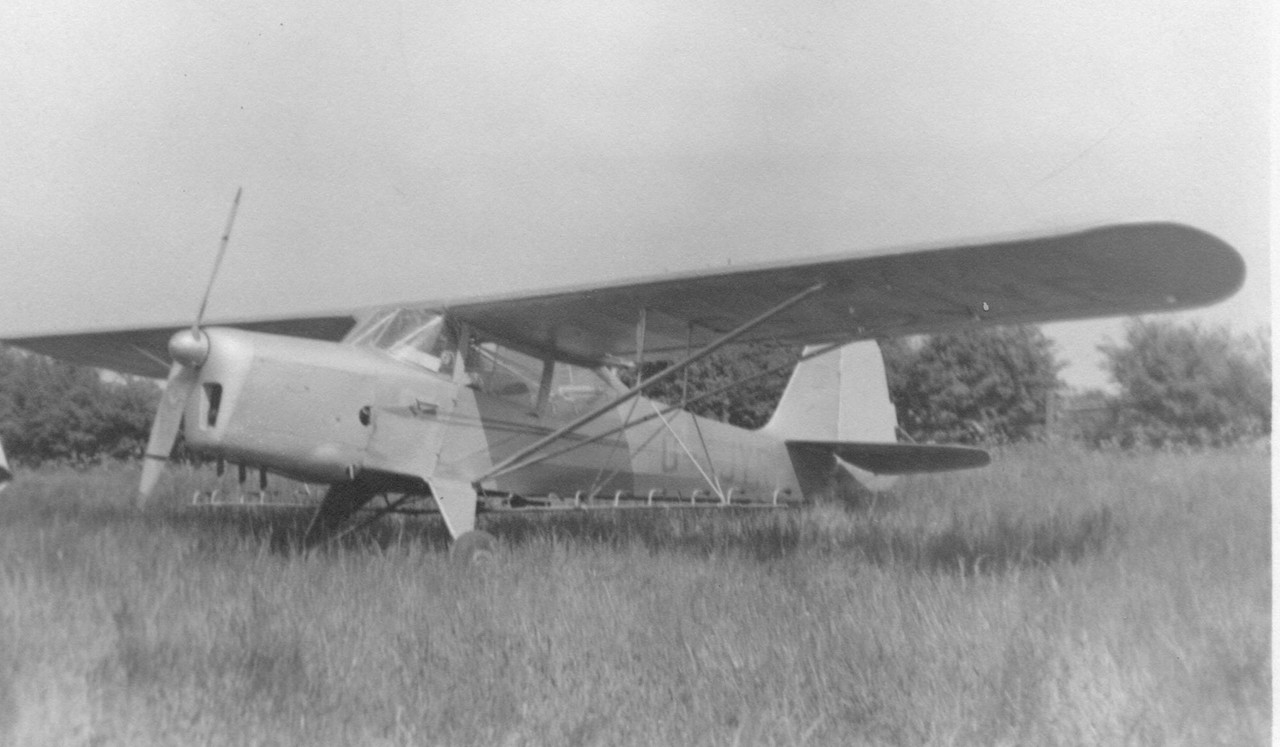
The J-4 Archer emerged from Auster Aircraft Ltd's systematic development of civilian trainers following World War II. Building directly upon the J-2 Arrow introduced earlier in 1946, the Archer represented a targeted upgrade for flight training operations. The most significant modification was the installation of the 90-horsepower Cirrus Minor inline engine, replacing the less powerful 75-horsepower Continental C75-12 found in the J-2. This engine change necessitated a lengthened nose section, giving the aircraft what contemporary observers described as a more purposeful appearance suited to its training mission.
The aircraft maintained Auster's proven high-wing configuration, inherited from the company's successful wartime Air Observation Post designs like the AOP.5. However, unlike its military predecessors, the J-4 was optimized purely for civilian flight instruction, with a two-seat tandem arrangement ideal for student-instructor operations.
Limited Production Run
Auster Aircraft Ltd manufactured exactly 26 J-4 Archers between 1946 and 1947, making it one of the rarer variants in the company's post-war J-series lineup. This limited production reflected the aircraft's specialized training role and competition from larger, more versatile three- and four-seat Auster models that offered greater operational flexibility. Several early examples, including G-AIZP, G-AJYX, and G-AIZT, were initially registered to Auster Aircraft Ltd itself, likely serving as demonstration and development aircraft.
The Manufacturer's Journey
Auster Aircraft Ltd emerged in 1945 when the Taylorcraft license expired, allowing the company to independently develop aircraft based on their wartime experience. The company operated successfully until 1960, when Pressed Steel Co. acquired both Auster and Miles Aircraft, combining them into British Executive and General Aviation, known as BEAGLE. This consolidation lasted until 1966, when BEAGLE itself was bought out. The Auster design rights eventually transferred to Hampshire and Sussex Aviation in 1968, marking the end of the original company's existence.
Engine and Technical Specifications
The heart of the J-4 Archer was the Blackburn Cirrus Minor, a refined inline piston engine that delivered 90 horsepower. Manufactured by Cirrus Aero Engine Co., later associated with Blackburn, this powerplant represented a significant improvement over earlier Continental engines used in Auster trainers. The Cirrus Minor provided reliable performance specifically suited to training operations, though it remained modest compared to the 130-horsepower Gypsy Major engines powering larger Auster variants.
The inline configuration contributed to the aircraft's distinctive extended nose profile, differentiating it visually from radial-engine contemporaries. This engine choice reflected Auster's commitment to providing adequate power for training missions while maintaining the economic operation essential for flying schools.
Operational Service
The J-4 Archer found its primary home with flying schools and aviation clubs across the British Commonwealth. Loxhams Flying Services operated the type from Blackpool Squires Gate between January 1947 and April 1953, demonstrating its utility in commercial flight training. In Australia, both Kingsford Smith Aviation Flying School and Kingsford Smith Flying School incorporated J-4 Archers into their training fleets, with aircraft registered as VH-AAL, VH-AET, VH-FRD, and VH-CDQ.
British flying organizations including the Middlesex Flying Group, Shakespeare Flying Group, and Aberdeen Auster Flying Group operated the type domestically. International operators extended to New Zealand, where ZK-AXC served local aviation needs, and Portugal, which registered CR-LDJ. Private owners also acquired examples, including B.G. Sellars and Miss Kidner Elsie Irene Iffley, reflecting the aircraft's appeal beyond institutional training roles.
Legacy and Survival
The J-4 Archer's small production run and intensive training use resulted in a high attrition rate, with aviation safety records documenting at least 19 accidents between 1949 and 2004, most resulting in complete write-offs. Despite these losses, at least one example persisted into the 21st century: G-AIJT, a J-4-100 variant operated by Aberdeen Auster Flying Group, survived multiple incidents in 1998, 1999, and 2004 while remaining operational.
The Archer represented a brief but significant chapter in British post-war aviation training, bridging the gap between wartime observation aircraft and civilian flight instruction needs. While overshadowed by more popular Auster models like the J-5 series, the J-4 demonstrated the company's ability to adapt proven designs for specific market requirements, even when those markets proved limited in scope.