
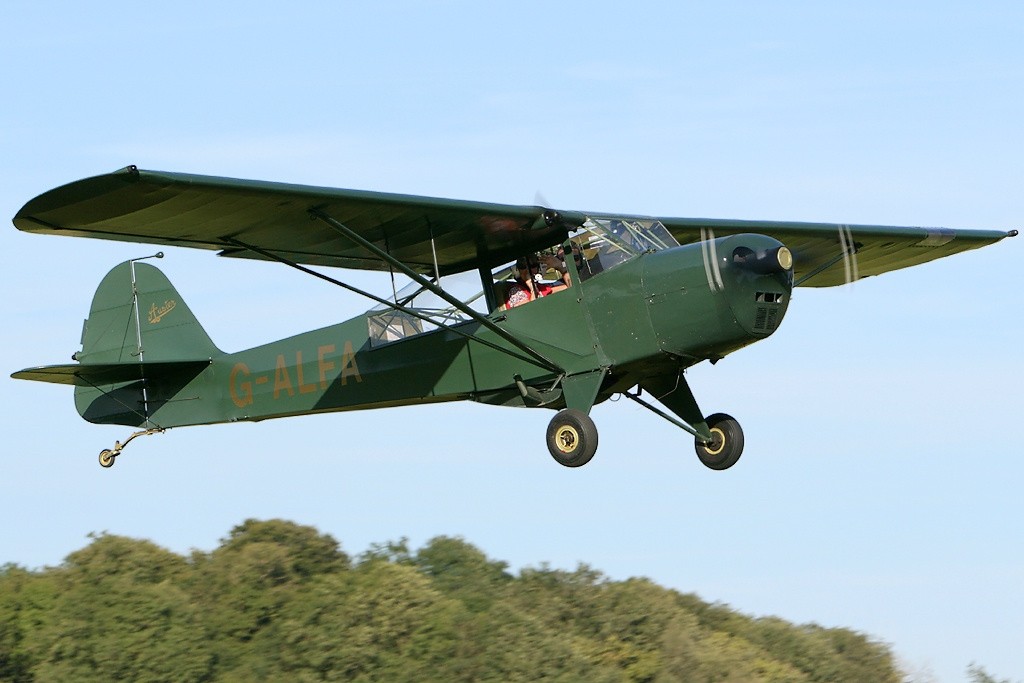
Wartime Dominance
The Auster 5 became the backbone of British air observation operations during World War II, equipping twelve RAF Air Observation Post squadrons along with Polish forces, the Royal Canadian Air Force, Royal Australian Air Force, and Royal Navy units. The aircraft first proved its worth when elements of 651 Squadron landed in Algiers on November 12, 1942, with eight aircraft and eleven Royal Artillery pilots, marking the beginning of extensive combat operations across multiple theaters.
The concept originated from pre-war trials conducted by D Flight, formed on February 1, 1940, at Old Sarum under Major Charles Bazeley of the Royal Artillery. These early experiments with the Taylorcraft Model D demonstrated the viability of light aircraft for artillery spotting, leading directly to the Auster series development and the eventual Mk V production variant.
Design Innovation and Engineering
The Auster 5's design philosophy centered on maximizing short-field performance while providing stable observation platforms for military crews. Chief among its innovations were split trailing-edge flaps that enabled the remarkably low stall speed of 24 knots, essential for operating from improvised forward airstrips near combat zones. The aircraft featured a slightly enlarged three-seat cabin compared to earlier marks, blind flying instruments for adverse weather operations, and a conventional trimmer system replacing the mass-balanced designs of previous variants.
The wing-mounted engine configuration enhanced takeoff performance while the robust landing gear, complete with brakes and precise stick controls, made the aircraft ideal for the demanding requirements of air observation post duties. Unlike its predecessors powered by the modest 55-horsepower Lycoming O-145-A2 or 90-100 horsepower Blackburn Cirrus Minor engines, the Mk V's 130-horsepower Lycoming O-290-3 provided substantially improved performance and reliability.
Manufacturing Excellence
Taylorcraft Aeroplanes (England) Ltd established an impressive manufacturing network across Leicestershire to meet wartime demands. The company, originally registered on November 21, 1938, had evolved from modest beginnings in rented premises at Britannia Works, Thurmaston, to operating over ten facilities by war's end. Production plants at Thurmaston, Syston, Mountsorrel, and Leicester collectively delivered approximately 800 Auster 5 aircraft during the intensive fourteen-month production run.
The parent company's transformation reflected the aircraft's success. After the war, Taylorcraft Aeroplanes (England) Ltd dropped its American licensing arrangement and renamed itself Auster Aircraft Ltd, developing civilian derivatives like the popular J/1 Autocrat based on the military Mk V's proven design.
Design Heritage
The Auster lineage traced back to C. Gilbert Taylor, a Nottingham-born aviation pioneer who emigrated to America, created the Taylorcraft series and contributed to the famous E-2 Cub design before returning to Britain. His collaboration with Taylor-Young Aeroplane Company eventually led to the UK licensing arrangement that produced the Auster series. The prototype Plus C, registered G-AFNW, completed construction on April 24, 1939, and made its maiden flight on May 3, 1939, from Sir Lindsay Everard's airfield at Ratcliffe on the Wreake.
Post-War Civilian Service
Following victory in Europe, surplus military Auster 5 aircraft found new life in civilian roles, converted for private flying, aerial photography, cable laying, and sporting aviation. The type proved particularly successful in air racing, exemplified by G-ALKI, an Auster Mk 5C that captured third place in the 1950 King's Cup Race at 213 kilometers per hour under the skilled hands of Group Captain Alan H. Wheeler.
Many examples found their way to Commonwealth nations, including ZK-BMD (ex-RAF NJ635) which reached New Zealand in 1955, and VH-AZV which served in Australia from 1952 until withdrawal in 1972. The Royal Navy operated several Mk 5s, including three aircraft stationed at Sembawang, Singapore, beginning October 30, 1946.
Enduring Legacy
The Auster 5's influence extended far beyond its wartime service, establishing design principles that influenced subsequent British light aircraft development. Several examples remain airworthy today, including OK-BTA, which entertained crowds at the 2024 14th Historical Airshow in the Czech Republic, and the "Spirit of Singapore" (ex-G-APIC/VR-SED) preserved at Bankstown, New South Wales.
The aircraft's operational versatility, demonstrated through successful adaptations including float and ski installations, proved the soundness of its basic design. As part of the broader Auster family that ultimately produced more than 1,600 aircraft, the Mk V represented the pinnacle of World War II air observation technology while laying groundwork for post-war general aviation development in Britain and the Commonwealth.