
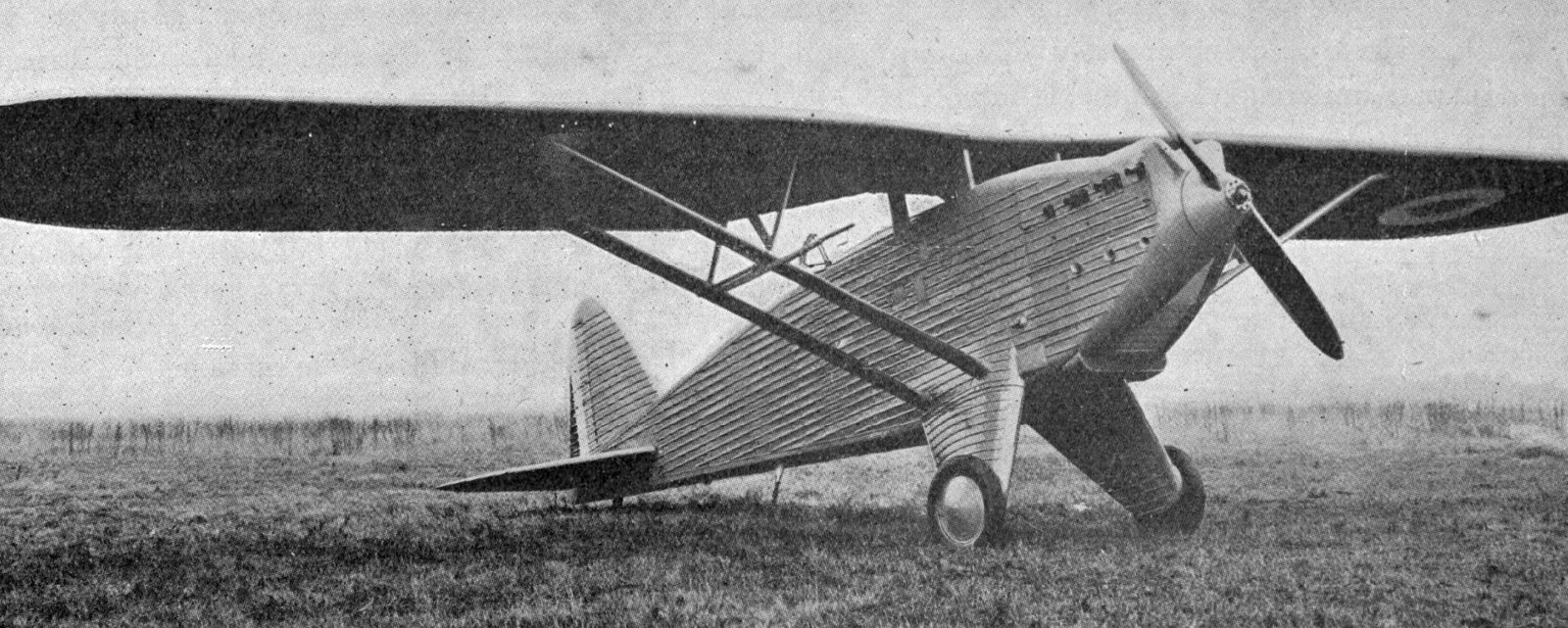
The Aviméta 88 was a French experimental aircraft developed as a two-seat reconnaissance-fighter or heavy fighter. Designed by George Lapère (also cited as Georges Lepére), the aircraft was a significant early attempt by France to produce a combat aircraft utilizing an all-metal construction. The aircraft featured a parasol-wing configuration and fixed landing gear.
The aircraft was manufactured by Aviméta, known as the Société pour la Construction d'Avions Métallique. Corporate records indicate a transition period around December 1926; aircraft produced between 1922 and 1926 were filed under the name Schneider, while subsequent models were produced under the Aviméta brand. Jean Schneider served as the administrator for the rebranded company.
Only one prototype of the Aviméta 88 was ever built. It began flight trials in 1927, powered by a single water-cooled V-12 Hispano-Suiza 12Hb piston engine capable of producing 444 kW (595 hp). Despite its aerodynamic design, the aircraft suffered from excessive weight, which hindered its performance and contributed to the project's eventual failure. The prototype's dimensions included a wingspan of 17.00 meters, a length of 9.76 meters, and a height of 3.55 meters, with a total wing area of 40 m².
In terms of performance, the Aviméta 88 reached a maximum speed of 240 km/h at sea level and 220 km/h at an altitude of 5,000 meters. It possessed a service ceiling of 7,500 meters and could climb to 5,000 meters in 16 minutes. The aircraft had an empty weight of 1,550 kg and a gross weight of 2,400 kg. Its fuel system featured a jettisonable, crashproof tank with a capacity of 420 liters (310 kg).
Designed for combat, the aircraft was equipped with a variety of armament: two fixed 7.7 mm Vickers machine guns synchronized to fire through the propeller disc, two additional wing-mounted guns, and two Lewis guns on a flexible rear mount. However, the Aviméta 88 never entered operational service. Development was abandoned after trials when the official military requirement for a two-seat fighter-reconnaissance aircraft was rescinded. No airframes are known to have survived.