
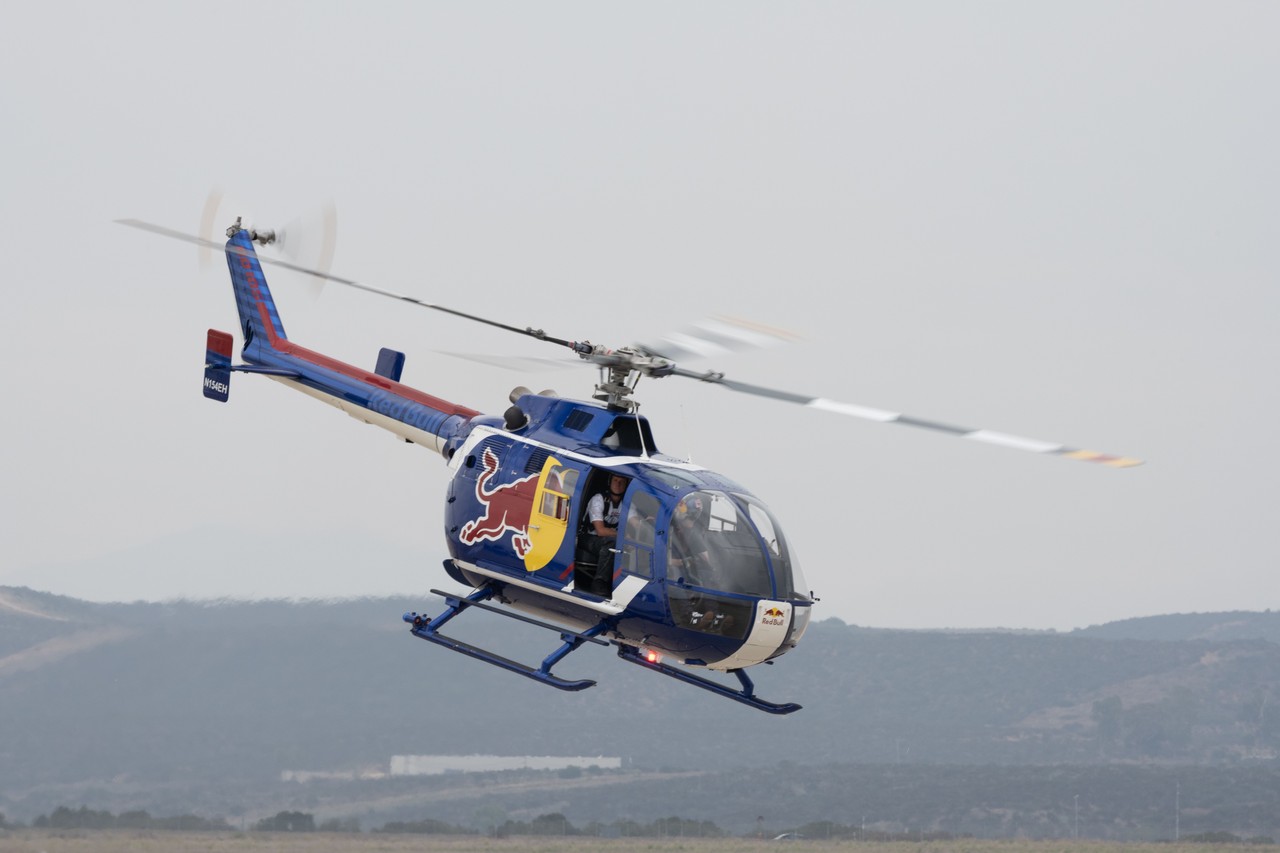
Revolutionary Design and Development
Development of the Bo 105 began in 1964 at Bölkow of Ottobrunn, West Germany, though work on its revolutionary hingeless rotor system had commenced earlier. The program faced early setbacks when the first prototype was destroyed on the ground due to resonance problems before achieving flight. Success came with the second Bo 105A prototype, which conducted its maiden flight on February 16, 1967, at Ottobrunn, followed by its first public demonstration in May 1967.
The aircraft's most significant innovation was its rigid rotor design, which eliminated the traditional hinges found in conventional helicopter rotors. This breakthrough allowed the Bo 105 to become the first rotorcraft capable of performing aerobatic maneuvers such as inverted loops, a capability that was revolutionary when the type entered service in 1970 following certification on October 13, 1970.
Military Dominance and Tactical Applications
The Bo 105's exceptional nap-of-the-earth flight capability made it invaluable for military operations, allowing pilots to fly below treetop level for reconnaissance and observation missions. The German Army became the type's largest military operator, authorizing production of 439 Bo 105s for service. The Bo 105C variant, developed in 1972, was selected by the German Ministry of Defence for its light observation helicopter program, with an initial purchase of 100 aircraft.
Military variants served diverse roles across multiple nations. The Swedish Air Force operated an unarmed search and rescue version designated HR 9B, while Indonesian National Armed Forces Bo 105s saw action during the 1999 East Timorese crisis and the Papua conflict. The aircraft's rigid rotor system provided exceptional maneuverability and stability in combat environments, making it particularly effective for low-level tactical missions.
Manufacturing Evolution and Corporate History
The Bo 105's manufacturer underwent significant corporate transformations during the aircraft's development and production life. Bölkow-Entwicklungen KG merged with Messerschmitt AG in June 1968, forming Messerschmitt-Bölkow. This entity merged with Blohm & Voss in 1969 to create Messerschmitt-Bölkow-Blohm KG (MBB). MBB was subsequently acquired by DASA in 1989, and in 1992, MBB's helicopter division merged with France's Aérospatiale to form Eurocopter, which later became Airbus Helicopters.
Production was distributed globally, with the main facility at Donauwörth, Germany, manufacturing all Bo 105s for the world market except for specific regional variants. Licensed production occurred in Canada at Fort Erie, Ontario, while CASA assembled Spanish variants, IPTN manufactured Indonesian versions, and production also took place in the Philippines.
Engine Technology and Performance
The Bo 105's twin Allison 250 turboshaft engines provided exceptional reliability and performance. The main production Bo 105CB variant, introduced in 1975, featured two 313 kW (420 shaft horsepower) Allison 250-C20B engines. Later variants incorporated uprated powerplants, with the Bo 105CBS and Bo 105LS models using Allison 250-C28C turboshafts producing 373 kW maximum take-off power each.
The Bo 105LS variant, developed in 1984, combined the enlarged fuselage of the Bo 105CBS—stretched by 25 centimeters with an additional window—with the uprated engines to improve maximum take-off weight and hot-and-high flight performance. This configuration enhanced the aircraft's operational capability in challenging environmental conditions.
Commercial Success and Global Operations
Boeing-Vertol partnered in the Bo 105's production and development while marketing the type in the United States, contributing to its commercial success. The civil version became a major export achievement, with specialized applications including emergency services operations. Police/Medical Aviation Services Ltd operated five specially-equipped Bo 105s in emergency services roles, demonstrating the type's versatility beyond military applications.
By the time production concluded in 2001, Bo 105 aircraft worldwide had accumulated 3,400,000 flight hours, testament to the type's operational reliability and longevity. The aircraft served operators across 55 nations, establishing itself as one of the most successful light twin-engine helicopters ever produced.
Legacy and Technological Influence
The Bo 105 was formally replaced in Eurocopter's product range by the EC135, which was itself a direct development from the Bo 105, ensuring continuity of the original design's innovations. The hingeless rotor technology pioneered by the Bo 105 became standard in modern helicopter design, influencing subsequent rotorcraft development worldwide.
With 1,406 aircraft manufactured at the primary facility plus approximately 234 additional units through licensed production, the Bo 105's total production of roughly 1,640 aircraft represented one of the most successful European helicopter programs. Its combination of twin-engine safety, aerobatic capability, and tactical versatility established design principles that continue to influence contemporary rotorcraft development.