
Wartime Dominance
The B-25 Mitchell earned its legendary status through versatility and reliability across every theater of World War II. Operating from Alaska's frozen airstrips to the scorching deserts of North Africa, from European bases to Pacific atolls, the Mitchell proved adaptable to any mission requirement. The aircraft served not only with the U.S. Army Air Forces but also the U.S. Navy and Marine Corps as the PBJ-1, the Royal Air Force, and the Soviet Union among other Allied nations.
No mission elevated the B-25's reputation more than the audacious Doolittle Raid of April 18, 1942. Lieutenant Colonel James H. Doolittle led sixteen specially modified B-25Bs launched from the aircraft carrier USS Hornet to strike the Japanese mainland—the first American retaliation following Pearl Harbor. The unprecedented carrier launch of medium bombers required extensive training at Eglin Field, Florida, under Navy Lieutenant Henry Miller's guidance, proving the Mitchell's exceptional handling characteristics even in impossible circumstances.
Marine Corps Innovation
The U.S. Marine Corps pioneered devastating new tactics with their PBJ-1 Mitchells, beginning with VMB-413's commissioning on March 1, 1943, at Marine Corps Air Station Cherry Point. This squadron, first of sixteen Marine B-25 units, developed techniques for low-level attacks using bombs, torpedoes, and rockets against heavily defended Japanese positions throughout the Pacific. The Marines' aggressive employment of the Mitchell in close support roles demonstrated the aircraft's structural integrity under extreme combat conditions.
Manufacturing Excellence
North American Aviation achieved unprecedented production efficiency with the B-25, operating simultaneous assembly lines at their Inglewood, California headquarters and the Fairfax Airport plant in Kansas City, Kansas. The Kansas facility alone produced 6,608 aircraft between December 1941 and war's end, including 2,290 B-25D-NC models starting January 3, 1942, and 4,390 B-25J-NC variants. This massive output contributed to NAA's distinction as the highest-volume aircraft manufacturer of World War II, simultaneously producing the AT-6 Texan trainer and P-51 Mustang fighter.
North American Aviation, founded in 1929, maintained its independence until Rockwell International's acquisition in 1967. The company's engineering legacy continued through subsequent mergers, eventually becoming part of Collins Aerospace under RTX Corporation in 2020.
Engineering Innovation
The Mitchell's design emerged from U.S. Army Air Corps Proposal No. 39-640, issued March 11, 1939, demanding a medium bomber capable of carrying 3,000 pounds of bombs across 2,000 miles at speeds exceeding 300 mph. North American's engineering team, led by test pilot Vance Breese and engineer Roy Ferren during the August 19, 1940 first flight, created an aircraft that exceeded these specifications.
Unique design features included the distinctive gull-wing configuration, adopted after February 25, 1941 testing resolved roll-yaw stability issues using NACA 23017 airfoils at the wing roots transitioning to NACA 4409-R sections at the tips. Engineers tested five different vertical tail configurations before achieving optimal stability characteristics.
Powerplant Performance
Twin Wright R-2600 Cyclone radial engines provided the Mitchell's impressive performance envelope. These air-cooled, fourteen-cylinder, twin-row powerplants delivered reliable operation across diverse climatic conditions, from Arctic cold to tropical humidity. The R-2600's robust construction enabled the Mitchell to maintain formation speeds exceeding 300 mph while carrying maximum bomb loads, crucial for survival in defended airspace.
Variant Evolution
Production variants reflected evolving combat requirements throughout the war. The B-25C and D models established the type's reputation for reliability, while the B-25G introduced heavy anti-shipping armament with a 75mm cannon. The B-25H featured enhanced forward firepower with eight .50-caliber machine guns and simplified single-pilot operation, while 1,000 examples were manufactured including 248 PBJ-1H variants for the Marines. The final B-25J became the most numerous variant, optimized for both bombing and ground attack missions.
Enduring Legacy
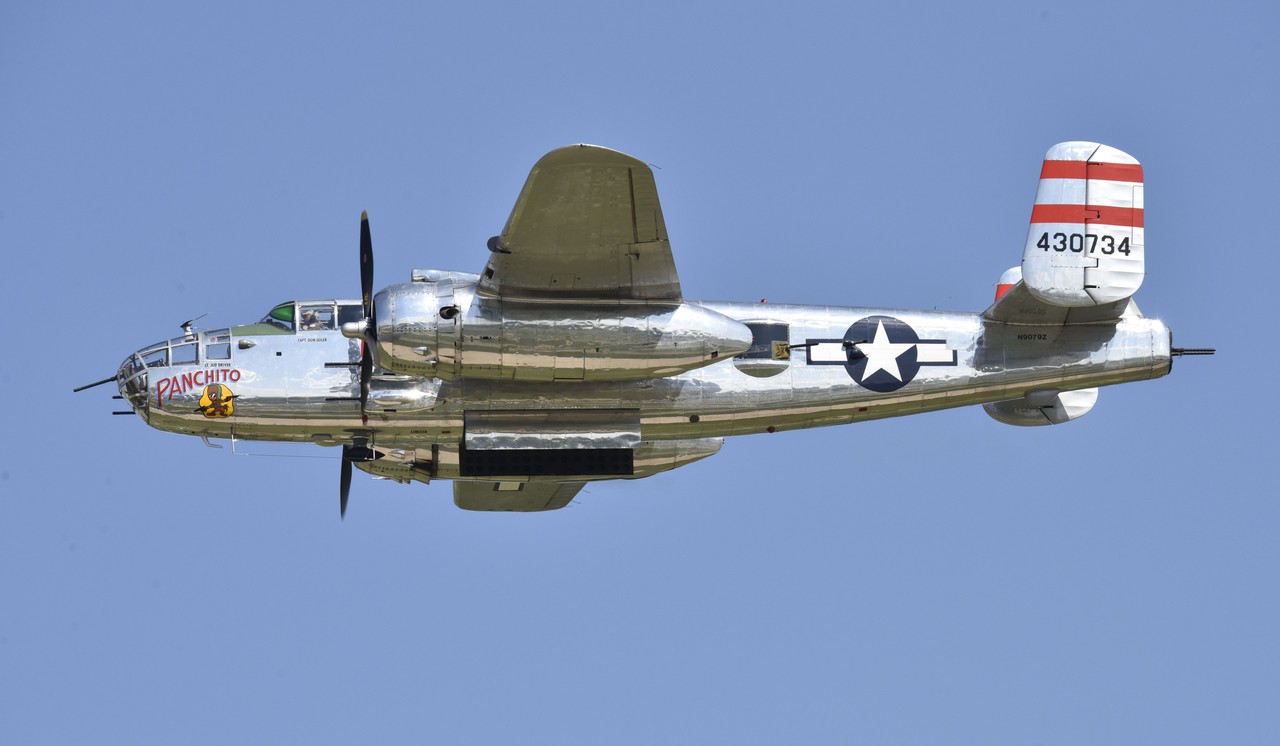
Approximately fifty to sixty B-25s remain airworthy today, maintained by museums and private collectors worldwide. Notable survivors include "Miss Hap," the oldest surviving example built in 1940-41 at Inglewood and now displayed at the American Airpower Museum, and "Panchito," a B-25J preserved at the Delaware Aviation Museum. The Commemorative Air Force's "Show Me" continues flying demonstrations, keeping alive the memory of the 9,815 Mitchells that helped secure Allied victory.
Named for General William "Billy" Mitchell, the controversial advocate of strategic air power, the B-25 Mitchell validated his vision of aviation's decisive role in modern warfare through its remarkable service record across four years of global conflict.