
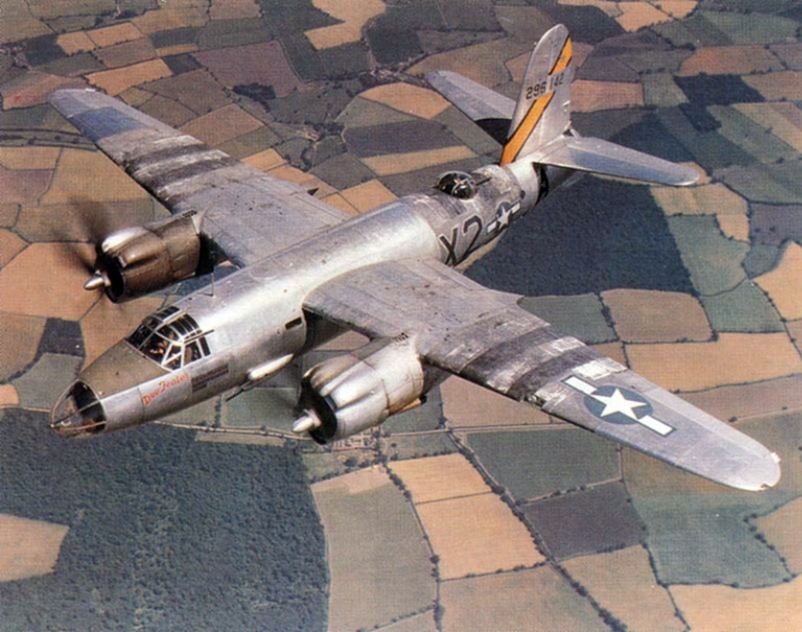
Early Development and Design Challenges
The B-26 Marauder emerged from an ambitious 1939 Army Air Corps requirement for a high-performance medium bomber. Martin's design was so promising that the military ordered it directly off the drawing board without building a prototype, an unusual practice that reflected confidence in the company's engineering capabilities. However, this rapid development path would later contribute to significant operational challenges.
The aircraft's initial design featured exceptionally high wing loading, which dramatically increased takeoff and landing speeds compared to contemporary bombers. This characteristic, combined with engine and propeller malfunctions, earned the B-26 ominous nicknames such as "Widow Maker" and "One-a-Day-in-Tampa-Bay" during training operations. The situation worsened when Army Air Corps personnel removed ballast from aircraft without replacement, shifting the center of gravity forward and creating dangerous handling characteristics that caused numerous training accidents.
Production and Variants
Glenn L. Martin Company manufactured approximately 5,200 B-26 Marauders between February 1941 and March 30, 1945, at facilities in Baltimore, Maryland, and Omaha, Nebraska. Production included 201 original B-26s, 139 B-26As, 1,883 B-26Bs, 1,210 B-26Cs, 300 B-26Fs, 893 B-26Gs, and 57 TB-26G trainers.
The most significant design improvement came with the B-26B variant, which featured a six-foot wingspan increase and enlarged tail surfaces to address the aircraft's challenging handling characteristics. Engineers also modified the wing's angle of attack by 3.5 degrees to improve takeoff and landing performance. These changes, along with the installation of additional defensive armament that helped correct the center of gravity issues, transformed the Marauder from a dangerous trainer into a reliable combat aircraft.
Combat Service and Effectiveness
The B-26 began combat operations in the Southwest Pacific during spring 1942, though most aircraft were eventually deployed to European and Mediterranean theaters. By war's end, Marauder crews had flown more than 110,000 sorties and dropped 150,000 tons of bombs on enemy targets, primarily conducting tactical bombing missions against airfields, transportation networks, and military installations.
Despite higher production costs and accident rates compared to the North American B-25 Mitchell, the B-26 proved superior in operational effectiveness once crews mastered its demanding flight characteristics. The aircraft required higher training standards than its contemporaries but offered exceptional survivability and performance that no other medium bomber could match.
Record-Setting Aircraft
Two B-26s achieved remarkable combat records that demonstrated the type's ultimate reliability. "Mild and Bitter," a B-26B-25 with serial number 41-31819 from the 450th Squadron, 322nd Bomb Group, became the first Allied bomber in the European Theater to complete 100 operational missions on May 9, 1944. During a raid on a German airfield at Evreux/Fauville, this aircraft accomplished the milestone on its original engines after accumulating 449 hours of flight time, including 310 combat hours, without a single mechanical abort or crew casualty.
Even more impressive was "Flak Bait" (B-26B-25-MA, serial number 41-31773), which flew 202 combat missions over 21 months—more than any other American aircraft during World War II. Completed at Baltimore in April 1943, "Flak Bait" reached 100 missions by June 1, 1944, and completed its 200th mission on April 17, 1945, leading the entire 322nd Bomb Group to Magdeburg. The aircraft earned its name after consistently returning riddled with flak holes while other bombers in the formation remained unscathed, accumulating 725 hours of combat time while operating from four different airfields.
International Operators
Beyond the United States Army Air Forces, approximately 522 B-26s served with the British Royal Air Force and South African Air Force units, primarily in Mediterranean operations. The Free French Air Force also operated Marauders during the final months of World War II, giving the aircraft a truly international combat presence.
Performance and Legacy
The production Marauder achieved a maximum speed of 285 mph and cruising speed of 190 mph, with a service ceiling of 19,800 feet and range of 1,100 miles in standard configuration. With maximum fuel capacity of 1,462 gallons, the aircraft could extend its range to 2,600 miles while carrying a 3,000-pound bomb load.
Production ceased in 1945 as military requirements shifted, and massive post-war scrapping efforts eliminated nearly all surviving aircraft. Today, only three B-26 Marauders remain in existence. The nose section of "Flak Bait" is displayed at the National Air and Space Museum in Washington, D.C., while a complete B-26G resides at the National Museum of the United States Air Force, painted to represent a 9th Air Force aircraft from the 387th Bomb Group in 1945.