
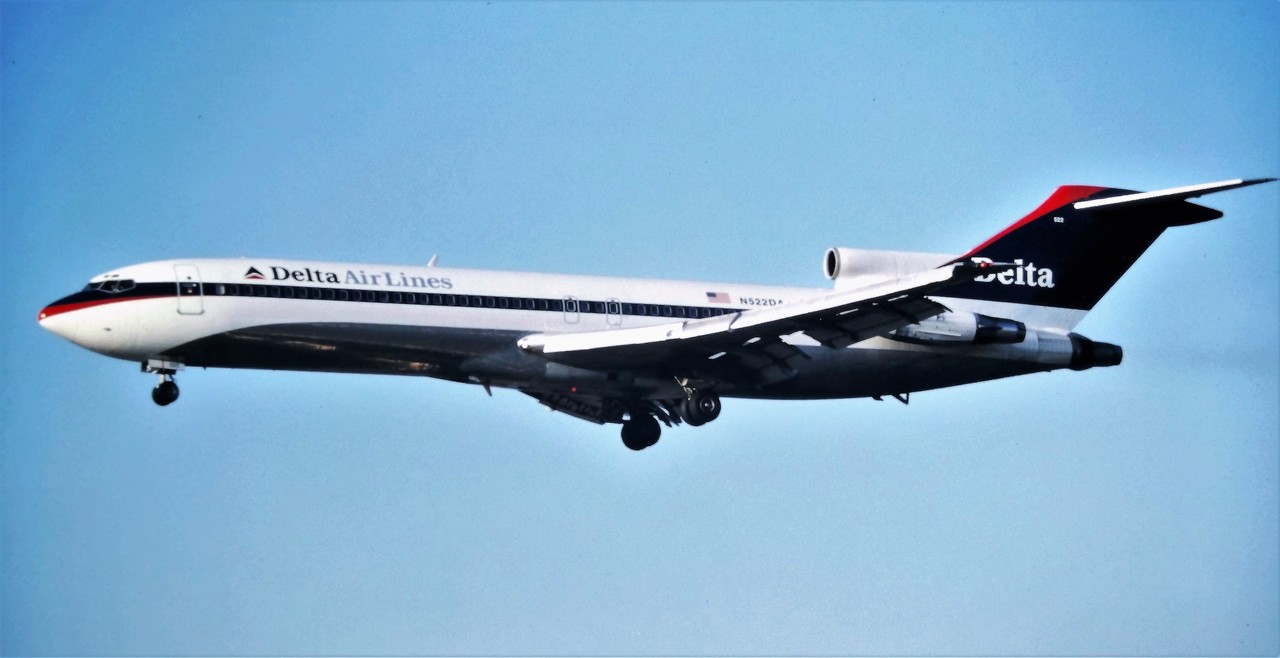
Service History
The 727-100 transformed commercial aviation by demonstrating that jet aircraft could profitably serve regional routes previously dominated by slower propeller aircraft. When Eastern Air Lines operated the first commercial passenger service on February 1, 1964, between Miami, Washington DC, and Philadelphia, it marked the beginning of widespread jet service to secondary markets. By the program's conclusion in 1972, Boeing had delivered 571 aircraft of the 727-00/100 series to more than 100 airlines worldwide, making it an immediate commercial success that opened jet travel to countless smaller cities.
The aircraft's unique ability to operate from shorter runways while maintaining jet speed and efficiency made it indispensable to airlines seeking to expand their route networks. Northwest Airlines, which ordered 11 aircraft in early 1964 and eventually operated 32 by 1972, configured their initial fleet with 93 seats and extra legroom, demonstrating the flexibility that made the type attractive to carriers with varying service philosophies. United Airlines and Eastern Air Lines, the launch customers with 40 orders each announced on December 5, 1960, proved the commercial viability of the trijet concept.
The Manufacturer
Boeing Commercial Airplanes, a division of The Boeing Company founded in 1916, developed the 727-100 as a strategic response to market demands following their successful but larger 707 quadjet introduced in 1958. The company recognized that airlines needed an aircraft capable of economical operation on routes too short for the 707, yet still requiring jet speed and passenger appeal. This market insight proved prescient, as the 727 family would eventually comprise 1,832 aircraft delivered between 1963 and 1984.
Boeing's engineering team created an innovative solution that balanced operational flexibility with economic efficiency. The company's decision to concentrate all three engines at the aircraft's rear, including mounting one engine inlet directly in the vertical stabilizer, represented a bold departure from conventional design philosophy. This configuration became Boeing's signature approach to trijet design, influencing subsequent aircraft development and establishing the company's reputation for innovative solutions to complex operational requirements.
Engine & Technical Details
The three Pratt & Whitney JT8D-1 turbofan engines provided the 727-100 with the power and efficiency necessary for its intended role. Each JT8D-1 represented advanced turbofan technology for the early 1960s, offering improved fuel economy compared to pure turbojet designs while maintaining the reliability essential for commercial operations. The rear-mounted engine configuration not only kept the wing clean for optimal aerodynamics but also positioned the engines higher above ground debris and runway contamination.
The aircraft's distinctive T-tail configuration, with the horizontal stabilizer mounted atop the vertical fin, was necessitated by the rear engine layout but provided additional benefits including improved elevator effectiveness and reduced engine noise in the passenger cabin. This design required only a standard three-member flight crew, making it economical to operate while providing airlines with jet performance previously available only on longer routes served by four-engine aircraft.
Pilot Perspective
Pilots appreciated the 727-100's responsive handling characteristics and its ability to operate from airports that challenged larger jets. The aircraft's high-thrust-to-weight ratio provided excellent climb performance, while its sophisticated flap system allowed for steep approach angles that proved valuable at noise-sensitive airports. With a cruising speed up to Mach 0.79 and operational ceiling exceeding 35,000 feet, it delivered true jet performance while maintaining the flexibility to serve airports with runways as short as 4,500 feet.
The cockpit layout reflected Boeing's attention to pilot workload management, with engine controls positioned for efficient monitoring of the three powerplants during critical phases of flight. Pilots particularly valued the aircraft's predictable stall characteristics and its ability to maintain control authority even during challenging weather conditions, factors that contributed to the type's excellent safety record throughout its operational career.
Production & Legacy
Production of the 727-100 series concluded in October 1972 after 571 deliveries, with Boeing retaining one aircraft for company use to bring total production to 572. The success of the -100 variant led directly to the larger 727-200, launched in 1965, which extended the fuselage to accommodate up to 189 passengers while retaining the proven trijet configuration. The entire 727 family earned the nickname "the DC-3 of the Jet Age" for its fundamental impact on commercial aviation.
The prototype 727-100, registered N7001U and first flown on February 9, 1963, carried approximately three million passengers during its service life before being donated to the Museum of Flight in Seattle in 1991. Following extensive restoration, this historic aircraft made its final flight to the museum on March 2, 2016, where it remains on display as a testament to the revolutionary impact of Boeing's trijet design. The last commercial passenger flight by any 727 occurred in January 2019, marking the end of an era that fundamentally changed how airlines approached route development and service to smaller communities worldwide.