
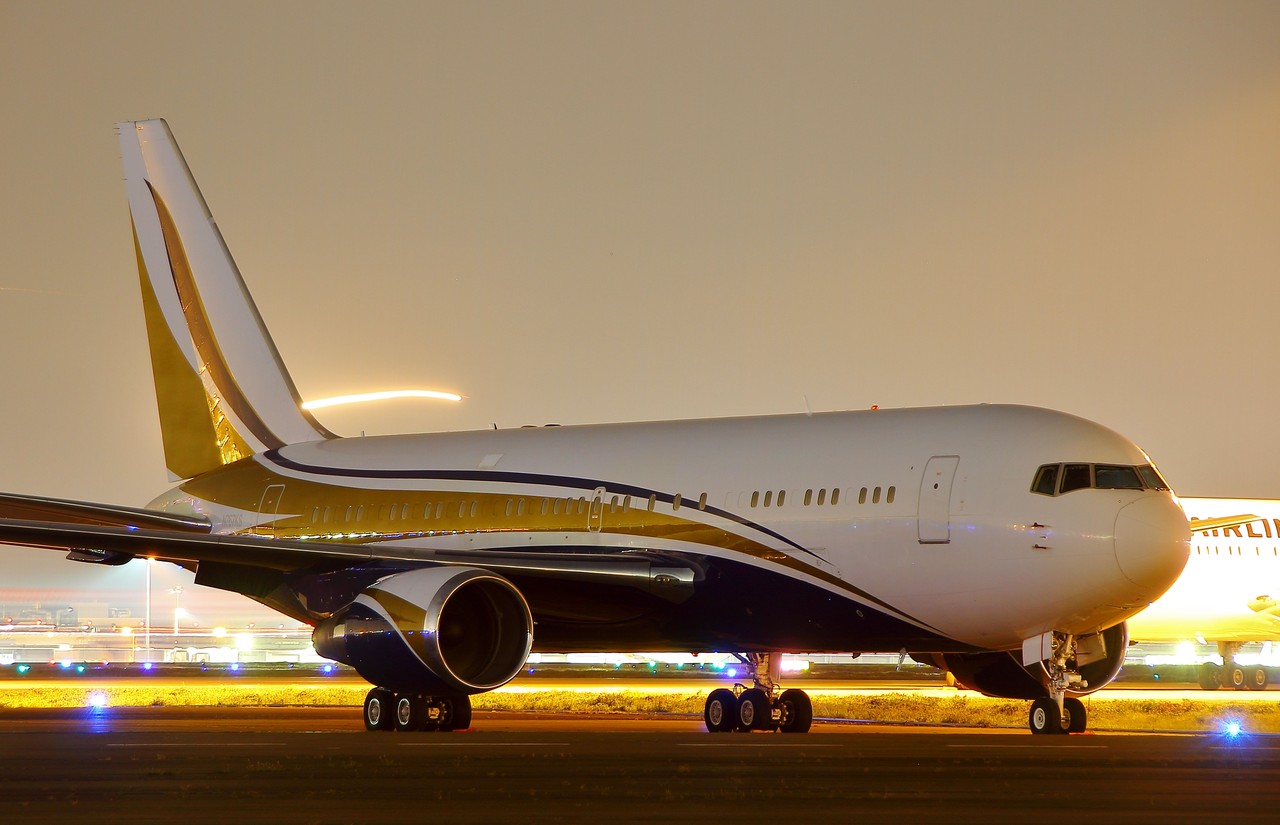
Commercial Aviation Revolution
The 767-200 fundamentally transformed airline economics by demonstrating that twin-engine aircraft could match the capacity and range of four-engine competitors while delivering superior fuel efficiency. United Airlines placed the launch order for 30 aircraft in July 1978, followed by American Airlines and Delta Air Lines with 50 additional orders. By the aircraft's rollout, 173 firm orders had been secured from major carriers worldwide.
United Airlines received the first production aircraft on August 19, 1982, operating the inaugural passenger service on September 8, 1982, between Chicago and Denver using aircraft N606UA. Delta Air Lines followed with the first General Electric CF6-powered variant on October 25, 1982. The aircraft quickly gained acceptance among international carriers including Air Canada, All Nippon Airways, Britannia Airways, and TWA.
Engineering Innovation
Boeing's engineering team launched the 7X7 program on July 14, 1978, designing the 767-200 alongside the narrow-body 757 with shared cockpit technology that allowed pilots to maintain common type ratings across both aircraft. This cockpit standardization reduced airline training costs and improved operational flexibility.
The aircraft introduced Boeing's first wide-body twin-engine layout, featuring advanced wing design optimized for efficient lift generation. More significantly, the 767-200 achieved Extended-range Twin-engine Operational Performance Standards (ETOPS) certification, enabling twin-engine aircraft to operate transatlantic routes previously restricted to three or four-engine aircraft. This certification breakthrough eliminated the need for costly four-engine aircraft on many long-haul routes.
The Boeing Company Legacy
Boeing Commercial Airplanes, founded by William E. Boeing in 1916, had established itself as a commercial aviation pioneer with the 707 in 1958 and the 747 in 1970. The company underwent significant expansion through the 1990s, acquiring Rockwell International's aerospace division in 1996 and merging with McDonnell Douglas in 1997. The 767 program represented Boeing's strategic response to the Airbus A300, marking the company's entry into the twin-engine wide-body market.
Production occurred at Boeing's Everett factory in Washington, which had been extended in January 1978 specifically to accommodate the new wide-body family. The facility's expansion demonstrated Boeing's commitment to the program's long-term success.
Powerplant Options and Performance
The prototype flew with Pratt & Whitney JT9D turbofans, though operators could select from multiple high-bypass turbofan options including General Electric CF6 and Rolls-Royce RB211 engines. Later production aircraft offered Pratt & Whitney PW4000 engines, replacing the earlier JT9D variants. These high-bypass ratio engines delivered improved fuel efficiency compared to previous generation quad-jets while providing sufficient thrust for high-density wide-body operations.
The aircraft achieved a service ceiling of 43,100 feet with a maximum operating speed of Mach 0.86. The basic 767-200 variant provided a range of approximately 3,900 nautical miles, though the extended-range 767-200ER offered significantly greater capability for intercontinental routes.
Production Transition and Cargo Conversion
Boeing produced the baseline 767-200 from 1981 through 1987, when assembly switched entirely to the extended-range 767-200ER variant. The shorter-range model had proven its design concepts, but airlines increasingly demanded the additional range capability offered by the ER version.
The 767-200 found renewed purpose in cargo operations through the 767-200SF (Special Freighter) conversion program launched in 1998 by Boeing and Israel Aerospace Industries. These converted aircraft replaced aging Douglas DC-8 freighters and met growing demand from express cargo carriers. FedEx placed substantial orders between 2011 and 2015, demonstrating the continued value of the 767 platform in freight operations.
Lasting Impact
The 767-200 established the foundation for Boeing's most successful wide-body program after the 747, with over 1,300 total 767 variants delivered by 2024. While passenger variant production ended in 2014, freighter versions continue production at approximately three aircraft per month through 2027, with potential extensions based on military tanker and domestic freight demand.
The Delta Flight Museum maintains a 767-200 from 1982 as part of their permanent aviation exhibit, preserving an example of the aircraft that bridged the gap between four-engine quad-jets and modern twin-engine efficiency. The 767-200's ETOPS pioneering work enabled the economic viability of today's twin-engine long-haul aircraft, fundamentally reshaping international airline route structures and making air travel more accessible through improved economics.