
Development and Design
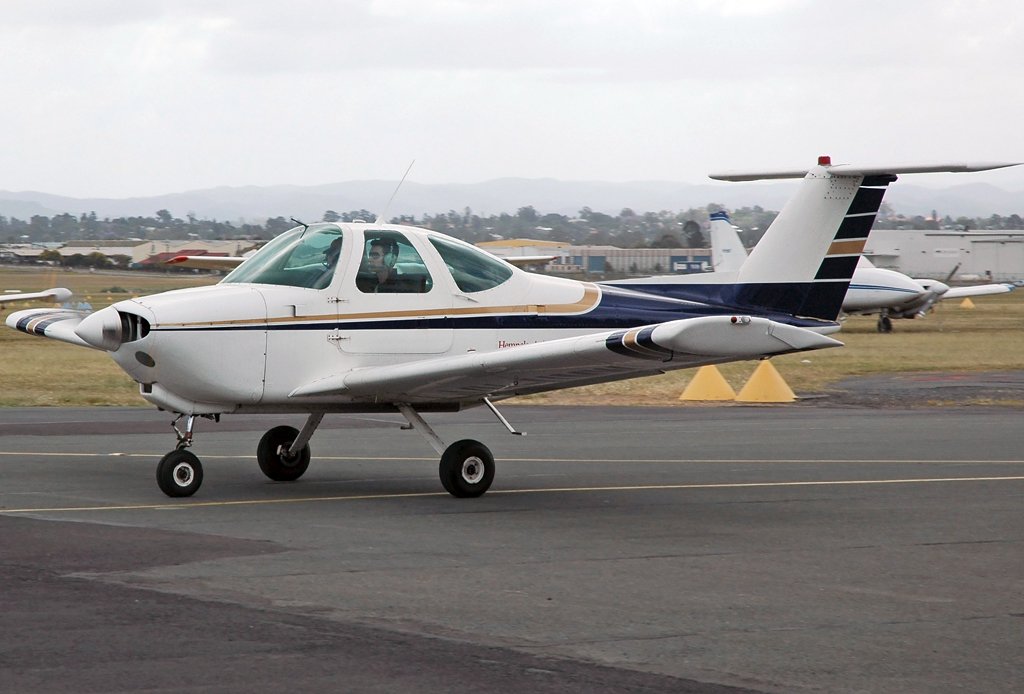
The Skipper emerged from Beechcraft's PD285 design project initiated in 1974, representing the company's ambitious entry into the competitive two-seat trainer market. Chief engineering test pilot Vaughn Gregg took the prototype aloft on February 6, 1975, initially powered by a 100-horsepower Continental O-200 engine and featuring a conventional tail configuration. However, significant modifications followed during the four-year development period, most notably the adoption of a distinctive T-tail design that would become the aircraft's signature feature.
Beechcraft's design objectives centered on creating an economical trainer capable of operating on lower octane fuels while delivering approximately 75-100 kilowatts of power. The company specifically targeted the global flight training market, intending the Skipper to serve as the entry-level aircraft in their training progression that would advance students through the Sundowner, Sierra, and Duchess models. The final design incorporated full 360-degree visibility, dual side doors for convenient access, and certification for intentional spins up to six turns - a crucial capability for comprehensive flight training.
Production and Market Entry
Production commenced at Beechcraft's Liberal, Kansas facility in late 1978, with the first customer deliveries beginning in April 1979 following FAA certification that same month. The company achieved a steady production rate of approximately ten aircraft monthly during peak operations, manufacturing 47 units in 1979, 140 in 1980, and 125 in 1981 before economic pressures forced production termination.
The Skipper entered a market already dominated by Piper's PA-38 Tomahawk, which had launched two years earlier and established significant market penetration. While Piper delivered over 1,000 Tomahawks in their first production year and ultimately completed more than 2,500 examples through 1982, the Skipper's late arrival and brief production run limited its market impact despite comparable performance specifications.
Technical Specifications and Performance
The production Skipper featured a single Avco Lycoming O-235-L2C four-cylinder horizontally-opposed engine generating 115 horsepower at 2,700 rpm - ironically the same powerplant used by its primary competitor, the Tomahawk. This engine selection represented a change from the prototype's Continental O-200, reflecting Beechcraft's commitment to optimizing performance and reliability.
The aircraft's low-wing configuration combined with the elevated T-tail created distinctive handling characteristics that pilots found both challenging and rewarding. The fixed tricycle landing gear simplified ground operations while reducing training costs, making it ideal for flight schools seeking economical primary trainers. The spacious two-place cabin provided comfortable side-by-side seating with excellent visibility through the canopy-style enclosure.
Service History and Global Operations
Beechcraft initially targeted their worldwide network of Beech Aero Centers as primary customers, receiving strong initial orders numbering in the hundreds. These company-operated flight training facilities were intended to provide a controlled market for the new trainer while demonstrating its capabilities to independent flight schools and private owners.
International adoption proved limited, with Australia representing one of the few export markets. Hawker Pacific assembled the first two Australian examples at Bankstown, New South Wales, with aircraft VH-CXN and VH-CXQ entering service at Moorabbin, Victoria in 1980. However, only 16 Skippers appeared on the Australian civil register and two in New Zealand, demonstrating the aircraft's struggle to penetrate established markets where the Tomahawk had gained earlier acceptance.
The Beech Aircraft Legacy
Beech Aircraft Corporation, founded by Walter and Olive Ann Beech in 1932, had established a reputation for premium general aviation aircraft before attempting to enter the competitive trainer market. The company's expertise in crafting sophisticated business aircraft like the Bonanza and King Air series didn't necessarily translate to the cost-sensitive training market, where price often trumped refinement.
The Skipper's brief production run reflected broader challenges facing American general aviation manufacturers in the early 1980s. Product liability concerns, economic recession, and intense competition combined to create an inhospitable environment for new aircraft introductions. Beechcraft's decision to cease Skipper production after just three years demonstrated the harsh realities of a market segment where established competitors held significant advantages.
Current Status and Collectibility
Today, the Skipper represents an increasingly rare sight on airport ramps, with only a small number remaining airworthy. The aircraft's brief production run and single model designation - no variants or special editions were ever produced - means all surviving examples maintain consistent specifications and design features.
Unlike mass-produced trainers that became commonplace fixtures at flight schools worldwide, the Skipper's scarcity has created a unique niche among aviation enthusiasts who appreciate its distinctive T-tail configuration and Beechcraft build quality. The aircraft serves as a reminder of an era when multiple manufacturers competed intensively for the training market, ultimately won by those who arrived first and established sustainable production volumes.