
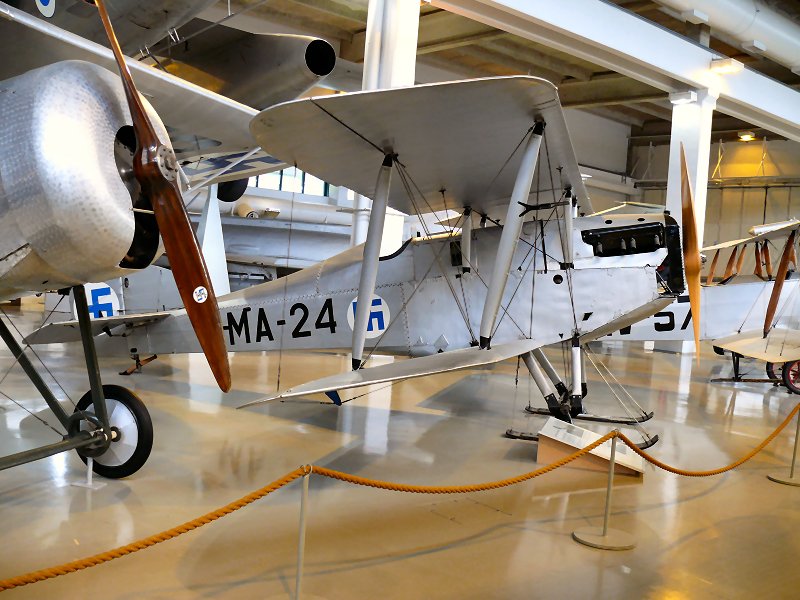
The Martinsyde F.4 Buzzard was a British single-seat biplane fighter developed in 1918. Designed by George Handasyde, the aircraft represented the culmination of a fighter development line that had seen earlier prototypes flying at Brooklands Aerodrome as early as October 1917. The F.4 variant was specifically developed in mid-1918 and underwent testing during the summer of that year, where it was noted for being superior to nearly all of its predecessors in terms of performance.
Technically, the Buzzard was powered by a 300 hp (approximately 220 kW) liquid-cooled Hispano-Suiza 8F eight-cylinder piston engine. This powerplant, combined with a streamlined biplane layout, made the Buzzard one of the fastest aircraft of the First World War era. Performance data indicates a maximum speed of 205 km/h for some examples, while other records cite 140 mph at sea level and 132 mph at an altitude of 15,000 feet. The aircraft's physical dimensions included a length of 7.71 m, a wingspan of 9.98 m, and a height of 2.44 m.
Production took place in Great Britain by Martinsyde Ltd. between 1918 and 1919. Total production numbers vary across sources, with estimates ranging from 330 to 370 aircraft, though some records suggest fewer than 400 were built overall. While the RAF placed a large order following successful trials, the Armistice in November 1918 led to the immediate cancellation of most orders. Consequently, the Buzzard saw very limited operational use with the RAF before the war ended, with conflicting reports suggesting either only seven or up to 57 aircraft were actually utilized.
Following the war, the original manufacturer went bankrupt, and the Aircraft Disposal Company sold surplus variants. The Buzzard found a second life through wide export, serving in the air forces of Spain, Finland, Portugal, Latvia, and the Soviet Union, with individual aircraft reaching Japan, Poland, and Uruguay. In Finland, one aircraft was evaluated in 1923, followed by the purchase of 14 more in 1927. Spain operated 20 units, six of which were still active at the start of the Spanish Civil War. Latvia operated eight Jaguar-powered ADC.1 derivatives, one of which remained in service until 1938. Beyond combat roles, the aircraft served as training and communications planes, including two used as high-speed communications aircraft during the French Peace Conference.
Today, the Martinsyde F.4 Buzzard is extremely rare. The only surviving example of the type, and the sole remaining Martinsyde aircraft in the world, is the MA-24 preserved at the Finnish Air Force Museum.