
Service History
The C-119 Flying Boxcar became the backbone of American tactical airlift operations throughout the 1950s and 1960s, with the United States Air Force operating the majority of the 1,183 aircraft produced. During the Korean War from 1950 to 1953, C-119s performed crucial logistics missions, transporting troops and supplies to forward operating bases while conducting paratroop drops behind enemy lines. The aircraft proved equally valuable during the Vietnam conflict, where standard transport variants supported ground operations alongside the specialized AC-119G "Shadow" gunship configuration, which mounted four 7.62mm miniguns for close air support missions.
International operators included the Royal Canadian Air Force, which utilized C-119s for northern territory operations, and numerous allied nations including Belgium, Italy, and India, which received 141 aircraft through the Mutual Defense Assistance Program. The US Navy and Marine Corps designated their versions R4Q-1 and R4Q-2, operating them primarily for cargo transport and medical evacuation roles.
Design and Development
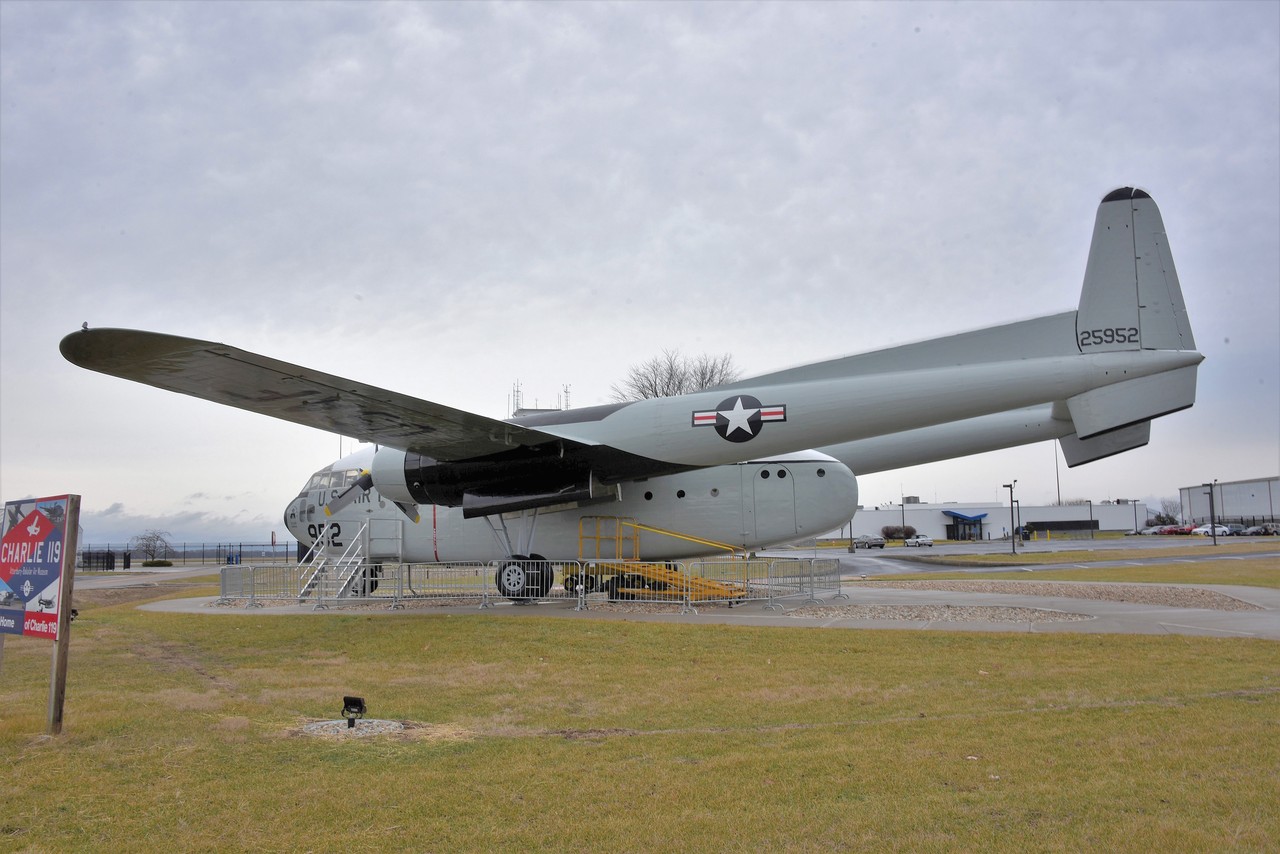
Fairchild's engineering team developed the C-119 as an improved successor to their wartime C-82 Packet, addressing the earlier aircraft's loading limitations and performance shortcomings. The design team retained the twin-boom configuration that provided unobstructed access to the cargo compartment while significantly widening the fuselage cross-section for easier loading of vehicles and equipment. The XC-119A prototype, originally designated XC-82B, completed its maiden flight on November 17, 1947, demonstrating the enhanced capabilities that would make it attractive to postwar military planners.
The aircraft's most distinctive feature was its rear-loading capability through large clamshell doors, allowing vehicles and heavy equipment to be driven directly into the cargo bay. This innovation proved particularly valuable for military operations requiring rapid deployment of mechanized equipment to remote airfields.
The Manufacturer
Fairchild Engine & Airplane Corporation, founded in 1924 by Sherman Fairchild, had established itself as a significant military contractor during World War II with aircraft like the PT-19 trainer and C-82 Packet transport. The company manufactured 1,112 C-119s at its Hagerstown, Maryland facility, while an additional 71 aircraft were assembled by Kaiser-Frazer Corporation at the former B-24 production plant at Willow Run Airport in Belleville, Michigan, during 1952-1953.
Fairchild underwent significant corporate changes during the C-119's production run, eventually being acquired by Republic Aviation in 1960. The company continued through various mergers and acquisitions, ultimately becoming part of Fairchild Industries before its assets were eventually absorbed into what became Northrop Grumman through subsequent corporate transactions.
Engine and Technical Specifications
Two different powerplant configurations equipped C-119 variants throughout production. Early models, including the C-119B and C-119C, utilized twin Pratt & Whitney R-4360-20W or -30 Wasp Major engines, each producing 3,500 horsepower from 28 air-cooled cylinders arranged in four rows of seven. Later production aircraft, particularly the C-119F and C-119G variants, switched to Wright R-3350-85 or -89A Duplex-Cyclone engines generating 3,400 to 3,500 horsepower each from 18 cylinders in two rows of nine.
The aircraft required a five-person crew consisting of pilot, copilot, navigator, radio operator, and crew chief. Despite its substantial power, the C-119 suffered from marginal single-engine performance, with climb rates dropping below 100 feet per minute when operating on one engine, a limitation that concerned pilots operating in mountainous terrain or adverse weather conditions.
Performance and Operational Characteristics
The Flying Boxcar achieved a maximum speed of approximately 250 knots and cruised at lower speeds optimized for cargo operations. With a service ceiling of 30,000 feet and maximum range of 2,000 miles, it provided adequate performance for tactical transport missions while maintaining the ability to operate from relatively short, unprepared airfields.
Pilots appreciated the aircraft's stability and predictable handling characteristics, though many noted its modest climb performance and the significant workload required during single-engine operations. The spacious cargo compartment could accommodate various mission configurations, from 65 combat-equipped paratroopers to 35 medical litter patients, making it exceptionally versatile for military operations.
Production and Legacy
Production concluded in 1955 after exactly 1,183 aircraft had been completed, with variants including 55 C-119B models, 303 C-119C aircraft, 327 C-119F transports, and 484 C-119G variants. The AC-119G gunship conversion extended the aircraft's combat relevance into the early 1970s, when these specialized variants concluded their Vietnam War service.
Today, approximately three C-119s remain airworthy, while around 60 examples survive in museums and static displays worldwide. Notable preserved aircraft include examples at Hill Aerospace Museum in Utah, Pima Air & Space Museum in Arizona, and the Air Mobility Command Museum in Delaware. Several surplus aircraft found second careers as aerial firefighters during the late 1960s and 1970s, modified with retardant tanks and sometimes supplemented with fuselage-mounted jet engines for improved low-altitude performance.