
Production and Manufacturer History
The Douglas C-124 Globemaster II was developed by the Douglas Aircraft Company between 1947 and 1949. The prototype first took flight on November 27, 1949, and the first production aircraft, the C-124A, were delivered to the U.S. Air Force in May 1950. All units were manufactured at the Douglas facility in Long Beach, California. Production continued until May 1955, with a total of 448 aircraft delivered to the USAF. This total is generally composed of 204 C-124A and 243 C-124C models, though some records cite a slight discrepancy in the final count.
Design and Technical Specifications
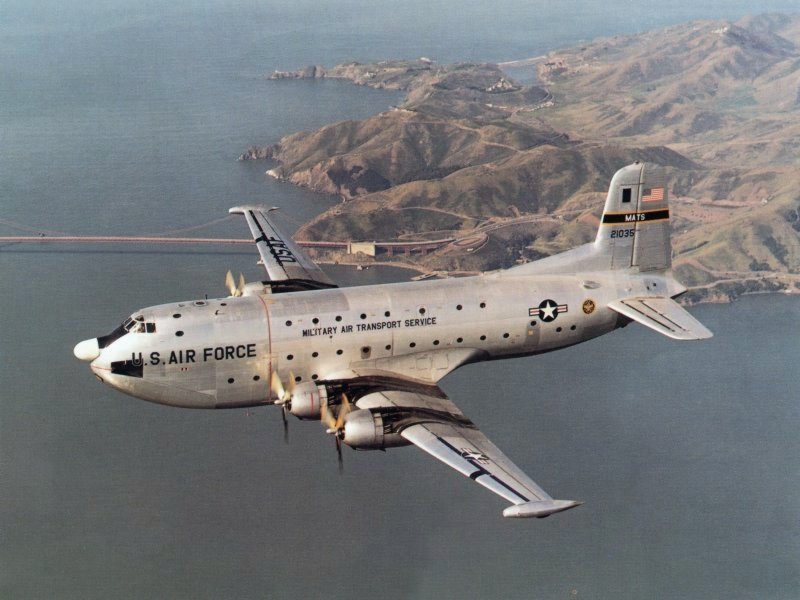
Designed as a major enlargement and redesign of the earlier C-74 Globemaster, the C-124 was engineered specifically to move very large, outsized cargo. Its most distinctive design features included clamshell nose doors and an integral ramp, which allowed ground vehicles to be driven directly into the fuselage. The aircraft featured a double-deck cabin that could be configured to transport 200 fully equipped troops or 127 litter patients and attendants for aeromedical evacuation.
Power was provided by four Pratt & Whitney R-4360-63A Wasp Major engines, which were 28-cylinder, air-cooled radial piston engines. These engines produced approximately 3,800 horsepower each, enabling the aircraft to lift payloads of 74,000 lb over a distance of 4,030 miles, although some sources list a maximum cargo load of 68,500 lb. The aircraft's overall dimensions included a wingspan of approximately 174 ft, a length of 130 ft, and a height of 48 ft, operated by a crew of eight.
Military Service
The C-124 served exclusively with the U.S. Air Force, beginning with the Strategic Air Command (SAC), where the 1st, 2nd, 3rd, and 4th Strategic Support Squadrons used the aircraft for nuclear weapon transport. It later became a primary asset for the Military Air Transport Service (MATS), and subsequently the Military Airlift Command (MAC) after 1966.
Operationally, the C-124 was indispensable during the Korean War as the only aircraft capable of transporting many of the Army's vehicles. It supported the 1961 Berlin Wall Crisis through troop build-ups in Europe and transported Thor intermediate-range ballistic missiles to England between 1959 and 1961. The aircraft also provided heavy airlift during the Vietnam War and supported U.S. polar stations via Operation Deep Freeze in Antarctica. Additionally, it performed humanitarian missions, including refugee evacuations in the Congo and disaster relief in Chile and Morocco. The C-124 was finally retired from USAF service in 1974.
Legacy
As the first strategic long-range airlifter, the C-124 bridged the gap between World War II transports and the jet-age heavy lifters like the C-141 Starlifter and C-5A Galaxy. Today, only a small number of airframes survive as static museum displays, including a C-124A at the Air Mobility Command Museum and C-124C examples at the Hill Aerospace Museum and the Travis Heritage Center.