
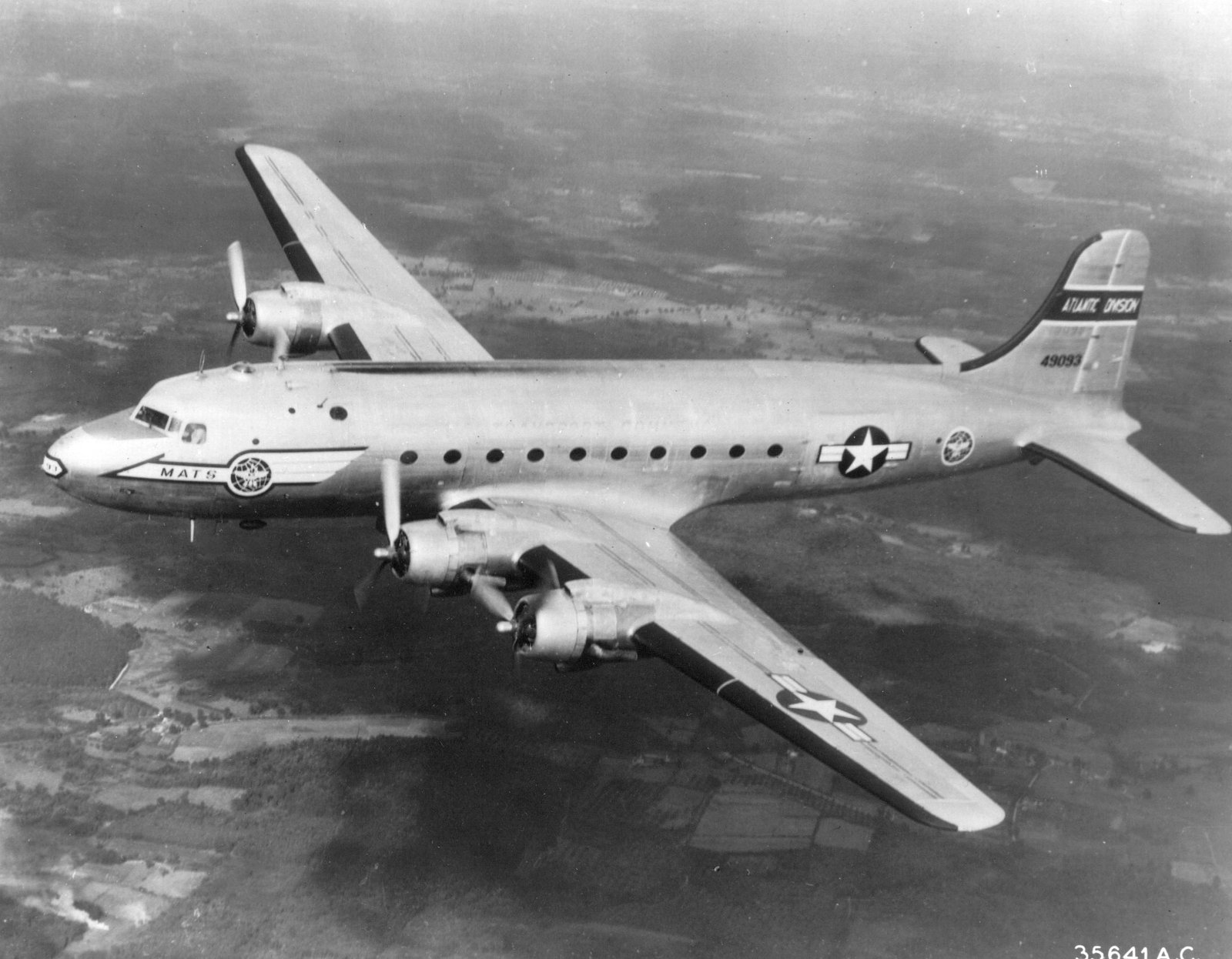
Production and Manufacturer History
The Douglas C-54 Skymaster was produced by the Douglas Aircraft Company (also referred to as the Douglas Aircraft Corporation). While initial production of the DC-4/C-54 line began at the company's plant in Santa Monica, California, manufacturing was moved to a dedicated factory in Chicago, Illinois, to meet the high demands of wartime production. USAAF acceptance of these aircraft occurred between 1942 and 1947. Production totals vary across records, with documented figures including 1,163, 1,164, and 1,242 aircraft delivered during the war years.
Design and Technical Specifications
Derived from the Douglas DC-4 civil airliner—a design created in cooperation with five major U.S. airline companies—the C-54 was the first four-engine transport to enter USAAF service. The DC-4 prototype first flew in June 1938, while the military C-54 variant's first flight is recorded as occurring in early 1942, with specific dates cited as either February or March 26, 1942. The aircraft was designed for high-capacity transport, with the C-54A capable of carrying 50 soldiers or 32,500 lb of cargo, while standard models typically carried 49–50 passengers or 28,000 lb of cargo. It was powered by four Pratt & Whitney R-2000 air-cooled, 14-cylinder, twin-row piston radial engines, each producing approximately 1,200 horsepower. The aircraft typically required a crew of four to six.
Military Service
The U.S. government commandeered DC-4 production on December 5, 1941. During World War II, the C-54 became the workhorse of the U.S. Army Air Transport Command, most notably during the "Hump" airlift operations over the Himalayas into China. In the Pacific, Navy R5D-3 variants served with squadron VRE-1, evacuating nearly 60% of the 16,599 casualties from the Battle of Okinawa.
One of the most significant airframes was the VC-54C "Sacred Cow," the personal transport for President Franklin D. Roosevelt and the first dedicated presidential aircraft. On July 26, 1947, President Harry S. Truman signed the National Security Act of 1947 aboard the Sacred Cow, establishing the U.S. Air Force as an independent service. Later, during the Berlin Airlift (Operation Vittles) from June 1948 to September 1949, the C-54 carried the vast majority of the 2.3 million tons of supplies delivered to West Berlin. To maximize efficiency, 38 aircraft were converted into C-54M "airborne coal-carriers." During the Korean War, C-54s converted for medevac roles returned 66,000 patients to the United States.
Civil Service and Legacy
Following the war, many C-54s were returned to the DC-4 civilian configuration for passenger and freight service. Surplus aircraft also found roles in low-cost transport and aerial firefighting. Several notable examples are preserved today, including a C-54M at the Air Mobility Command Museum, a C-54D at the Pima Air & Space Museum, and a C-54D at the SAC Aerospace Museum.