
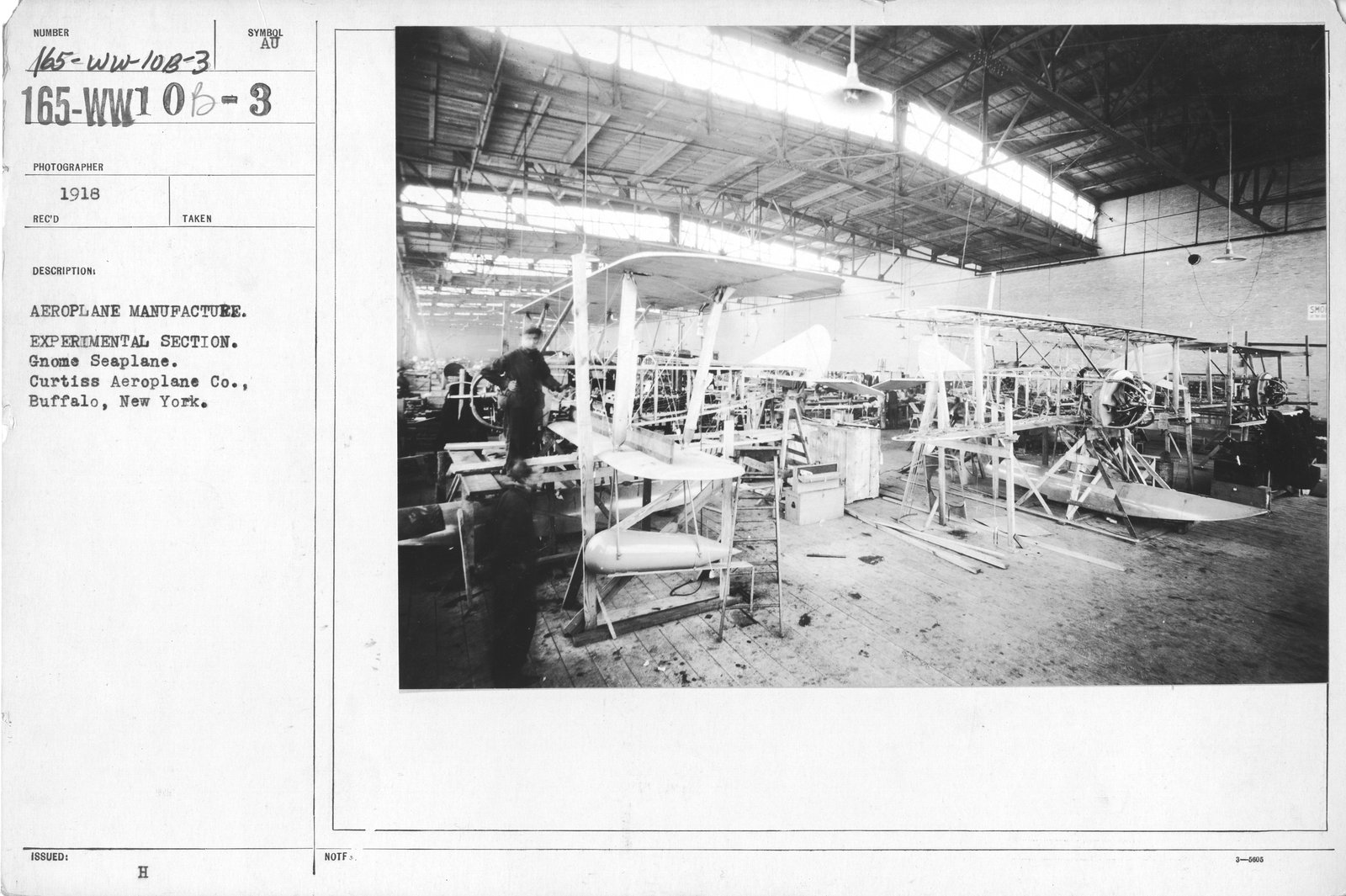
The Curtiss Gnome Scout was a specialized family of small scout floatplanes developed for the United States Navy during the First World War. Produced between 1917 and 1918, the aircraft were manufactured by the Curtiss Aeroplane and Motor Company at their facilities in Buffalo, New York. The company, founded by aviation pioneer Glenn H. Curtiss, would later merge with Wright Aeronautical in 1929 to become the modern entity known as Curtiss-Wright.
Designed as a single-seat reconnaissance platform, the Gnome Scout was produced in two distinct wing configurations. The initial order placed by the Navy in 1917 consisted of five biplane aircraft, which were later designated as the GS-2. Subsequently, a sixth aircraft was ordered as a triplane, designated as the GS-1. To facilitate water operations, the aircraft featured a central float and additional stabilizer floats positioned at the ends of the lower wings.
Technical specifications for the GS series centered on a 100 hp Gnome rotary piston engine. While the engine was of French origin, some documentation references an American-built version of the same powerplant. The aircraft were delivered to the U.S. Navy in 1918 to serve in a scout and reconnaissance role, though they remained experimental in nature rather than becoming mass-produced assets.
Operational records for the Curtiss Gnome Scout are limited. The most notable event in its service history occurred on April 1, 1918, when the GS-1 triplane was destroyed during a landing accident. Beyond this incident, few details regarding the service lives of the five GS-2 biplanes are documented. The aircraft's primary legacy is its role as a developmental step in the Navy's early exploration of float-equipped scout aircraft. There are no known surviving examples of the GS-1 or GS-2 in existence today.