
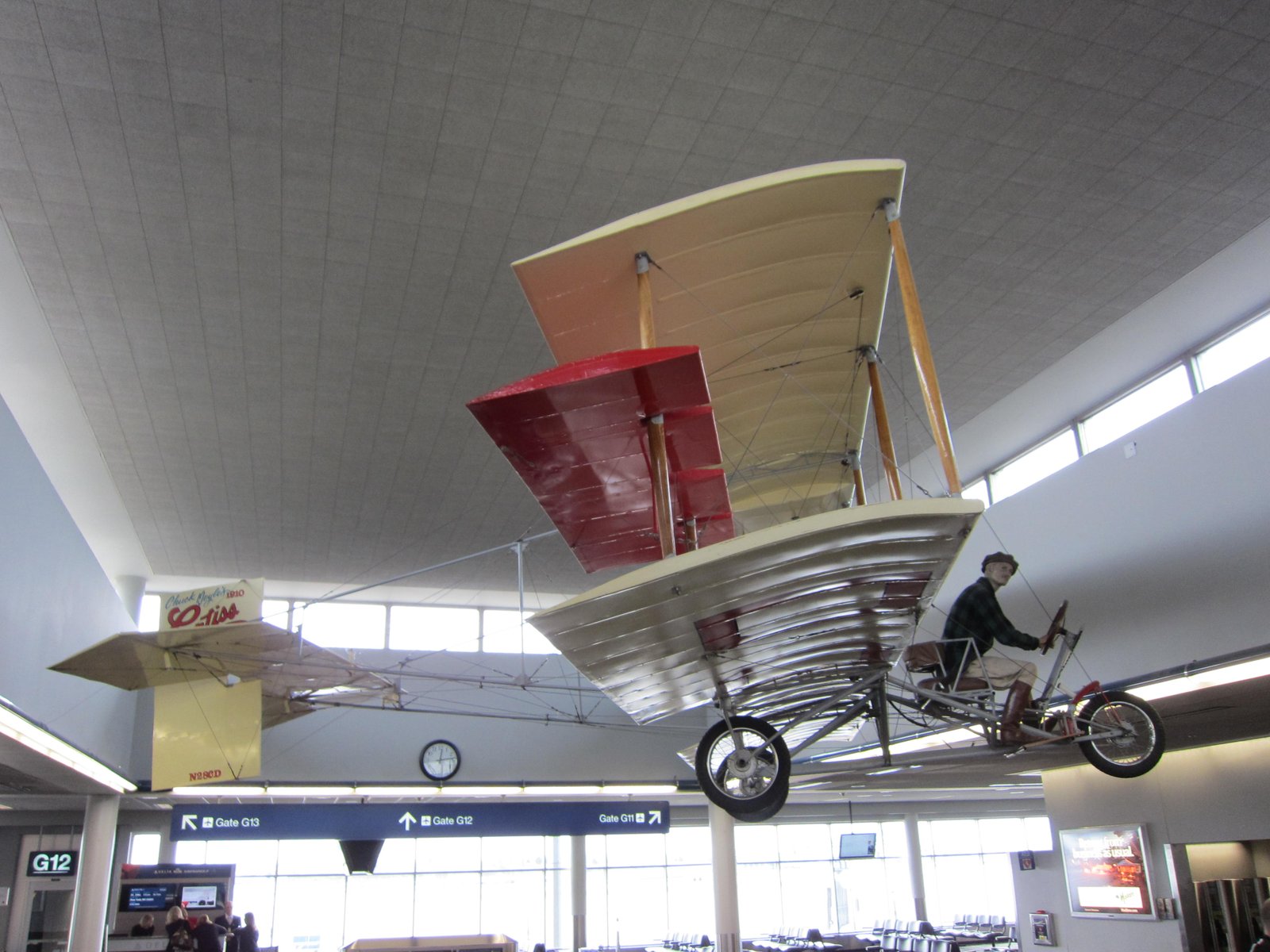
Developed by Glenn H. Curtiss and his design team in Hammondsport, New York, the Curtiss Model D (often referred to as the "Curtiss Pusher") emerged as one of the first aircraft in the world to be produced in significant numbers. The lineage began with the 1909 Golden Flyer, which Curtiss designated as the Model D. The design evolved through several iterations between 1910 and 1912, most notably the 1911 Model D and the 1912 "Headless Pusher," the latter of which removed the front elevator (canard) to improve handling by relocating pitch control to the rear.
The aircraft featured a pusher configuration with the engine and propeller located behind the pilot and twin booms supporting the tail. A defining technical characteristic was the use of external ailerons mounted on the aft interplane struts, which replaced the wing-warping methods used by contemporaries. The pilot operated these ailerons using his shoulders, while a steering wheel on a column controlled the rudder and elevator. For military applications, Curtiss implemented a modular "knock-down" design, allowing the aircraft to be disassembled and transported in Army wagons.
Power was provided by Curtiss-manufactured water-cooled V-8 piston engines. While specifications varied by year and customer, the 1911 Model D Type IV used by the U.S. Army was rated at approximately 60 hp, while other variants utilized engines ranging from 50 to 51.2 hp. The Army Type IV configuration featured a wingspan of 38 ft 3 in and a length of 29 ft 3 in, with a maximum speed of 50 mph and an endurance of 2.5 hours.
The Model D was instrumental in establishing naval aviation. On November 14, 1910, pilot Eugene Ely flew a Curtiss pusher (Type I) to achieve the first takeoff from a U.S. Navy ship, the USS Birmingham. On January 18, 1911, Ely used a Model D Type IV Military equipped with an arresting hook to perform the first shipboard arrested landing on the USS Pennsylvania. The U.S. Army also adopted the type; the Model D Type IV became Signal Corps Airplane No. 2 on April 27, 1911. Tragically, this aircraft was involved in a fatal crash on May 10, 1911, killing 2nd Lt. George E. M. Kelly due to a control component failure.
Beyond military use, the Model D was a staple of early civilian aviation. Exhibition pilots like Charles F. Walsh used the aircraft for barnstorming, including a notable appearance at the New Mexico Territorial Fair on October 11, 1911. The aircraft family was also used for early technological experiments, including the first radio communications with a flight, the first firearm use from an aircraft, and the first simulated bombing runs. Today, the legacy of the Model D survives through rare originals, such as the 1911-1912 aircraft built by Paul and Josh Wilbur, and various reproductions held by the National Museum of the U.S. Air Force and the National Air and Space Museum.