
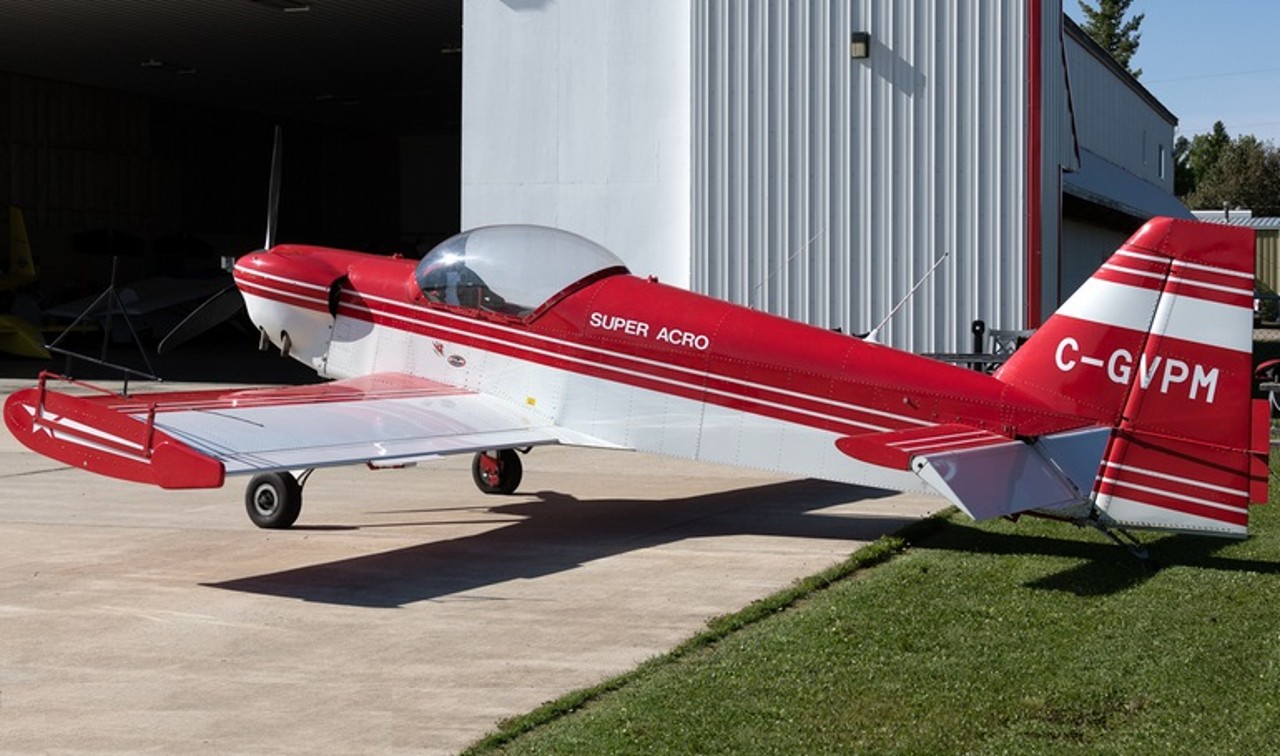
Design Philosophy and Development
Chris Heintz conceived the CH-180 Super Acro-Zénith as a purpose-built aerobatic performer, departing from Zenair's traditional focus on practical kit aircraft for homebuilders. Drawing on his experience as chief aeronautical engineer at Société des Avions Pierre Robin and his subsequent work with Embraer and de Havilland, Heintz applied his expertise in lightweight metal construction to create an aircraft optimized for competition aerobatics.
The CH-180 featured a NACA 0015 airfoil section across its 20-foot wingspan, chosen specifically for its symmetrical profile that provides equal performance in inverted flight. This design decision reflected Heintz's understanding that serious aerobatic aircraft required fundamentally different engineering priorities than his company's typical STOL and touring designs.
Performance Specifications
The aircraft's 150-horsepower Textron Lycoming IO-360 four-cylinder engine delivered exceptional power-to-weight performance, with an empty weight of just 800 pounds against a maximum takeoff weight of 1,150 pounds. This power loading enabled a remarkable initial climb rate of 3,000 feet per minute and a service ceiling of 16,000 feet.
The CH-180's aerobatic credentials were established through its structural limits of +8/-8 G normal loading, with ultimate limits reaching ±12 G. The aircraft's 270-degree-per-second roll rate placed it among the most agile single-engine aerobatic designs of its era. Despite this performance focus, the aircraft maintained practical cross-country capability with a range of 650 miles and cruise speed of 190 mph.
The Zenair Legacy
Zenair Ltd emerged from humble origins when Chris Heintz established the company in 1974, initially manufacturing aircraft kits from his two-car garage in Midland, Ontario. The unexpected success of his lightweight Zenith 200 design created demand that grew into a comprehensive aircraft manufacturing operation. By the time of the CH-180's development in the 1980s, Heintz had introduced more than twelve distinct kit aircraft designs.
The company's business model evolved significantly during the 1990s. In 1992, Heintz licensed manufacturing and marketing rights for several designs, including the popular STOL CH 701 and ZODIAC CH 601, to Zenith Aircraft Company. This strategic decision allowed Zenair to focus on new development while expanding market reach for proven designs.
Zenair achieved a milestone in 1996 with FAA type-certification of the Zenith CH 2000, a two-seat low-wing trainer that demonstrated the company's capability beyond the kit aircraft market. International expansion followed, with a 2012 announcement of plans to assemble CH 2000 aircraft in Peru through partnerships with that nation's armed services and local aerospace facilities.
Technical Innovation
The CH-180's fuel system incorporated 27 Imperial gallons (32 US gallons) of capacity in two fuselage-mounted tanks, an unusual configuration that optimized weight distribution for aerobatic maneuvering. The aircraft's fixed-pitch two-blade propeller reflected a focus on simplicity and reliability over maximum performance optimization.
The low stall speed of 48 mph provided pilots with a wide speed envelope for aerobatic sequences, while the aircraft's clean aerodynamic design enabled efficient cruise performance despite its specialized mission profile. These characteristics made the CH-180 suitable for both competition aerobatics and cross-country flying.
Operational History
As a specialized aerobatic aircraft produced in limited numbers, the CH-180 served primarily in the civilian competition and demonstration flying communities. The aircraft represented Zenair's most performance-oriented design, complementing the company's broader portfolio of utility and training aircraft.
Documented examples of related Zenair aerobatic aircraft, including the CH-150 Acro-Z variant, have appeared at European airfields, indicating international distribution of Heintz's aerobatic designs. The registration F-POET, photographed at France's Abbeville Airport in 2019, demonstrates the continuing airworthiness of these specialized aircraft decades after production.
Legacy and Impact
The CH-180 Super Acro-Zénith represented Chris Heintz's successful expansion beyond utility aircraft into the demanding realm of competition aerobatics. While production numbers remained limited compared to Zenair's popular kit designs, the aircraft demonstrated the company's engineering versatility and Heintz's comprehensive understanding of diverse aviation markets.
Chris Heintz's death on April 30, 2021, at age 82, marked the end of an era for Canadian aircraft design. His innovations in lightweight construction and practical aircraft design influenced homebuilt aviation worldwide, with the CH-180 serving as testimony to his ability to excel across multiple aircraft categories. Today, Zenair continues operations from its Midland, Ontario base, maintaining the legacy of innovation established through designs like the Super Acro-Zénith.