
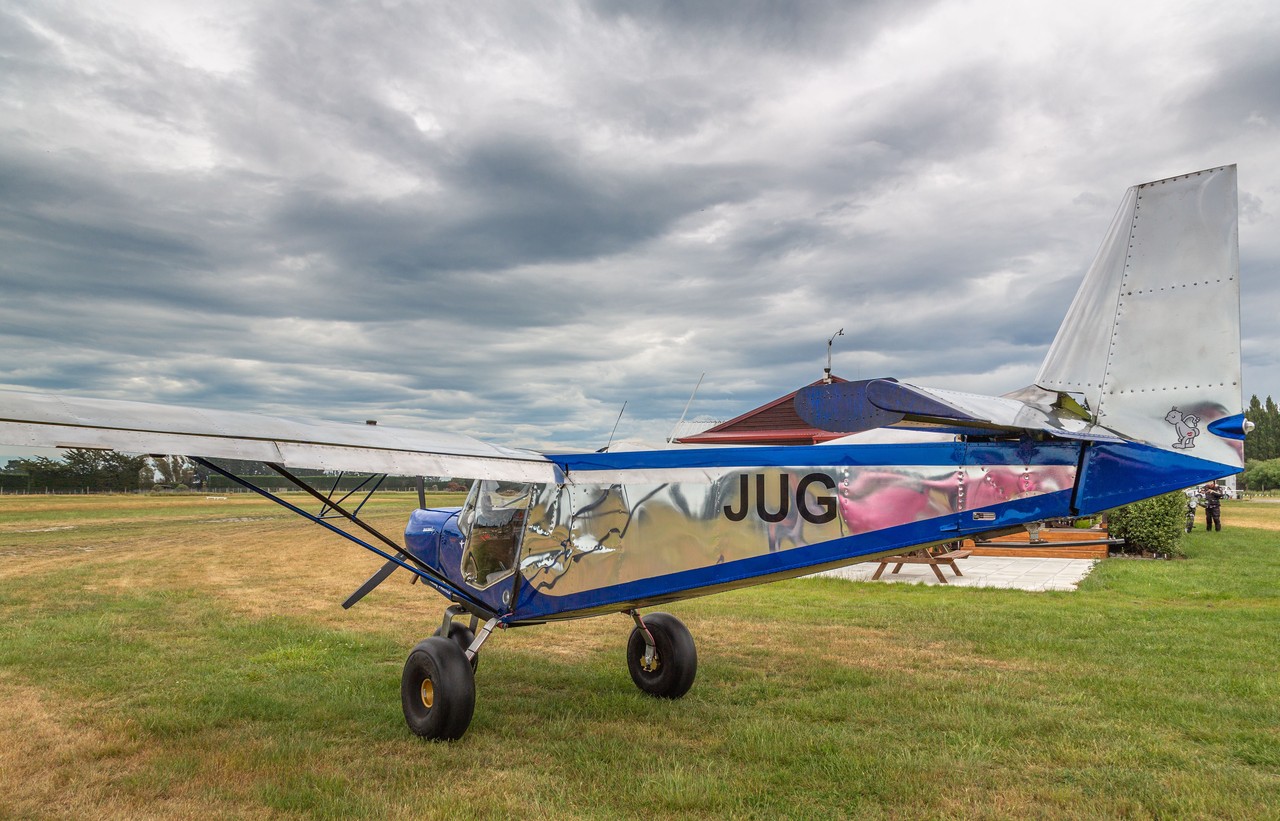
Design Innovation
The CH-701 STOL emerged from the creative vision of Chris Heintz, a French-Canadian aeronautical engineer who founded Zenair Limited as an anagram of his own name. Drawing upon his aerospace industry experience, Heintz developed the aircraft to meet Canada's Advanced Ultralight design standards, which he helped establish. The design brief called for an "off-airport" aircraft that would combine the capabilities of a real airplane with the short-field performance of an ultralight.
Heintz incorporated several groundbreaking features into the CH-701's design. Fixed leading-edge slats provide exceptional high-lift characteristics, while full-span flaperons serve dual functions as both ailerons and flaps. An all-flying rudder enhances control authority at low speeds, and the entirely metal construction ensures durability for outdoor storage and rough-field operations.
Manufacturing Evolution
Production commenced in 1986 from Zenair's original facility in Midland, Ontario. The company's success necessitated expansion, leading to a significant relocation in 1992 to Mexico, Missouri, where Zenith Aircraft Company established a modern manufacturing facility. This move positioned the company to better serve the North American market while maintaining production quality.
International recognition followed quickly, with a Czechoslovakian firm obtaining licensing rights to produce European market variants from 1992 to 2006. Across the globe in India, Agni Aero Sports Adventure Academy assembled approximately 105 aircraft, demonstrating the design's worldwide appeal and adaptability to different manufacturing environments.
Powerplant Development
The CH-701's engine options evolved significantly throughout its production run. Initial variants utilized two-stroke Rotax engines, specifically the 50-horsepower 503 and the 64-horsepower 582 models. As builders demanded enhanced performance capabilities, Zenair introduced the CH-701 SP variant, designed around the more powerful 80-100 horsepower Rotax 912 four-stroke engine manufactured by Bombardier Recreational Products.
Some builders pushed performance boundaries further, with documented examples featuring 130-horsepower engines and alternative powerplants such as UL Power engines. This flexibility in engine selection allowed builders to customize their aircraft for specific mission requirements, from basic recreational flying to more demanding backcountry operations.
Operational Versatility
The CH-701 found its niche far from traditional airports, with most of the 500-plus aircraft operating from short grass strips, backyard fields, and remote locations. This operational philosophy aligned perfectly with Heintz's original vision of an airplane that could access areas previously limited to foot traffic or all-terrain vehicles.
In agricultural applications, the CH-701 established itself as an economical solution for pest control and crop spraying, particularly in Europe and Africa where modest field sizes favored its maneuverability. The aircraft's low-speed characteristics and precise control enable accurate application with minimal overspray and reduced chemical waste, making it an environmentally conscious choice for aerial application work.
Performance Characteristics
The CH-701's short-field performance remains its defining characteristic. At gross weight, the aircraft becomes airborne in less than 120 feet from unprepared grass surfaces, or just 90 feet from hard-surfaced runways. Lift-off occurs at 25 mph in ground effect, typically within four seconds of beginning the takeoff roll. These capabilities open up landing sites that conventional aircraft cannot access.
With a wingspan of 27 feet and overall length of 20 feet 11 inches, the compact aircraft fits into tight spaces while maintaining a respectable 122 square feet of wing area. The never-exceed speed of 110 mph and maximum structural cruising speed of 99 mph reflect the design's focus on slow-speed precision rather than cross-country speed.
Builder Community and Legacy
The CH-701's success spawned an active builder and operator community worldwide. Its all-metal construction proves particularly advantageous for continuous outdoor storage, eliminating hangar and tie-down fees that burden many aircraft owners. This economic benefit, combined with the aircraft's ability to operate from private strips, significantly reduces the total cost of aircraft ownership.
Zenair's design philosophy proved so successful that the company developed two additional STOL designs: the CH-750 and CH-801, creating a family of specialized aircraft adapted for various missions including bush operations and agricultural work. German manufacturers produced variants such as the Roland Z 601 and STOL 701 D Sky Jeep, while Czech Aircraft Works developed agricultural versions.
Current Status
Today, hundreds of CH-701 aircraft continue flying worldwide, testament to the design's enduring appeal and practical utility. Zenith Aircraft Company remains active in Mexico, Missouri, continuing to support existing aircraft while developing new variants. The aircraft's significance extends beyond its production numbers, having demonstrated that kit aircraft could successfully bridge the gap between ultralight simplicity and conventional aircraft capability, opening backcountry aviation to a broader community of pilots and builders.