
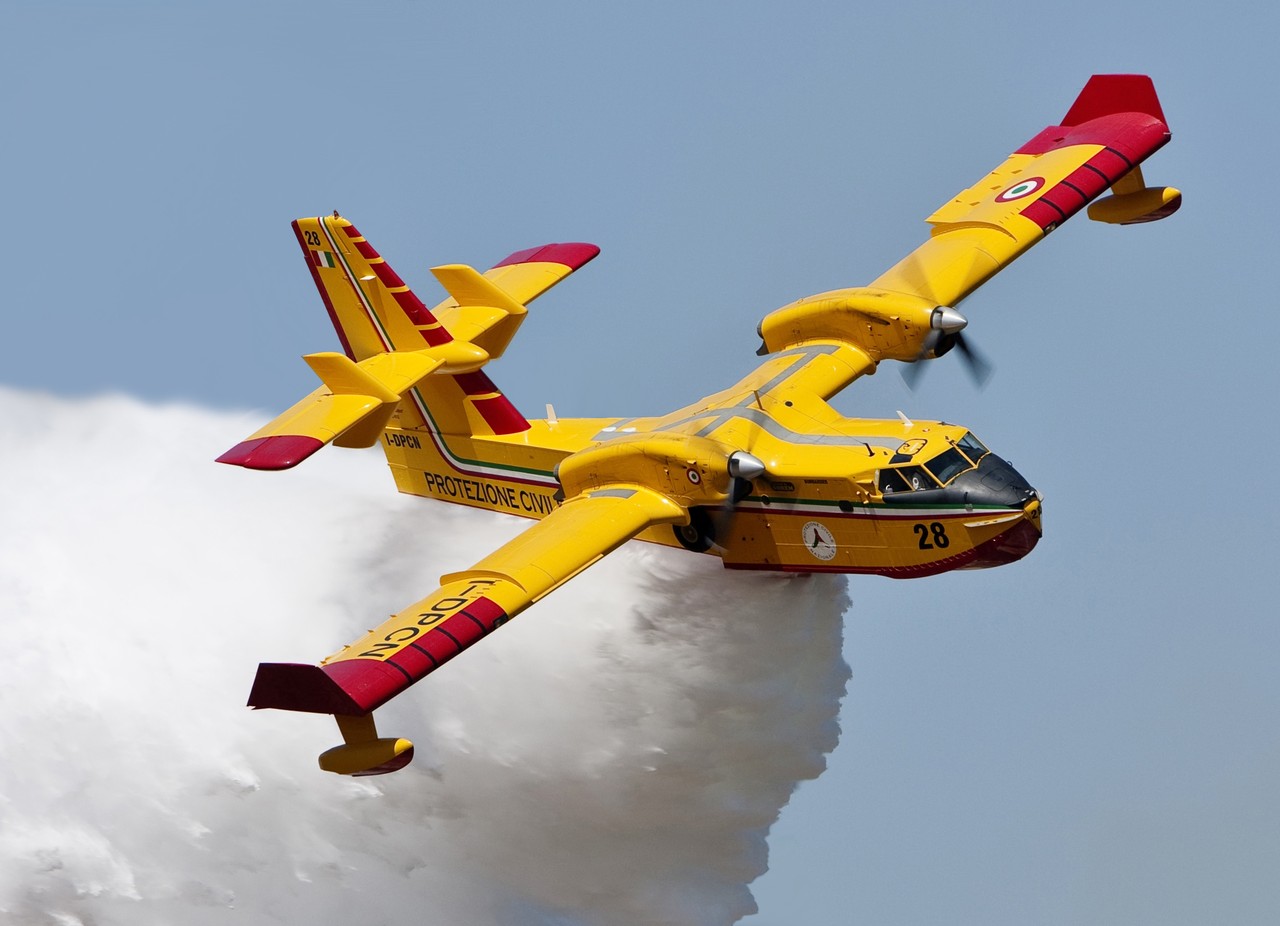
Operational Dominance
The CL-415 established itself as the premier aerial firefighting platform, earning the nickname "Superscooper" for its unmatched water-dropping capabilities. During peak operations, a single aircraft could remain airborne for 3-4 hours per mission, representing a 50% increase in air time compared to its piston-powered predecessor. Croatian operators demonstrated the aircraft's effectiveness by maintaining six CL-415s in continuous service since 1996, with the last two delivered in 2009-2010.
Manufacturing Legacy
Bombardier Aerospace inherited the firefighting aircraft program when it acquired Canadair, which had pioneered purpose-built waterbombers beginning with the CL-215's first flight on October 23, 1967. Between 1994 and 2015, Bombardier's Montreal facility produced 95 CL-415 aircraft using traditional aluminum construction methods specifically treated to withstand both fresh and saltwater operations. The company prioritized new-build CL-415 production over CL-215T conversions, though 17 of the older aircraft received turbine engine upgrades.
In 2016, Viking Air acquired the program from Bombardier, followed by De Havilland Canada in 2022. De Havilland immediately renamed the updated variant DHC-515 and announced production restart based on 22 letters of intent, including orders from the Croatian Ministry of Defense. Meanwhile, Bombardier redirected its focus to business aviation, concentrating on aircraft like the Challenger series.
Revolutionary Powerplant
The CL-415's two Pratt & Whitney Canada PW123AF turboprops represented a quantum leap over the CL-215's 2,100-horsepower Pratt & Whitney R-2800 radial engines. The turboprop installation, shared with the Dash 8-Q400 airliner, delivered crucial one-second idle-to-full power response compared to six seconds typical of jet engines. This rapid throttle response proved essential during low-altitude, slow-speed firefighting operations where split-second power adjustments meant the difference between successful drops and dangerous terrain encounters.
Engineers mounted the engines inboard on the high wing to maintain controllability during single-engine operations, while large winglets and canted endplates enhanced stability during water scooping runs. An innovative inverted leading-edge slat on the right stabilizer further improved handling characteristics during the demanding firefighting profile.
Technical Innovation
The CL-415's amphibious design allowed it to scoop water from lakes, rivers, and coastal areas in just 12 seconds while traveling at operational speeds. The aircraft's 6,137-liter capacity tank system included foam injection capability for enhanced fire suppression effectiveness. Multiple variants emerged during production, including the CL-415MP for multi-purpose operations, CL-415GR for the Greek market, and CL-415EAF featuring enhanced aerodynamics with improved winglets and finlets.
Beyond firefighting, operators configured CL-415s for search and rescue missions, maritime surveillance, and general transport duties. The French Civil Protection, among the first CL-215 operators since June 1969, demonstrated the aircraft family's versatility across multiple mission profiles.
Production Achievement
By 2019, the combined CL-215 and CL-415 production total reached 164 aircraft, with the original CL-215 accounting for 125 units produced through 1990. The final CL-215 delivery occurred in May 1990, after which Bombardier concentrated on the more advanced CL-415 design. Despite production ending in 2015, De Havilland Canada maintains type certificate authority and provides spare parts support for all CL-215, CL-215T, and CL-415 variants.
Enduring Impact
The CL-415 established performance benchmarks that remain unmatched in aerial firefighting. No other aircraft was purpose-designed for wildfire suppression, giving it unique operational advantages in an increasingly fire-prone world. Croatia's continued operation of six CL-415s, combined with their order for two new DHC-515s, demonstrates the design's enduring relevance. The aircraft's legacy lives on through De Havilland Canada's commitment to restart production, ensuring this specialized capability remains available to firefighting agencies worldwide facing escalating wildfire challenges.