
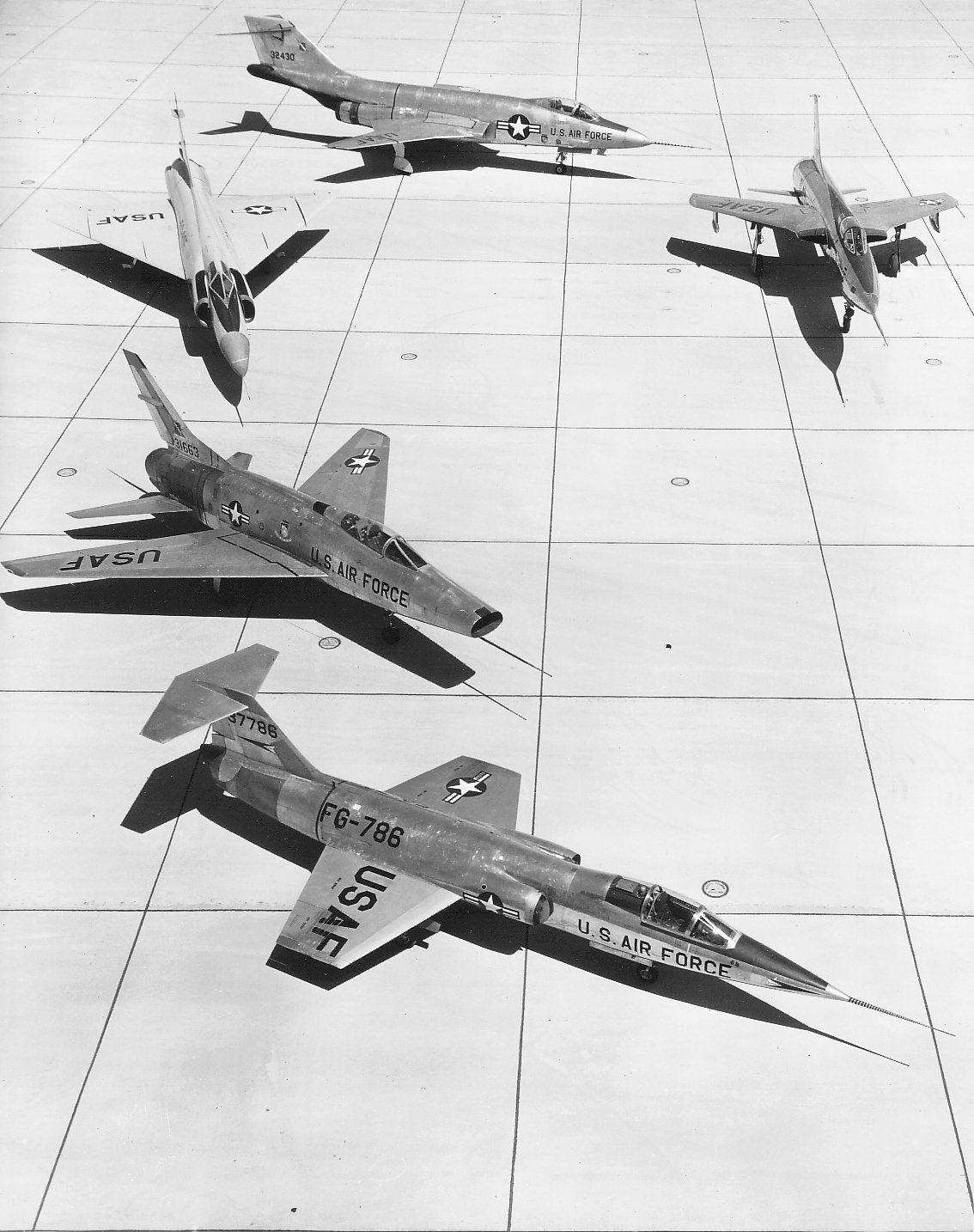
The term "Century Series" refers to an informal collective group of six United States Air Force fighter aircraft designated F-100 through F-106. Rather than representing a single aircraft model or a specific type with a unified design, the Century Series describes a category of supersonic jets developed during the 1950s and early 1960s to meet the evolving strategic demands of the Cold War.
This group consists of six distinct aircraft produced by several different manufacturers: the North American F-100 Super Sabre, the McDonnell F-101 Voodoo, the Convair F-102 Delta Dagger, the Lockheed F-104 Starfighter, the Republic F-105 Thunderchief, and the Convair F-106 Delta Dart. Because these aircraft were designed by different companies—including North American Aviation, McDonnell Aircraft, Convair, Lockheed, and Republic Aviation—they possess vastly different airframes, engine specifications, and production histories.
The Century Series is noted for introducing several technical milestones in aviation. The F-100 was the first USAF aircraft capable of achieving supersonic speeds in level flight, while the F-101 was the first to exceed 1,000 mph. The F-102 Delta Dagger was the first production aircraft to incorporate the "area rule," a fuselage shaping technique used to reduce transonic drag. Additionally, the F-104 Starfighter was the first combat aircraft capable of Mach 2 in level flight and is the only aircraft to have simultaneously held the world speed, rate-of-climb, and altitude records.
In terms of operational roles, the group included fighter-bombers (such as the F-100 and F-105) and all-weather interceptors (such as the F-102 and F-106). These aircraft were central to Cold War air defense in North America and NATO Europe, and played significant roles in strike operations during the Vietnam War. While most were phased out of front-line service by the 1970s and 1980s, some remained in use as target drones or in foreign service, with the F-104G serving in the Italian military until 2004.