
Overview
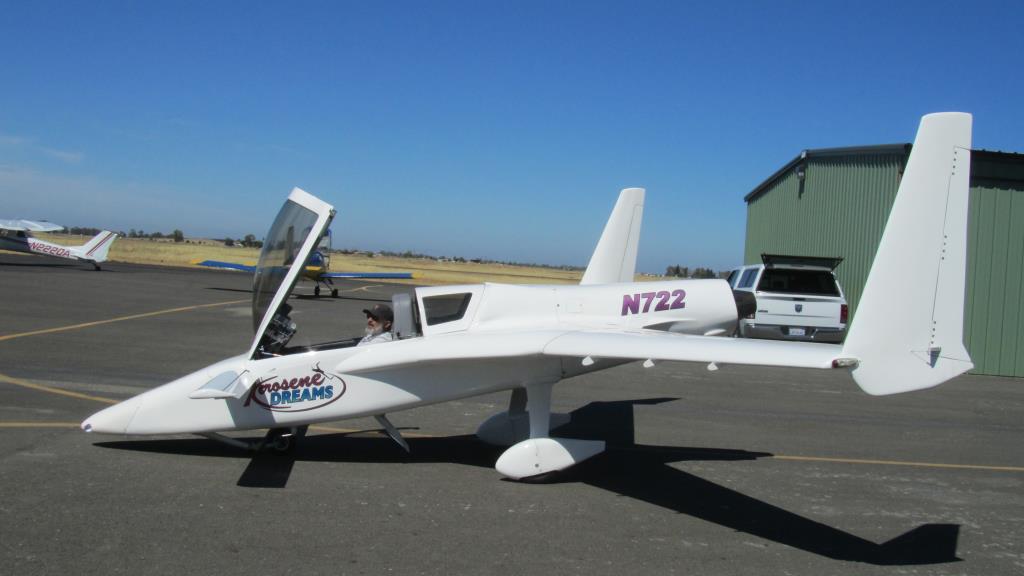
The CozyJet is a unique, one-off experimental aircraft: a homebuilt Cozy — a Burt Rutan-inspired composite canard design — converted to jet propulsion. Registered N722 and nicknamed "Kerosene Dreams," it is widely described as the first successfully flying composite canard jet of the Rutan lineage. Unlike the piston Cozy from which it descends, the CozyJet is a jet aircraft: it has no propeller, and its converted turbine exhausts through a tail nozzle to produce thrust.
From Cozy to Jet
The base design is the Cozy, a wider-cabin, side-by-side derivative of Burt Rutan's Long-EZ conceived by Nat Puffer, built using composite construction with a canard foreplane. Greg Richter undertook the radical conversion of an airframe to turbine power. The aircraft passed through more than one powerplant during its development — it was flown with a Mazda 13B rotary engine (originally from a 1992 Mazda RX-7) before receiving its defining jet installation.
The Powerplant — a Turboshaft Made into a Jet
The CozyJet is powered by a General Electric T58-8F. In its original form the T58 is a turboshaft — a helicopter engine (used in types such as the Sikorsky H-3 Sea King and CH-46 Sea Knight) that delivers around 1,250 shaft horsepower through a free power turbine. To turn it into a jet, that free power turbine (the "N2" section that would normally drive a rotor or output shaft) is removed, and a tailpipe/exhaust nozzle is fitted so the gas-generator core's exhaust produces direct thrust. In this turbojet configuration the engine produces on the order of 600–800 pounds of thrust and weighs roughly 280–300 lb installed — about the weight of a small piston aircraft engine. This is why the CozyJet is correctly classed as a jet rather than a turboshaft or turboprop: there is no propeller and no output shaft, only jet thrust. Reported thrust figures vary between sources (roughly 600 to 840 lbf), reflecting the aircraft's amateur-built, one-off nature. The bare T58 conversion is famously loud; the builder and collaborators developed a custom hush kit that brought the noise down to roughly the idle level of a business jet.
Flight
The first jet "hop" was flown by professional test pilot Len Fox, around 2001, after the aircraft's earlier rotary-engine phase. Richter's account of that first hop describes a climb of roughly 3,000 feet per minute at about 150 knots indicated. The CozyJet has been displayed at EAA AirVenture Oshkosh, drawing attention as an unusual marriage of surplus turbine hardware with amateur-built composite construction.
Status
The CozyJet remains a single, one-off experimental aircraft (registration N722). It stands as a notable example of experimental-aviation ingenuity — adapting a helicopter turboshaft into a jet to power a homebuilt canard. Precise build and first-flight dates come only from enthusiast and builder sources and should be read as approximate.