
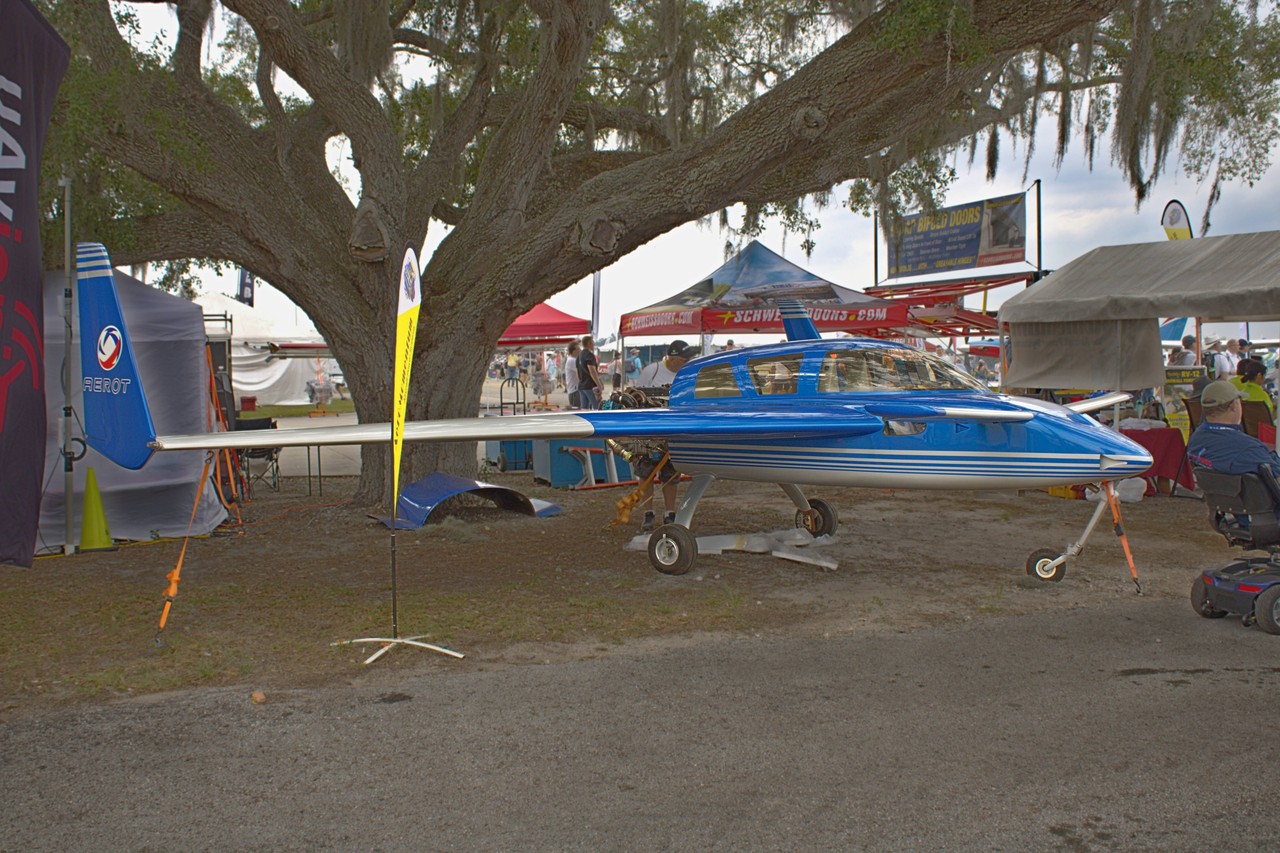
Development and Design Philosophy
Jeff Russell, a former Cozy builder who captured the plans-built champion award at Oshkosh in 1991, conceived the AeroCanard as an evolution of existing canard designs. Working alongside his father Greg Russell, a former Rockwell engineer, Jeff scaled up Nat Puffer's proven Cozy Mk-IV design while incorporating Velocity-inspired features for enhanced roominess and performance. The design philosophy centered on reducing construction time from the typical 2,000-plus hours required for plans-built aircraft to an estimated 1,200-1,500 hours through pre-fabricated fiberglass components.
The prototype made its debut flight to Oshkosh in 1995, demonstrating the successful merger of Cozy flight characteristics with modern kit-building techniques. Russell's innovations included larger molded parts that provided increased headroom and cabin space, addressing common complaints about cramped quarters in earlier canard designs.
Manufacturing and Production
AeroCad, Inc. began operations around 1994 as a custom shop in Florida, initially producing kit parts for Puffer's Cozy Mk-IV under a licensing agreement with Co-Z Development Corp. The company transitioned to manufacturing complete AeroCanard kits by the mid-1990s, delivering at least 18 kits by 1995. Jeff Russell produced approximately 50 complete kits before departing the company around 2005, while AeroCad sold an additional 30-plus AeroCanard tops to existing Cozy builders seeking upgrades.
Following the 2005 ownership change, the company's business and assets relocated from Florida to Florissant, Missouri. Production ceased under the original AeroCad name after this transition, with no confirmed current operations. The company offered multiple variants including the standard AeroCanard, the AeroCanard SB (Small Body) based on the Cozy Mk-IV, and options for both fixed and retractable landing gear configurations.
Technical Specifications and Performance
The AeroCanard utilized the proven Lycoming IO-360 powerplant, a four-cylinder, air-cooled, fuel-injected engine producing 200 horsepower. This engine choice, recommended in the 160-200 horsepower range, paired with a three-bladed constant-speed propeller to achieve cruise speeds of 210 mph while consuming less than 10 gallons per hour. The aircraft's pusher configuration placed the engine behind the cabin, driving the propeller through an extension shaft.
Measuring 28.1 feet in wingspan with 102.3 square feet of wing area, the AeroCanard achieved impressive performance figures. The aircraft demonstrated a maximum speed of 230 mph, stall speed of 78 mph, and climb rate of 1,900 feet per minute. With a 50-gallon fuel capacity, the AeroCanard provided a range of 1,000 miles, making it suitable for cross-country travel. The aircraft's empty weight of 1,300 pounds and gross weight of 2,150 pounds resulted in a useful load of 850 pounds.
Variants and Construction Options
AeroCad offered several variants to meet different builder preferences and budgets. The FG (Fiberglass) model represented the standard configuration with fixed landing gear, requiring approximately 1,400 build hours. The SB (Small Body) variant, based closely on the Cozy Mk-IV design, demanded about 1,500 hours for completion. The RG (Retractable Gear) model, featuring electrically-operated landing gear, increased build time to roughly 1,700 hours but enhanced cruise performance. The SX variant offered additional features, maintaining the 1,400-hour construction timeline.
All variants employed composite construction techniques, with builders working primarily with fiberglass and carbon fiber materials. The cantilever canard design eliminated the need for external bracing while providing inherent stability and stall resistance characteristics that made the aircraft relatively forgiving to fly.
Operational History and Legacy
By the end of 2011, 24 AeroCanard aircraft had been completed and flown, comprising 18 FG models, 2 SB models, 3 RG models, and 1 SX model. The Federal Aviation Administration registered four aircraft by October 2012, reflecting the typical completion rate for kit aircraft projects. These aircraft served exclusively in private hands, with no commercial or military applications.
The AeroCanard represented a significant step in the evolution of homebuilt canard aircraft, bridging the gap between plans-built designs requiring extensive fabrication skills and modern quick-build kits. Its influence extended beyond mere construction convenience, demonstrating that amateur builders could achieve airline-like cruise speeds and cross-country capability in four-seat aircraft.
Today, the AeroCanard stands as a testament to the innovation possible within the experimental aircraft community, though production challenges and market dynamics ultimately limited its widespread adoption. The surviving aircraft continue to showcase the potential of well-executed canard designs in private aviation.