
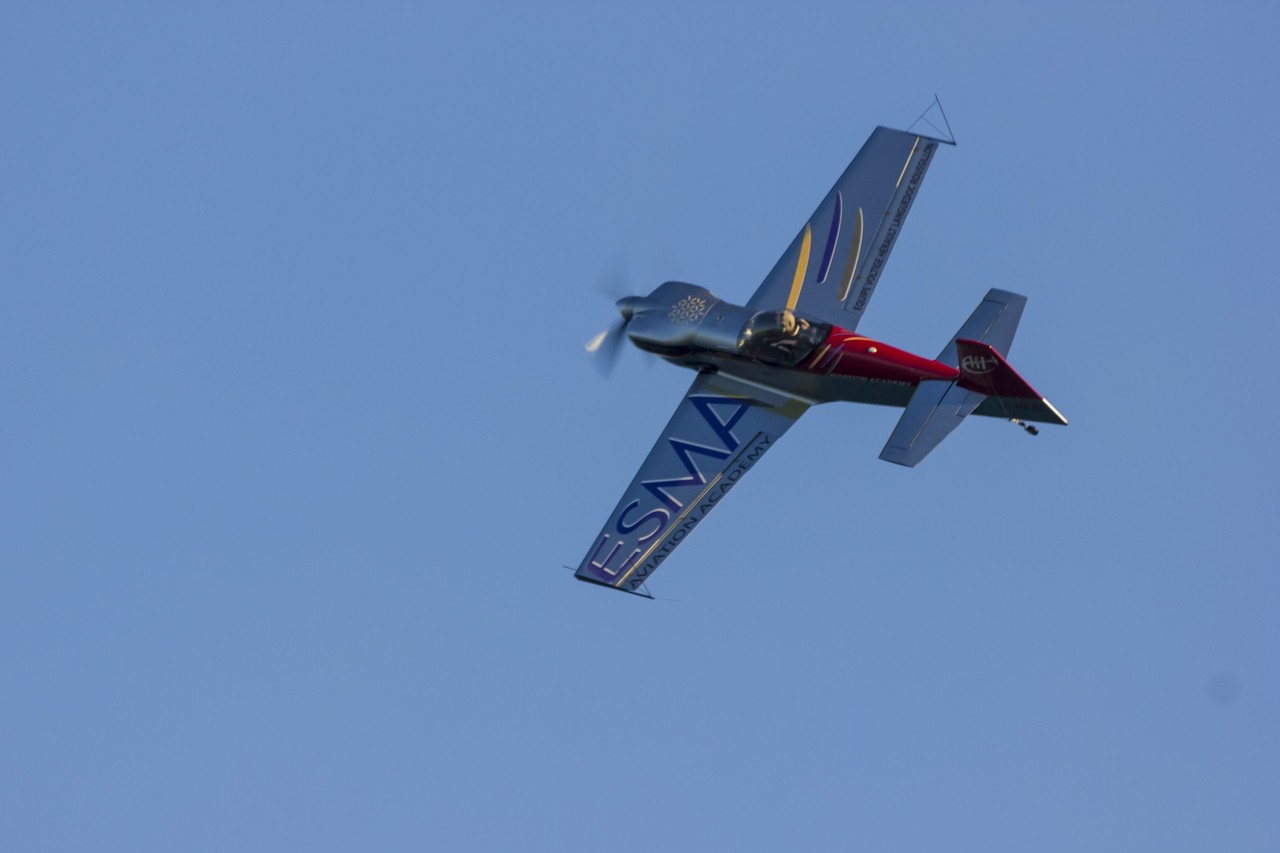
Competition Dominance
The CAP-230 established itself as a formidable force in international aerobatic competition during the late 1980s and 1990s. The aircraft and its variants won multiple World Aerobatic Championships, with the CAP-231 taking the title in 1990 and the CAP-231EX continuing the winning streak in 1998, 2000, and 2007. At the 2007 World Aerobatic Championships alone, CAP variants secured second place individual for the CAP-231EX, sixth place for the CAP-232, and first place team honors, demonstrating the design's sustained competitive excellence.
Military Service
The French Air Force became the primary military operator, with the Equipe de Voltige de l'Armée de l'Air (French Air Force aerobatic team) flying CAP-230s from 1986 to 1990. The team then transitioned to later variants, operating CAP-231s from 1990 to 1998 and CAP-232s from 1999 to 2005. The Moroccan Air Force also operated at least one CAP-230, registered CN-ABJ with constructor number 07, indicating the aircraft's limited international military appeal.
A fatal accident on August 30, 2005, involving French Air Force CAP-232 F-TGCC resulted in one fatality and led to the grounding of the fleet for fuselage reinforcements, ultimately contributing to the end of military operations with the type.
The Manufacturer
Avions Mudry et Cie was founded by Marcel Mudry and had been producing aerobatic aircraft since the 1960s, starting with models like the CAP-10. The company began documented production in 1971 and established itself at manufacturing facilities in Bernay-Saint-Martin, France. Mudry focused exclusively on the specialized niche of aerobatic competition aircraft, with the CAP-230 representing the evolution of their successful CAP-21 design.
The company later evolved into CAP Aviation, with some later variants handled by AkroTech Europe for the CAP-232. Production remained limited throughout the company's existence, reflecting the specialized nature of competition aerobatic aircraft. The company ceased operations under the original Mudry name after completing the CAP-23x series.
Engine and Technical Innovation
The CAP-230 was powered by a single Lycoming AEIO-540-L1B5D, a six-cylinder air-cooled horizontally-opposed piston engine producing 224 kW (300 horsepower). This powerplant, manufactured by Lycoming Engines (a division of Textron), featured fuel injection and an inverted oil system essential for sustained negative-G maneuvers. The engine drove variable propeller configurations - two-bladed on the CAP-230, three-bladed on the CAP-231, and four-bladed on the CAP-232.
The aircraft's design incorporated strengthened wooden construction adapted from the CAP-21, with distinctive triangular surfaces added to the trailing edges of the trapezoidal wings. This combination achieved a power-to-weight ratio of 0.31 kW/kg, enabling exceptional performance capabilities.
Performance Characteristics
Pilots praised the CAP-230 for its exceptional aerobatic capabilities, with structural limits of ±10 G-forces far exceeding most competition aircraft of its era. The aircraft achieved a maximum roll rate of 270 degrees per second at 300 km/h and could climb at 16 meters per second (3,100 feet per minute). With a top speed of 400 km/h and operational ceiling around 15,000 meters, the CAP-230 provided pilots with a wide performance envelope for complex aerobatic sequences.
The aircraft's wing loading of 74 kg/m² contributed to its precise handling characteristics, while takeoff distance of just 200 meters allowed operations from relatively short airfields. The 65-liter fuel capacity provided approximately 360 kilometers of range, sufficient for competition flights and training missions.
Production and Legacy
Production numbers remained deliberately low, typical of specialized aerobatic aircraft, with constructor numbers as low as 07 and 10 indicating fewer than several dozen aircraft manufactured. Initial deliveries to the French Air Force occurred between 1986 and 1990, with manufacturing continuing in limited numbers for civilian operators.
Today, surviving CAP-230s continue flying in private hands across multiple countries. Notable civilian registrations include N231X and N232DG in the United States, G-GSGZ, G-GODV, G-IITC, and G-IIHZ in the United Kingdom, HB-SBC in Switzerland, and F-GPRC, F-HERA, and F-HKAP in France. Recent accidents, including F-HKAP near Chavenay/Villepreux, France on June 15, 2025, confirm that several examples remain active as of 2025, continuing to serve aerobatic competitors and enthusiasts more than four decades after the type's first flight.