
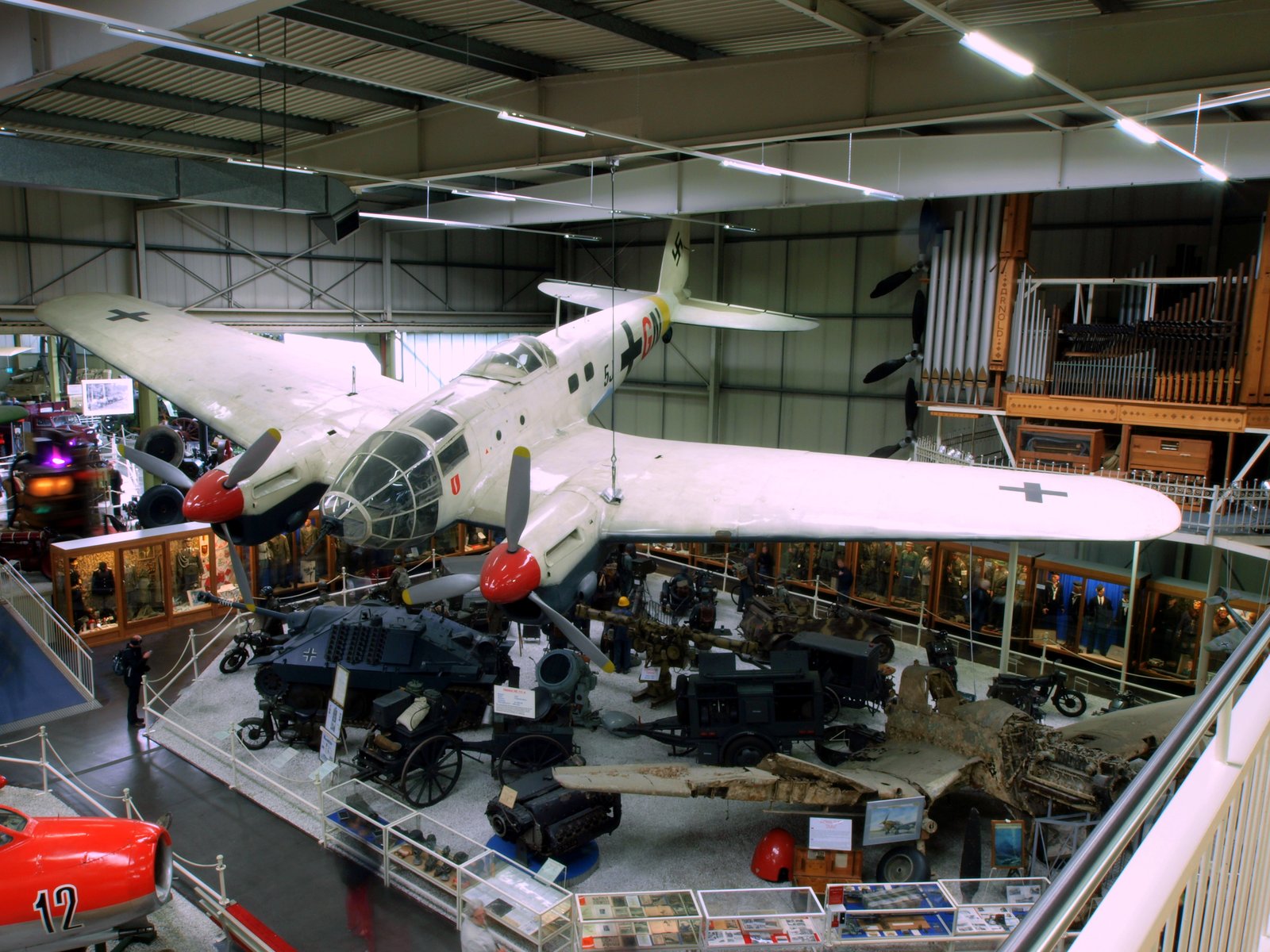
The CASA 2.111 was a Spanish-produced development of the German Heinkel He 111H-16, serving as a medium bomber and reconnaissance aircraft for the Spanish Air Force (Ejército del Aire). While the original design originated with Heinkel Flugzeugwerke, the Spanish variant was manufactured by Construcciones Aeronáuticas S.A. (CASA) at their facilities in Tablada, Seville. CASA negotiated the license for the aircraft in 1940, and the first Spanish-built example flew on May 23, 1945.
Technically, the aircraft maintained the all-metal construction, aerodynamic shape, and retractable landing gear of the original He 111. Early production models, such as the 2.111A, utilized Junkers Jumo 211 liquid-cooled V-12 piston engines. However, due to postwar difficulties in sourcing German parts, CASA transitioned to British powerplants. In April 1956, 173 Rolls-Royce Merlin 500-29 engines were ordered and installed using nacelles originally developed for the Beaufighter II and Avro Lancaster. These Merlin-powered versions, designated 2.111B (bomber) and 2.111D (reconnaissance), produced 1,176 kW (approximately 1,577 hp) per engine. The resulting aircraft reached maximum speeds of between 418 and 440 km/h and had a service ceiling of 7,800 meters.
In military service, the CASA 2.111 performed various roles, including close air support during the Ifni War from 1957 to 1958. Other variants included the 2.111F dual-control trainer and the 2.111T8, a nine-passenger transport. Some aircraft were further modified for specialized roles; one 2.111D served as a VIP transport for Generalissimo Francisco Franco, and others were used for aerial mapping and photography. The aircraft's longevity was remarkable, with some examples remaining in active service until January 1975, supporting campaigns in Western Sahara.
Beyond its military utility, the CASA 2.111 gained cultural prominence as a film prop. Due to its visual similarity to the original He 111, over 30 CASA bombers were used as stand-ins in the 1969 film Battle of Britain. Approximately 240 aircraft were built in total, with about 200 being the Merlin-powered B-series. Today, roughly 14 airframes survive in museums, including examples at the National Museum of the United States Air Force and the Deutsches Museum. The last airworthy CASA 2.111 was lost in a fatal crash on July 10, 2003, at Cheyenne Municipal Airport in Wyoming.