
Service History
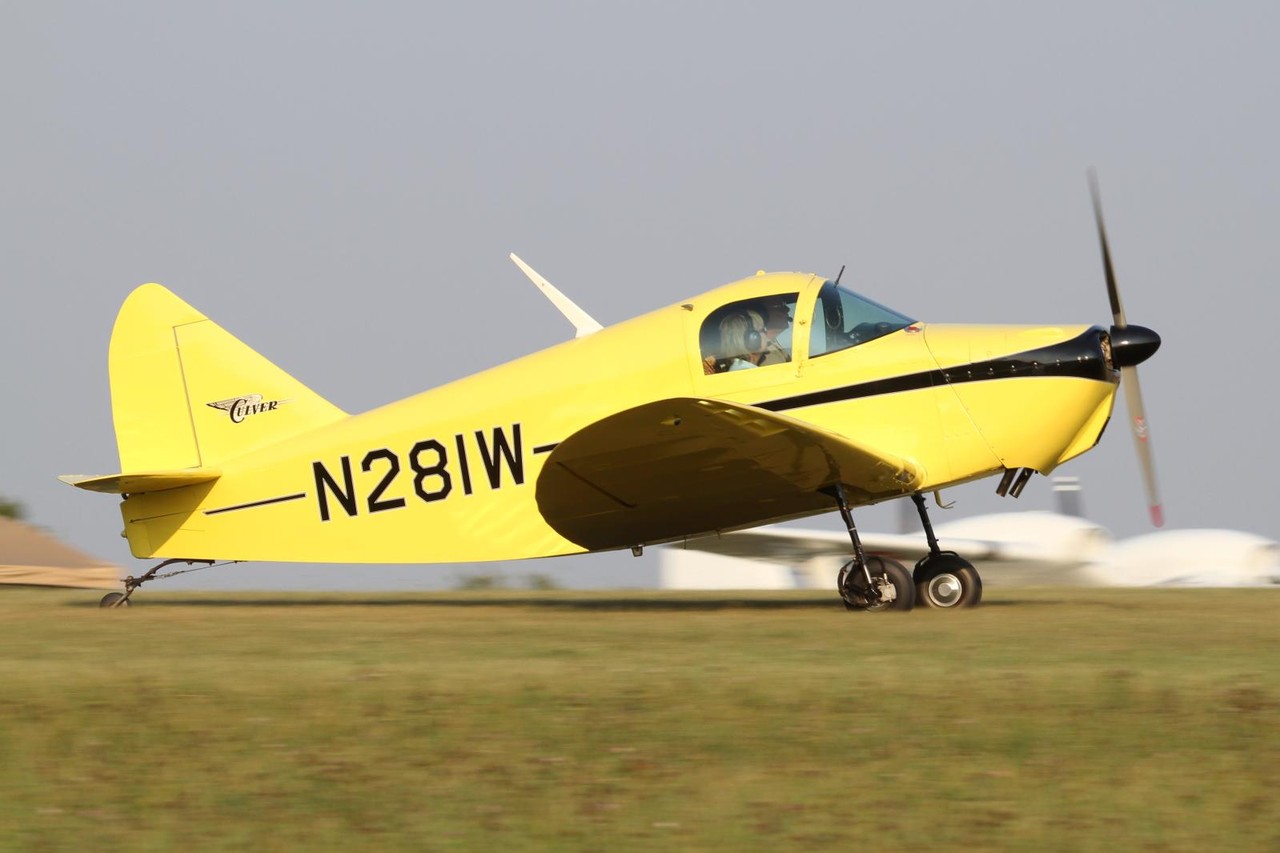
The Culver Cadet dominated the pre-war training market through exceptional efficiency that competitors could not match. While other two-seat aircraft of 1939 struggled to reach 80 mph with similar 75-horsepower engines, the Cadet delivered a factory-guaranteed cruise speed of 120 mph with an extraordinary fuel efficiency of 28.6 miles per gallon. This performance advantage made it "America's sweetheart, the darling of the sportsman pilot" when introduced in December 1939 at a price of $2,395.
Production continued steadily from 1939 through early 1942, with 359 civilian aircraft completed before the United States entered World War II. The aircraft found international interest, securing export orders to Uruguay before production ceased in December 1941 as the company shifted to military contracts.
Wartime Transformation
The Cadet's wartime service proved far more significant than its civilian role. In 1940, the U.S. Army Air Corps selected a modified version as the A-8 experimental radio-controlled target drone, later redesignated XPQ-8. Unlike the civilian version's retractable tailwheel, the military variant featured fixed tricycle landing gear and aluminum paint coating for enhanced radar visibility.
Successful testing led to massive military orders. The Army ordered 200 PQ-8 "Red Fox" drones, followed by 200 improved PQ-8A variants. The enlarged PQ-14 "Cadet" became the most numerous version, with Culver producing more than 2,000 for the U.S. Army. The Navy operated 200 TDC-2 aircraft (their designation for the PQ-8A) and received approximately 1,200 TD2C-1 "Turkey" drones transferred from Army contracts.
The Manufacturer
Culver Aircraft Company emerged from the vision of Knight Culver Jr., who purchased the Monosport aircraft design rights in 1938 and founded Dart Aircraft Company, later renamed Culver Aircraft. The acquisition included retaining designer Al Mooney and hiring his brother Art Mooney as factory superintendent. Originally based in Columbus, Ohio, the company relocated to Wichita, Kansas after Walter Beech and attorney Charles Yankey purchased the facility.
The original company dissolved after the war, though Helton Aircraft Corporation of Mesa, Arizona developed the derivative Helton Lark 95 in 1966. Helton achieved FAA type approval and delivered 15 aircraft before ceasing operations in 1971.
Engine & Technical Innovation
The standard Cadet LCA utilized the Continental A75-8, a four-cylinder horizontally-opposed engine producing 75 horsepower. The 1941 LFA variant featured the Franklin 4AC-176-F3 engine, generating 80-90 horsepower with additional equipment and refinements.
Al Mooney's design innovations centered on the semi-monocoque fuselage construction, departing from the welded steel tube frames common in contemporary aircraft. This structural approach, combined with the retractable tailwheel landing gear, reduced drag significantly. The clean aerodynamic design enabled the remarkable performance that distinguished the Cadet from competitors using identical powerplants.
Design Legacy
Al Mooney's eight years at Culver produced six different models and established design principles that influenced general aviation development for decades. After leaving Culver, Mooney founded Mooney Aircraft, which became a major general aviation manufacturer known for efficient, fast aircraft sharing design DNA with the original Cadet.
The aircraft's simple construction and docile flying characteristics made it an ideal trainer for new pilots during the pre-war aviation boom. Its combination of performance and economy provided a template for efficient light aircraft design that manufacturers studied and emulated.
Production & Survival
Total production across all variants exceeded 3,700 aircraft when combining the 359 civilian Cadets with military drone versions. The transition from civilian trainer to military target drone represents one of aviation's most dramatic role transformations, with the military variants outnumbering civilian aircraft by more than ten to one.
Today, surviving examples exist in private collections and museums. Documented restorations include aircraft originally purchased in 1940 and rebuilt with Continental C-90 engines and modern propellers. These survivors serve as reminders of an era when innovative design could achieve remarkable efficiency with modest power, principles that remain relevant in contemporary aviation.