
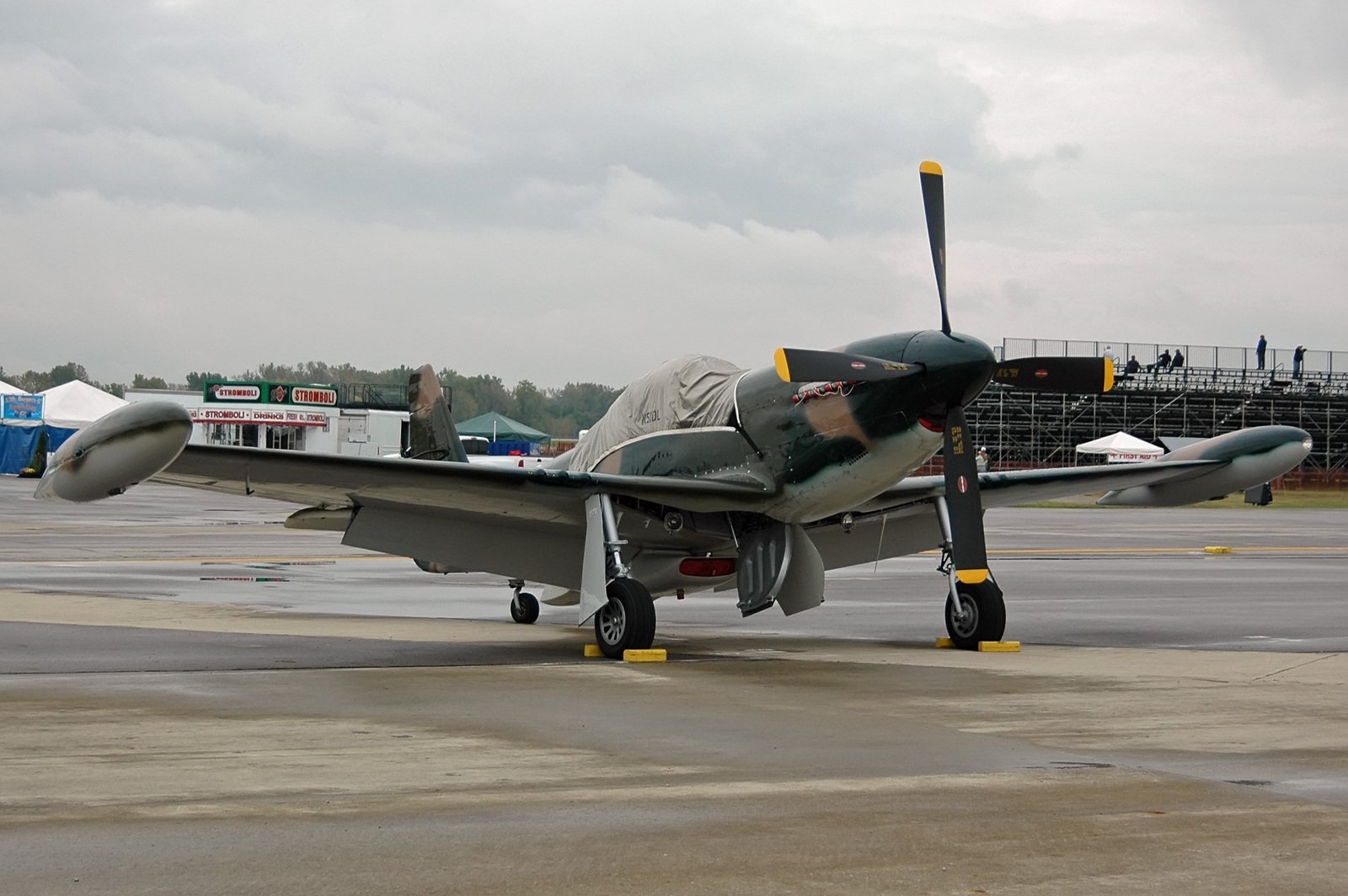
The Cavalier Mustang was not a clean-sheet design but a series of comprehensive rebuilds of surplus North American P-51D Mustangs. Developed by David Lindsay, the founder of Trans Florida Aviation, Inc. (which later became Cavalier Aircraft Corporation), the program began in 1958 with the first civilian conversion. The aircraft were manufactured in Sarasota, Florida, where they were transformed into high-speed business aircraft or modernized military platforms.
For the civilian market, the Cavalier Mustang was marketed as a luxury executive aircraft. These conversions involved the removal of military hardware and the installation of plush interiors, a second seat, luggage bays, and modern avionics. To increase range, some models were equipped with 96 US gallon wingtip tanks. These civil variants were categorized into series such as the Cavalier 750, 1200, 1500, 2000, and 2500, with the numbers roughly corresponding to their range in statute miles.
In the late 1960s, the program shifted toward military applications. In 1967, the company secured a US Department of Defense contract under the Military Assistance Program (MAP) to provide military-spec F-51D Mustangs for export. This led to the production of 11 aircraft (nine single-control F-51Ds and two dual-control TF-51Ds) delivered to Bolivia between 1967 and 1968. Further specialization resulted in the Cavalier Mustang II, a dedicated counter-insurgency (COIN) and close air support (CAS) aircraft. This variant featured six underwing hardpoints for bombs and rockets. Five Mustang IIs (including one TF-51D) were delivered to El Salvador in 1968, and another batch of six (five Mustang IIs and one TF-51D) was delivered to Indonesia between 1972 and 1973. To comply with US State Department rules, the Indonesian aircraft were delivered without tip tanks.
Technically, the aircraft retained the Packard-built Rolls-Royce Merlin V-1650 series liquid-cooled V-12 piston engine. The Mustang II variant achieved a maximum speed of 440 mph, a service ceiling of 41,000 feet, and a range of 2,000 miles. In combat, El Salvador utilized the aircraft during the 1969 "Football War" against Honduras, where at least one Cavalier was shot down. Additionally, the US Army operated two Cavalier F-51Ds as non-combat chase aircraft in the late 1960s. While the company is now defunct and the type was retired by 1984, several examples survive, including a US Army chase aircraft preserved at the Air Force Armament Museum at Eglin AFB, Florida.