
The Homebuilder's Revolution
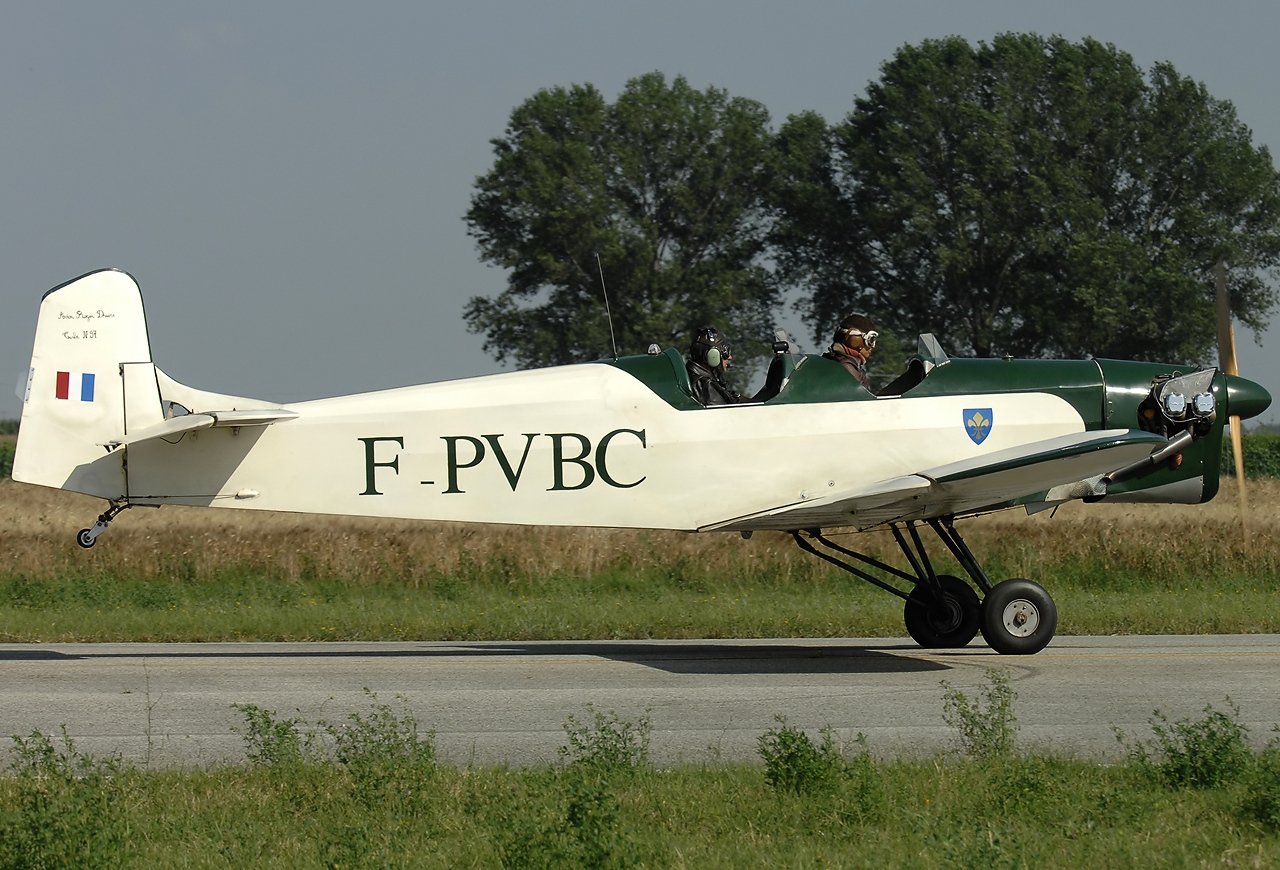
The Druine D-5 Turbi emerged as a natural evolution of Roger Druine's successful single-seat D.31 Turbulent, transforming amateur aviation by providing homebuilders with plans for their first practical two-seat touring aircraft. Roger Druine, a French flying instructor operating in the 1950s, recognized the growing demand among flying clubs and private pilots for an economical aircraft that could serve both training and recreational touring purposes.
Design Innovation and Construction
Druine's approach prioritized simplicity and accessibility over complexity. The D-5 Turbi featured a primarily wooden structure built around a parallel-chord wing mounted on a laminated box spar, making it well-suited for amateur construction using basic woodworking skills. The aircraft incorporated slotted ailerons that enhanced controllability, particularly important since solo operations required flying from the rear seat of the tandem open cockpits.
The generous wing area that produced the aircraft's remarkably low 34 mph stall speed made it forgiving for inexperienced pilots while maintaining respectable performance. This design philosophy reflected Druine's background as a flying instructor, emphasizing safety and predictable handling characteristics over raw performance.
Global Production and Variants
Unlike traditional aircraft manufacturing, the D-5 Turbi was produced exclusively through homebuilding efforts across multiple countries. Construction took place in France, England, Canada, Australia, and Italy, with builders using plans supplied by Avions Roger Druine. The first British example took flight from Hatfield, Hertfordshire in 1955, followed by additional examples like G-APBO, which was completed in Glasgow in 1960.
At least 205 aircraft were produced under the broader Druine marque, though exact numbers for the D-5 variant specifically remain unclear. This distributed manufacturing approach proved both the design's accessibility and its appeal to international homebuilders seeking an affordable entry into aircraft ownership.
Engine Options and Performance
The D-5 Turbi's flexibility extended to powerplant options, accommodating various engines based on availability and builder preference. Early British examples utilized the De Havilland Gipsy Minor, a four-cylinder inline piston engine from the pre-World War II era. However, the scarcity of these engines led builders to explore alternatives including the Beaussier-converted Citroën car engine producing approximately 50 horsepower, which enabled the aircraft to achieve its top speed of around 90 mph.
Other successful installations included the Continental C-75-12 producing 75 horsepower, the Lycoming O-235, and the Walter LOH II AE. The Continental engine proved particularly reliable, with aircraft like G-APBO providing decades of dependable service. This engine flexibility allowed builders worldwide to source locally available powerplants while maintaining acceptable performance characteristics.
The Manufacturer's Legacy
Avions Roger Druine represented a unique approach to aircraft manufacturing, focusing on design excellence and plan distribution rather than factory production. The company operated during the 1950s under Roger Druine's leadership, concentrating on simple, affordable homebuilt designs that could be constructed by amateur builders with basic facilities.
Following the success of the single-seat D.31 Turbulent, the D-5 Turbi expanded the company's influence into the two-seat market. However, like many small aircraft manufacturers of the era, Avions Roger Druine eventually ceased operations, with design rights and plans eventually transferred to independent suppliers like Manna Aviation in Australia.
Operational Service and Pilot Experience
The D-5 Turbi found its niche serving private owners and flying clubs as an economical touring aircraft and trainer. Its dual controls and forgiving handling characteristics made it suitable for instruction, while the open cockpit configuration provided an authentic flying experience reminiscent of aviation's golden age.
Pilots appreciated the aircraft's honest handling and predictable stall characteristics, though the requirement to fly solo from the rear seat took some adjustment. The low stall speed and generous wing area made it accessible to pilots with limited experience, while the respectable cruise speed of approximately 90 mph made it practical for touring applications.
Modern Legacy and Continuing Influence
Several D-5 Turbi aircraft remain airworthy today, including examples in the United Kingdom such as G-APFA, a D-52 Turbi variant. The design continues to influence modern homebuilding through updated versions like Chris Falconar's Canadian sliding canopy modification, with plans available through suppliers like Manna Aviation for approximately 444 Australian dollars.
The D-5 Turbi's significance extends beyond its immediate impact, representing a crucial step in democratizing aircraft ownership through accessible homebuilding. Its wooden construction techniques and emphasis on simplicity established principles that continue to influence amateur aircraft construction today, proving that innovative design and practical engineering could make aviation accessible to dedicated enthusiasts worldwide.